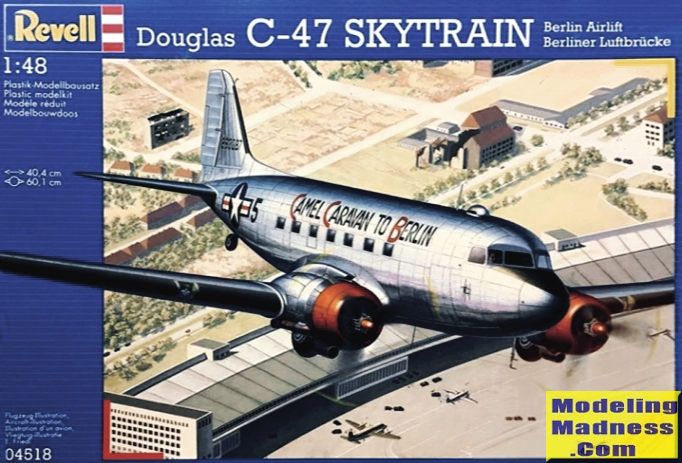
Revell 1/48 C-47 Skytrain
| KIT #: | 04518 |
| PRICE: | 35 Euros |
| DECALS: | Three options |
| REVIEWER: | Spiros Pendedekas |
| NOTES: | Monogram tooling. Berlin Airlift boxing. |
| HISTORY |
The Douglas C-47 Skytrain was the military transport development of the highly successful Douglas DC-3 airliner and became one of the most important transport aircraft of the Second World War. Entering US service in 1941, the C-47 quickly established a reputation for being rugged, dependable and remarkably versatile. It carried troops, cargo and wounded personnel, towed gliders and carried paratroopers, serving in virtually every major theater of the war. Its combination of reliability, simplicity and excellent load-carrying capability made it an aircraft that could be trusted to keep flying under conditions that would have challenged many other types.
During the Berlin Blockade of 1948–49, the Soviet Union cut the land and water routes supplying West Berlin, leaving the Western Allies with no alternative but to supply the city by air. Operation Vittles began for the Americans on June 26, 1948, with a C-47 landing at Tempelhof. The Skytrains became the initial workhorses of the operation, carrying food, coal, medicine and other essential supplies before the larger C-54s gradually took over much of the heavy lifting. The Berlin Airlift eventually delivered more than 2.3 million tons of supplies in almost 278,000 flights, becoming one of the great logistical achievements of the early Cold War.
| THE KIT |
 The
story of this kit begins with Monogram, which introduced its 1/48
C-47 Skytrain in 1978. This was very much a classic Monogram product
of the period: large, accurate, straightforward, robustly engineered
and with plenty of character. The tooling proved remarkably
successful and long-lived, being reboxed many times over the years
in various forms, representing several C-47/DC-3/Dakota
configurations and eventually finding its way into Revell's catalog.
The original tooling is still recognizable more than four decades
later.
The
story of this kit begins with Monogram, which introduced its 1/48
C-47 Skytrain in 1978. This was very much a classic Monogram product
of the period: large, accurate, straightforward, robustly engineered
and with plenty of character. The tooling proved remarkably
successful and long-lived, being reboxed many times over the years
in various forms, representing several C-47/DC-3/Dakota
configurations and eventually finding its way into Revell's catalog.
The original tooling is still recognizable more than four decades
later.
My particular example was bought around 2001–2002 from one of my beloved—and sadly now closed—toy/hobby shops in my hometown. I paid the then perfectly reasonable price of €35, which, looking back, seems almost modest for such a substantial model.
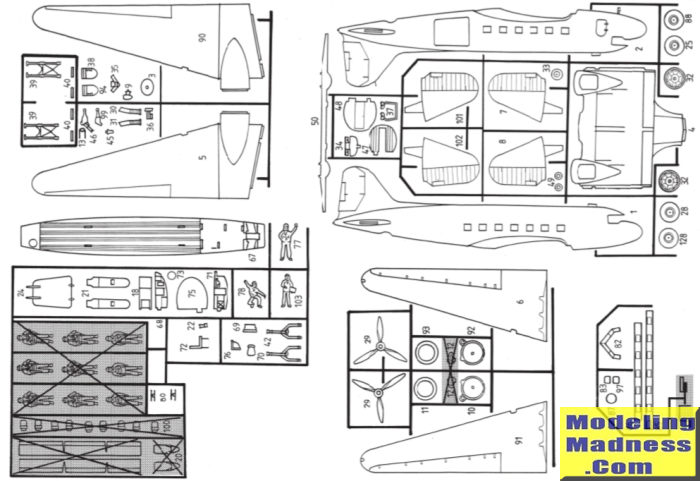
It comes in the classic large, top-opening Revell blue box. The box itself is somewhat flimsy, but it carries a fantastic piece of artwork by artist Herbert Friedl. Opening the box reveals an impressive amount of silver-gray styrene. Surprisingly, though, there are fewer than one might expect from such a large aircraft—less than 100 parts in total, neatly arranged on four sprues.
The molding is quite sharp for tooling of this age. There is some flash here and there, naturally, but nothing troublesome, and it cleans up quite easily during the normal preparation of the parts. The panel lines are, of course, raised, and while recessed panel lines may be considered more fashionable today, I have always felt that the raised lines on this particular aircraft have considerable merit. They are in the correct places and can represent the overlapping aircraft skin panels rather nicely. Overall shapes look very convincing as well, one of the qualities for which Monogram kits have traditionally been appreciated.
Cockpit is reasonably appointed, containing the basic equipment found in the real aircraft: seats, an instrument panel with raised instruments, control yokes, crew seats, bulkheads and even a toilet. It certainly isn't highly detailed by today's standards, but personally I find it perfectly acceptable for what can actually be seen, since the windshield and cockpit windows are relatively small, and very little of this interior will be visible once the fuselage is closed. Unless you are a die-hard super-detailer, there is therefore little reason to spend enormous amounts of time improving an area that will largely disappear into darkness.
The cargo compartment is a different matter. Apart from a reasonably well-molded floor, it is essentially empty. The real aircraft naturally contained various pieces of equipment and fittings, and these are absent here. With the cargo doors posed open, this emptiness will be quite visible, so the modeler has plenty of opportunity to add detail if desired. With the doors closed, however, relatively little will be visible through the small cabin windows.
Wing construction is particularly clever. Monogram provides a substantial internal spar which not only forms part of the main landing-gear bay structure but also gives the large wings considerable strength. It helps with alignment and, importantly, prevents the possibility of the wings sagging with time. This is another excellent example of the practical engineering for which Monogram was famous. The designers clearly understood that a large 1/48 aircraft needs a strong internal structure, and they solved the problem in a simple and very effective way.
The landing gear is nicely executed as well. Brake lines are not provided on the main struts, but that is an easy addition for anyone wishing to improve the detail. The engines are nicely represented, with only the front cylinder row molded. Once painted, detailed, and fitted in the cowlings, they should look perfectly adequate. The propellers are nicely done too.
One particularly interesting feature is the three different air-intake styles—short, medium and long—provided above the engine cowlings. These reflect variations in the Pratt & Whitney R-1830 installations and supercharger arrangements. Since C-47s were frequently re-engined and modified, however, intake length does not always identify a specific variant. Checking photographs of the aircraft being modeled is therefore the safest approach. Monogram’s inclusion of all three options is a welcome touch for accuracy.
The kit also includes a useful selection of figures: three maintenance personnel and nine paratroopers. The paratroopers are obviously not applicable to the Berlin Airlift subjects in this boxing, but their inclusion is nevertheless a welcome bonus. They are nicely done and can easily find a home in another C-47, a suitable diorama or simply another project. It is always nice to see Revell making use of the possibilities offered by the tooling and giving the modeler some useful extras.
 The
transparencies are very nicely done and crystal clear. A
particularly welcome feature is that the side windows are molded as
a single row for each fuselage half. This should make construction
considerably easier and avoids the tedious task of installing
numerous individual windows. Instructions are excellent, typical of
Revell's presentation style of the period, supplied as a 16-page,
double-sided, black-and-white A4 booklet. They include a photograph
of the finished model, a short history of the subject, a sprues map,
a color chart, and a construction sequence consisting of no fewer
than 36 simple, clear and concise steps, with color callouts
provided where necessary. There is nothing particularly complicated
here, and the instructions should present no difficulties to the
average modeler.
The
transparencies are very nicely done and crystal clear. A
particularly welcome feature is that the side windows are molded as
a single row for each fuselage half. This should make construction
considerably easier and avoids the tedious task of installing
numerous individual windows. Instructions are excellent, typical of
Revell's presentation style of the period, supplied as a 16-page,
double-sided, black-and-white A4 booklet. They include a photograph
of the finished model, a short history of the subject, a sprues map,
a color chart, and a construction sequence consisting of no fewer
than 36 simple, clear and concise steps, with color callouts
provided where necessary. There is nothing particularly complicated
here, and the instructions should present no difficulties to the
average modeler.
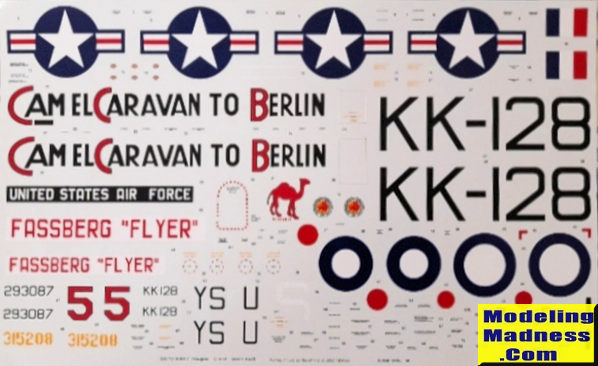
Three very attractive Berlin Airlift markings are provided. The first is a Douglas C-47A Skytrain, US Air Force, 525th Fighter Squadron, 86th Air Base Group, 293087, 5 Camel Caravan to Berlin "Clarence", based at Neubiberg in October 1948. The second is a Douglas C-47A-80-DL Skytrain, 315209 "Flyer", of the 60th Troop Carrier Wing, operating from Faßberg in November 1948. Completing the selection is a Royal Air Force Douglas Dakota Mk.III, KK128/YS-U of No. 77 Squadron, operating from Lübeck in February 1948. Color shades are provided in Revell codes as well as in generic form.
The decals are superbly printed, as was the norm with Revell at the time. Registration is sharp, the colors look convincing and the printing is clean and crisp. They appear to be in excellent condition despite their age, although, as always with older decals, their true condition can only be confirmed when they are actually used.
Construction begins in the familiar Monogram fashion, with the interior assembled first. The side windows are fitted from the inside of the fuselage halves, after which the interior, together with the small tail wheel bay, is trapped between the fuselage halves.
Construction then continues with the modification required for the specific version, involving the removal of the rear portion of the fuselage/tail as indicated in the instructions. This produces the appropriate configuration for the aircraft represented in this boxing. If building another C-47 version, however, the modeler should check references before making this modification.
The wings are next, and as mentioned earlier, they are particularly well engineered. The upper and lower assemblies are joined and then attached to the lower fuselage. With a model of this size, it is worth spending some quality time here, dry-fitting everything and making sure that the wings are correctly aligned. Landing gear follows, although I would personally leave it until later in the construction. It appears perfectly viable to install it during the final stages, making the model easier to handle.
The engines are then assembled and attached in position together with their cowlings and propellers. The correct carburetor air intakes should be selected at this stage for the particular aircraft being modeled. The tailplanes follow, after which the cargo door can be fitted either open or closed. If the open option is chosen, I would strongly recommend adding some detail to the cargo compartment before closing everything up. How far you take this is entirely up to you.
The canopy and remaining transparencies are then fitted, followed by the various antennas and external fittings. Overall, the construction is remarkably straightforward. Once the sheer size of the model and the amount of plastic are taken out of the equation, this is essentially a conventional twin-engine propeller aircraft kit. The engineering is sound, the sequence is logical, and the model should present few serious difficulties to an experienced modeler.
| CONCLUSIONS |
There is no doubt that this is a true classic from Monogram. It is almost remarkable to think that such a large, well-shaped and enjoyable 1/48 C-47 was produced as far back as 1978. More than forty years later, it still has everything needed to produce an impressive model of the Skytrain.
The overall shapes are very convincing, the cockpit provides a reasonable level of detail for what can actually be seen, the transparencies are excellent, and the kitt engineering is simply superb. The clever wing spar is a particularly fine example of the practical and robust engineering for which Monogram was famous.
The raised panel lines are characteristic of the period, but I would not regard them as a disadvantage. Indeed, on the C-47 they can look remarkably convincing, representing the overlapping skin panels rather nicely. The cargo compartment is basic, but this leaves plenty of opportunity for the modeler who wishes to add additional detail. The excellent instructions, attractive decals, clear transparencies, useful figures and straightforward construction complete a package that remains thoroughly enjoyable.
There are, of course, newer alternatives. The Trumpeter 1/48 C-47 is an impressive modern kit with a very high level of detail. Its cockpit and cargo compartment are particularly well appointed, and the extensive interior structure will appeal to modelers who enjoy detailed construction. However, some accuracy points have been noted with the Trumpeter kit, including its recessed rivet treatment, whereas the real C-47/DC-3 featured prominent raised rivets. The fabric-covered rudder has also been represented with metal-style rivet detail rather than fabric and the shape of the engine cowlings has been questioned, with aftermarket corrections available for those seeking the highest possible level of accuracy.
None of this takes away from the qualities of the Trumpeter offering, but it does put the old Monogram kit in an interesting light. In some respects, the supposedly old-fashioned kit gets important features of the real aircraft very nicely. Its raised surface detail is appropriate to the subject, its overall shapes have stood the test of time, and its engineering remains one of its greatest strengths.
Where the Monogram kit really shines is It does not overwhelm the modeler with hundreds of parts. Instead, it provides a solid, accurate and intelligently engineered foundation and lets the modeler decide how far to take it. Build it straight from the box and you will still have an impressive C-47; add some scratch-built detail and you can turn it into something considerably more elaborate.
Considering the very reasonable prices at which the Revell/Monogram kit can still be found, it represents excellent value. It may be a product of 1978, but it has aged remarkably well.
For me, this is exactly what a classic kit should be: accurate where it matters, intelligently engineered, uncomplicated to build and full of character. The Monogram C-47 may have been designed more than four decades ago, but it still delivers a thoroughly satisfying modeling experience.
This old Skytrain still has plenty of miles left in it—and I would happily recommend it to any modeler looking for a rewarding 1/48 C-47 project.
Happy Modeling!
August 2026
Copyright ModelingMadness.com. All rights reserved. No reproduction in part or in whole without express permission from the editor.
If you would like your product reviewed fairly and fairly quickly, please contact the editor or see other details in the Note to Contributors.