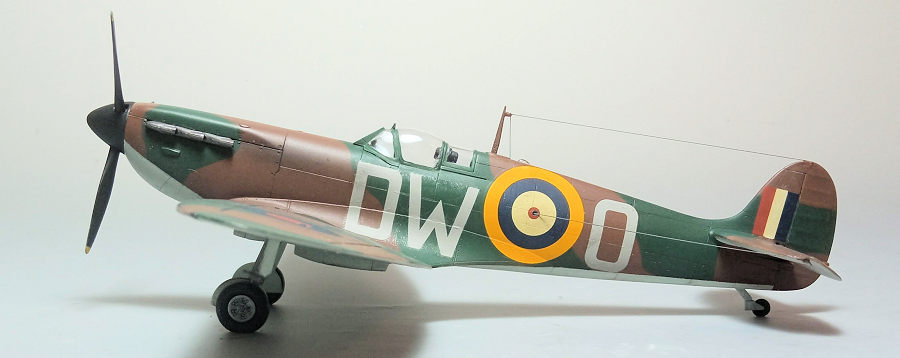
Tamiya 1/48 Spitfire I
| KIT #: | 61032 |
| PRICE: | $20.00 when new |
| DECALS: | Two options |
| REVIEWER: | Spiros Pendedekas |
| NOTES: | Initial tooling |
| HISTORY |
No. 610 (County of Chester) Squadron was a Royal Air Force Squadron
of the Auxiliary Air Force. Comprising very high quality pilots, often
ex-RAF officers and occasionally locally based company test pilots from
companies such as de Havilland and Airwork, its pilots were initially part
timers who would spend their weekends and spare time flying and practising
combat manoeuvres. The squadron was named the "County of Chester" and
adopted the motto "Alifero tollitur axe ceres"; which translates as "Ceres
rising in a winged chariot", Ceres being the Roman Goddess of Wheat, a
reference to Chester's Agricultural sector. Its badge contained the image of
a garb (sheaf of wheat).
The squadron was formed on 10 February 1936 at Hooton Park, Wirral, Cheshire
and was initially equipped with Hawker Hart light bombers. As war
approached, these were replaced by Hawker Hinds in May 1938. On 1 January
1939 the squadron role was changed to that of a fighter squadron, and on the
outbreak of war in September 1939 it received its first Hurricane fighters.
By the end of that same month it was flying the more advanced Spitfire.
The squadron gained its first experience of aerial combat against the
Luftwaffe whilst desperately attempting to protect the Army and Navy during
the Dunkirk evacuation. It was a very tough few days for ‘The Chesters’,
operating in difficult conditions from RAF Gravesend, against an enemy air
force which was a battle-hardened foe. In just four engagements with the
enemy, 610 Squadron lost seven pilots Missing or Killed In Action and one
wounded; 610 made claims of ten enemy aircraft destroyed, three unconfirmed
destroyed and one damaged, which shows the lethal nature of the dogfights.
All of 610’s casualties were experienced pilots, but they inevitably lacked
any combat experience, which could only be gained during the life or death
struggles in the skies over Dunkirk.
 During
the first two months of the Battle of Britain, 610 Squadron operated out of
RAF Biggin Hill as part of 11 Group, where it was one of the units bearing
the brunt of German attacks. It moved to RAF Acklington for rest and
recuperation at the end of August 1940, having fought heroically but
sustained heavy casualties in the process. During the Battle of Britain, 610
Squadron's pilots included Squadron Leader Andrew Thomas Smith AFC, Squadron
Leader John Ellis DFC, Flight Lieutenant Edward Brian Bretherton Smith DFC,
Flight Lieutenant William Warner, Flying Officer Stanley Norris DFC, Flying
Officer Constantine Oliver Joseph Pegge DRC, Sergeant Ronald Hamlyn DFM and
Sergeant Horatio Herbert Chandler DFM.
During
the first two months of the Battle of Britain, 610 Squadron operated out of
RAF Biggin Hill as part of 11 Group, where it was one of the units bearing
the brunt of German attacks. It moved to RAF Acklington for rest and
recuperation at the end of August 1940, having fought heroically but
sustained heavy casualties in the process. During the Battle of Britain, 610
Squadron's pilots included Squadron Leader Andrew Thomas Smith AFC, Squadron
Leader John Ellis DFC, Flight Lieutenant Edward Brian Bretherton Smith DFC,
Flight Lieutenant William Warner, Flying Officer Stanley Norris DFC, Flying
Officer Constantine Oliver Joseph Pegge DRC, Sergeant Ronald Hamlyn DFM and
Sergeant Horatio Herbert Chandler DFM.
In 1941, 610 Squadron moved south to RAF Westhampnett where it was one of
Douglas Bader's three Spitfire squadrons of the Tangmere wing. It remained
based in the UK until late 1944 when it moved to the Continent to provide
fighter cover as the allies entered Germany. 610 Squadron was disbanded
before the end of the war at RAF Warmwell on 3 March 1945.
The squadron was re-formed on 10 May 1946 at RAF Hooton Park as a Royal
Auxiliary Air Force fighter squadron, embodied in June of that year and
receiving its first Spitfire F.14s in November 1946, switching to more
powerful Spitfire F.22s in March 1949. Gloster Meteor F.4 jet fighters were
received in July 1951, being replaced by the later F.8 version in March
1952. Meteor T.7 twin-seat training aircraft were also used as advanced
conversion trainers. The Meteors were flown until shortly before the
squadron disbanded on 10 March 1957, together with all other RAuxAF flying
units.
As for the Spitfire Mk.1 that the Squadron started receiving from September
1939, little can be said that hasn’t been told: a high performance,
maneuverable fighter, especially in the context of the Battle of Britain.
Not without its limitations, but capable of embodying improvements
throughout its service life, to transform it into a highly capable and
much-loved fighter.
| THE KIT |
 This the
well known (now older mold) Tamiya quarter scale Spitfire, which was
introduced in the early 90’s as Mk.1 and Mk.Vb/trop, being periodically
reissued totally unchanged till mid-2010’s decade, before being superseded
by the superlative newer (2018) version.
This the
well known (now older mold) Tamiya quarter scale Spitfire, which was
introduced in the early 90’s as Mk.1 and Mk.Vb/trop, being periodically
reissued totally unchanged till mid-2010’s decade, before being superseded
by the superlative newer (2018) version.
This older mold still has all the virtues “modern” Tamiya has become famous
for: crisp molding, superb engineering and ease of construction (this is
certainly one of the kits that defined “shake and bake” in modeling). It has
been reported that there are a few accuracy issues, but it definitely looks
like a Spitfire when finished.
The specific kit is the initial 1993 version, bought in 2003 from a (sadly
now closed) hobby shop in my hometown (Chalkis, Greece) and for an in depth
look at its contents you may look no further than our Editor’s preview,
found in the ever growing MM archives.
| CONSTRUCTION |
 I
started by putting together the well appointed cockpit and sidewalls. Basic
cockpit color was a home brewed green, roughly equivalent to Hu78 Cockpit
Green. The instrument panel, the gunsight base, the stick yoke, the
headrest, the seat rear cushion and some sidewall details were painted
black, while the raised instruments were dry brushed with silver and some
knobs were randomly represented by “pinning” red, white and yellow paint
with a toothpick. The seat received seat belts from masking tape and this
concluded the cockpit which, though not any more comparable to the latest
and greatest offerings, still looks very good even out of the box,
especially under my de rigeur closed canopy attitude.
I
started by putting together the well appointed cockpit and sidewalls. Basic
cockpit color was a home brewed green, roughly equivalent to Hu78 Cockpit
Green. The instrument panel, the gunsight base, the stick yoke, the
headrest, the seat rear cushion and some sidewall details were painted
black, while the raised instruments were dry brushed with silver and some
knobs were randomly represented by “pinning” red, white and yellow paint
with a toothpick. The seat received seat belts from masking tape and this
concluded the cockpit which, though not any more comparable to the latest
and greatest offerings, still looks very good even out of the box,
especially under my de rigeur closed canopy attitude.
The two fuselage halves were next joined, with the cockpit rear bulkhead
trapped in position and the cockpit itself dropped in place from the
undersides. The three piece main wing was then assembled and attached to the
fuselage, followed by the engine cowling lower part (which is an insert, to
cater for the specific non-tropical version) and the tail planes, which had
their elevators separated by gently running the back of my hobby knife, in
order to be posed more dynamically.
The oil cooler fairing, the two piece carburettor inlet and the three-piece
radiator were attached underneath. The latter had its front and rear
mesh-like faces painted black and dry brushed with silver. The distinctive
top mounted fuel tank filler cap was attached at this time, as well.
This concluded basic assembly, which was simple, straightforward and very
pleasant. Fit was excellent all over and, though I used very small amounts
of filler at a few seams, I believe this kit can easily be put together
without any filler at all. It was then time to take the bird to the paint
shop!
| COLORS & MARKINGS |
 I
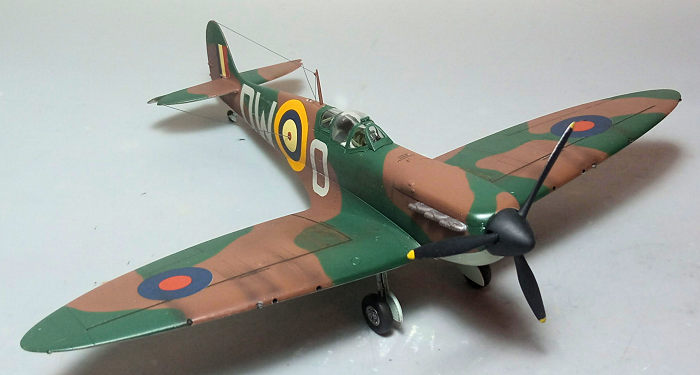
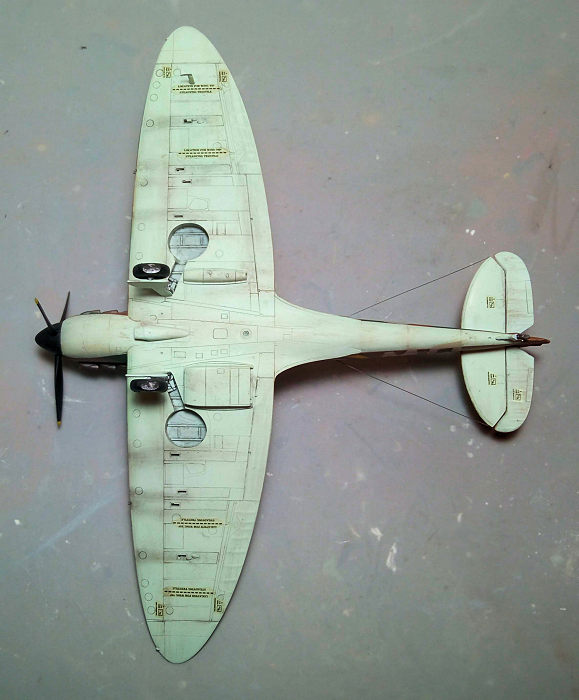
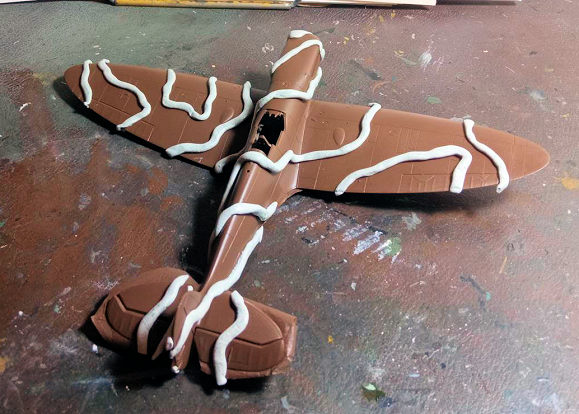
first gave all undersides, including wheel wells and doors, a coat of Hu23
Duck Egg Blue. After masking it off, I applied the topsides camo using Hu149
and MM2111 for the dark green and dark earth respectively. For the
demarcation lines, I used strings of tak, in order to achieve a tight but
not overly hard result. A coat of Future prepared the bird for decaling
I
first gave all undersides, including wheel wells and doors, a coat of Hu23
Duck Egg Blue. After masking it off, I applied the topsides camo using Hu149
and MM2111 for the dark green and dark earth respectively. For the
demarcation lines, I used strings of tak, in order to achieve a tight but
not overly hard result. A coat of Future prepared the bird for decaling
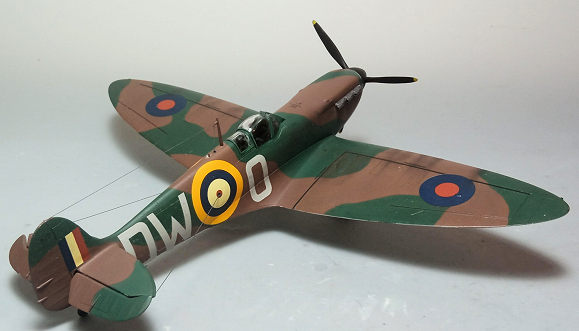
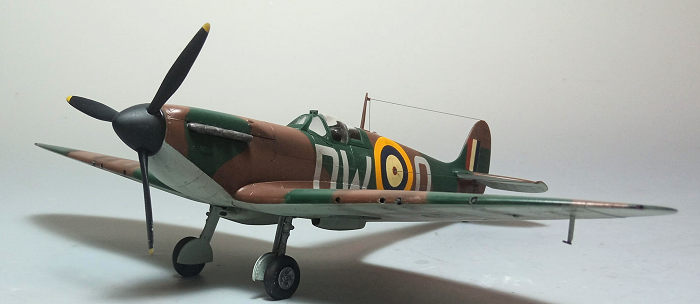
I used the kit decals, in order to represent the classic L1043/DW+O example,
as it stood in June 1940. The white portions of the decals were badly
yellowed, but otherwise the aged decals looked usable and I decided to use
them. They behaved satisfactorily, but, in retrospect, I should have at
least taped them on the inside of a window facing the strong sun for about a
fortnight, before use, to try reducing the yellowness. A coat of Future
sealed them.
| FINAL CONSTRUCTION |
The good looking
landing gear was attached in position, followed by the wheels and doors,
with the bird firmly standing on its feet. Everything fitted well. The
wheels were filed to look weighted. The main struts and all rims were
painted silver, wheel wells and door innards were painted underside color
and tires were painted black. The exhausts had their ends drilled to add
some realism, then they were painted Mr Hobby Burnt Iron and attached in
position. The elevators were attached “drooped” at this time, as well.
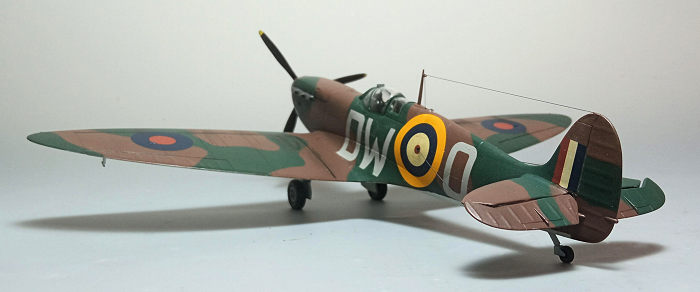 Time for
some weathering, consisting of a black wash to accentuate all nice engraved
detailing. The wash was heftier at the landing gear area, in order to give
the parts a used, oily look. Next, dark brown and black dry pastels were
used, in order to represent exhaust stains, dirt and grime at areas that
they would reside. A final matt coat gave the bird its final hue.
Time for
some weathering, consisting of a black wash to accentuate all nice engraved
detailing. The wash was heftier at the landing gear area, in order to give
the parts a used, oily look. Next, dark brown and black dry pastels were
used, in order to represent exhaust stains, dirt and grime at areas that
they would reside. A final matt coat gave the bird its final hue.
The good looking prop was assembled, had its hub base area filled and sanded
smooth and attached in position. It was painted matt black with yellow tips
and a hint of silver dry brushing at the tips, to represent minimum wear.
The top antenna mast and the pitot tube were painted per the surrounding
shade (the latter had its tip painted gunmetal) and attached in position, as
well.
The transparencies had their very well defined frames hand painted and
attached in position. Fit was excellent. I also managed to attach the
diminutive upper ID lamp uneventfully. The aerial wires were represented by
thin stretched sprue pieces, accordingly run. Blobs of red and green clear
paint simulated the wingtip lights, before calling this classic done!
| CONCLUSIONS |
Cannot get more “Tamiya” than this: molding, kit engineering, ease
of assembly, overall fit, quality of transparencies, instructions, but also
packaging and box quality are, among others, truly excellent. The 1993
printed decals were, understandably, aged, but, apart from yellowing, they
behaved well.
It is reported that there are a couple or so accuracy issues with this kit,
but I will leave that to the Spitfire aficionados by merely saying that the
final result definitely looks like a Spitfire. The fact that Tamiya has
issued a newer superlative tooling in 2018 means that this kit is out of
production for good, but, until it becomes a collector’s item, it can still
be found second hand at relatively low prices.
If you have one or come across one, do not hesitate to give it a go: after a
pleasant and effortless build, a very nice Spitfire will emerge.
Happy Modeling!
29 May 2025
Copyright ModelingMadness.com. All rights
reserved. No reproduction in part or in whole without express permission from
the editor. If you would like your product reviewed fairly and fairly quickly, please contact the editor
or see other details in the
Note to
Contributors. Back to the Main Page
Back to the Review
Index Page
Back to the Previews Index Page