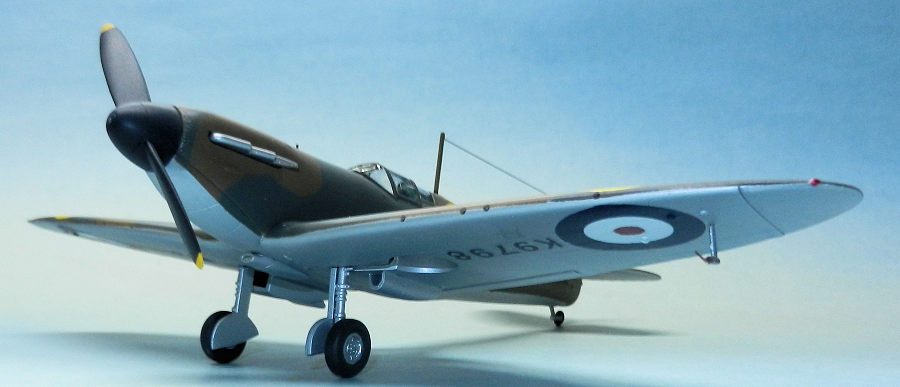
Airfix 1/48 Spitfire Mk.1
| KIT #: | 05115 |
| PRICE: | CAD$20.00 |
| DECALS: | Five options |
| REVIEWER: | Pablo Calcaterra |
| NOTES: | Initial Spitfire delivered to 19 Squadron in 1938 |
| HISTORY |
 The
introduction of the Spitfire to the RAF started August 4th, 1938 with the
arrival of K9798 which was, actually, the third Spit ever built.
Sqn Ldr Cozens immediately took charge of the plane and flew it on the 11th. He clocked around 400 hours in a couple of months, trying to develop tactics for the new super fast and modern plane. These flights, shared also with some of his pilots, were coordinated with Sqn Ldr Fuller-Good of 66 Sqn as both squadrons shared the same base and 66 was also receiving their new Supermarine planes. Their report asked for several improvements which were almost immediately delivered: hydraulic system to operate the landing gear (early planes had a lever that had to be pumped multiple times and pilots developed “Spitfire Knuckles” due to their injured hands), a blown hood for taller pilots and better visibility, a better engine starter and improved oil seals (which took a bit longer to be delivered).
The Squadron received one plane a week and by the end of 1938 they had their full compliment of 16 Spitfires. First planes lacked machine guns. Cozens fired the ones in his Spitfire only in November.
K9798 was flown by Sgt Unwin as WZ-L. After being sent to 65 Sqn in August 1940 (after spending a lot of time at a MU) this veteran was allocated to 57OTU, 61OTU, 2SoTT and finally SOC on December 14, 1944.
| THE KIT |
 This is the
2015 issue of the early Spitfire. It is based on the Airfix Spit MkV from the
70s. Thus the trailing edges of moveable surfaces are on the thick side. Decals
are good except for the roundels that are pixelated and thus not usable. The
cockpit of the early Spits is very well represented and options for different
windshields, hoods and propellers give you the choice to build a wide range of
early Spits. Of course it is not up to par with their latest issue of around
2020 but it is a simple and good shaped kit. Just what I want these days.
| CONSTRUCTION |
The interior of these early Spits was painted in a different green than RAF interior green. Some call it Supermarine green and looks like a bright apple green.
After I had glued the armour plate painted in black I read that these early planes did not have it so I had to detach it. Seat belts were scanned from some in my spares and printed in white decal paper. As the cockpit is tiny and not much can be seen…they play the part. Details in red with a gentle drybrush in aluminum livened up the instrument panel. A few boxes were painted in black and the cockpit was ready.
 The front and
back of the fuselage were painted in aluminum, as the oxygen bottles. The new
tail wheel taken from spares came from the Arii Spit MkVIII which fits very well
but had to open up the attachment point under the fuselage = putty, etc (the kit
was missing this part). Blanked the holes for spent cartridges under the wings
with tiny pieces of plasticard because these very first Spits didn’t have
armament. Photo of one of these in flight clearly shows these blanked off…Then I
removed molded light behind antenna mast as I was going to replaced it with a
clear part from the spares.
Fit of the base for the oil cooler is awful. Putty
and sandpaper were called to help in this area. Test fitted fuselage to wings
and the fuselage wing roots are lower than the wing surface. Was forced to sand
the wings…trailing edges are too thick anyways…
Only good thing about Airfix is the multitude of propellers, spinners, cannons,
tail wheels, antenna masts. Lots for the spares boxes.
Wings to fuselage had huge gaps. These disappeared once I bend up the wings to achieve the correct dihedral using tape. If you draw a straight line down from wingtip to a flat surface you get 7 mm. According to my calculations it should be 14. Good thing is that I had sanded the internal face of the wings, thinning them down.
By day 6 of starting the project wing roots gaps were closed by achieving correct dihedral by forcing the tips up with tape from tip to tip and a tiny bit of Vallejo plastic putty. Horizontal tail surfaces were glued in place and the cockpit was masked.
| COLORS & MARKINGS |
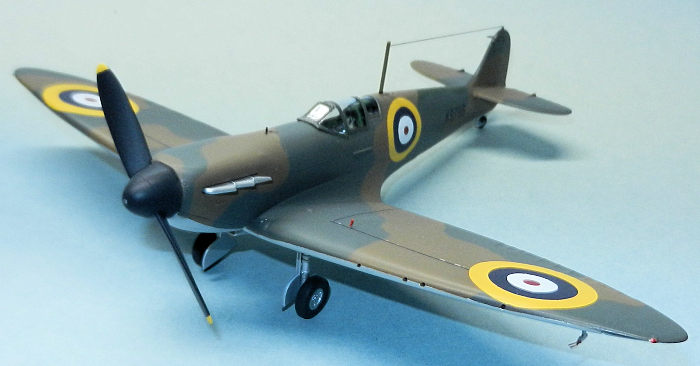 Using Tamiya
rattle can light grey primer the painting process started. I used white primer
where I was to paint the roundels.
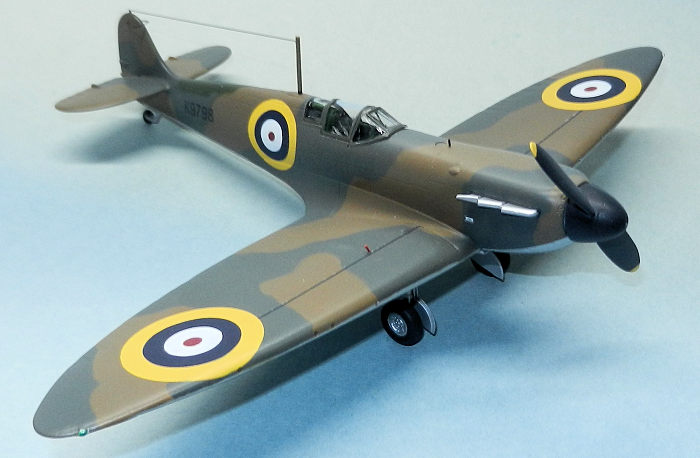
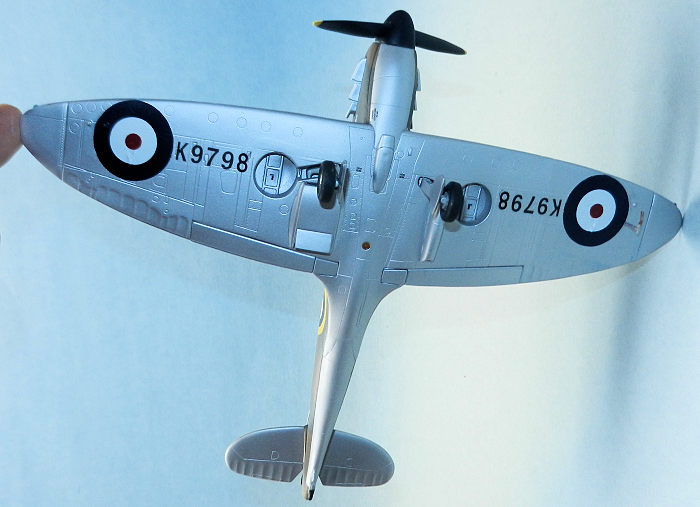
After making my masks for the roundels I applied the yellow and painted undersides in aluminum. Next step was top cammo. Using a picture of this plane early in Squadron life I realized that there were 2 tones of each one of the main colours. I used darker brown on the left wing close to fuselage and lighter/brighter green on spine. Funny enough these 2 are Vallejo’s RAF colours whereas the main 2 ones are the more accurate MM Acryl (last bottles of each in my inventory). Then I masked the surfaces to leave exposed the area for the blue portion of the roundels.
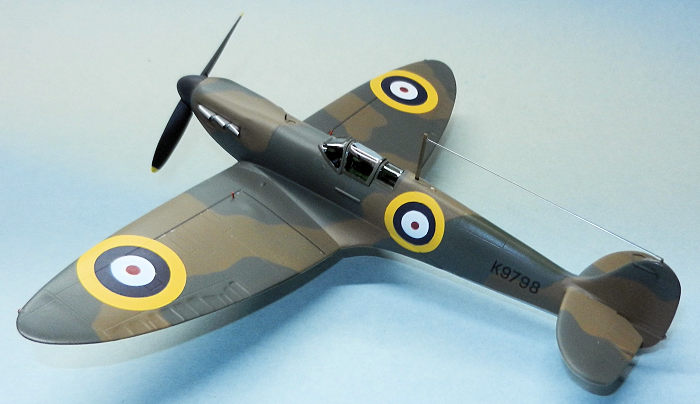
I made the decals for the red centers and I custom designed and printed the serial numbers (clear decal paper) as well. The hood has the break away panel made with my designed decals. Only a few stencils from the Airfix kit were used. All these were applied using some coats of Quick Shine.
| FINAL CONSTRUCTION |
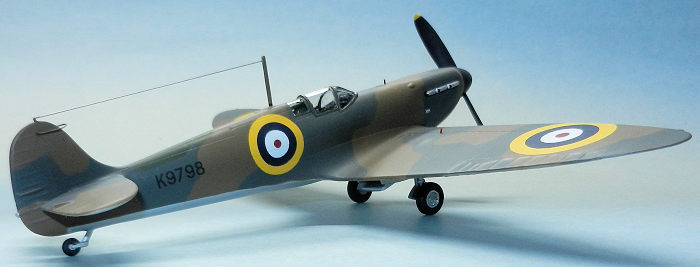 Some added
items like gunsight (photoetched inside the cockpit, the bead coming from the
spares), scratchbuilt the protection for anti spin parachute bending some wire
(used only in very first planes…that squarish structure on tail), landing gear
position indicators in red, light behind antenna with a couple of layers of
Klear…also made an early style pitot modifying the one supplied by Airfix.
Formation lights were made with Modelmaster clear red and green applied over a
drop of chrome silver on the wingtips. The exhausts, brand new, were painted
aluminum and attached. The tip of the spinner was also painted in aluminum. The
aerial was added using some piano wire.
The model was finished very clean in around 3 weeks. No dings. Just out of the factory (these planes leaked oil like crazy…but decided not to represent this)
| CONCLUSIONS |
A simple kit, but that shows the shortcomings of the early Airfix kits with fit issues and a very simple cockpit. Nothing critical that cannot be tackled with patience, putty and sandpaper. Now I have the earliest Spit in service in my shelf…I should place it next to the Spit 24 flown in Hong Kong in 1950 and that you can find in M2.
| REFERENCES |
Spitfire! By Dilip Sarkar
www.airhistory.org.uk/spitfire. You are looking for the history of ANY particular Spit? You will find it here.
10 November 2026
Copyright ModelingMadness.com. All rights reserved. No reproduction in part or in whole without express permission from the editor.
If you would like your product reviewed fairly and fairly quickly, please contact the editor or see other details in the Note to Contributors.