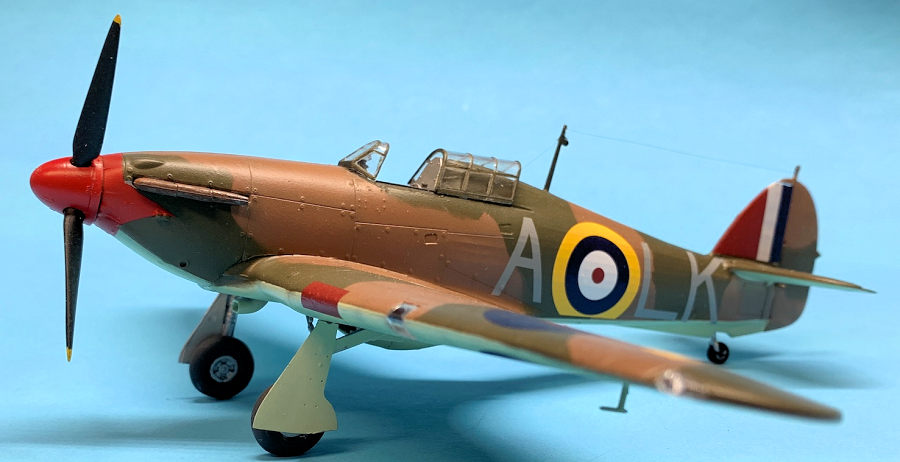
Airfix 1/48 Hurricane Mk.I
| KIT #: | A05127A |
| PRICE: | $40.00 |
| DECALS: | Two options |
| REVIEWER: | Blair Stewart |
| NOTES: | Good detail and fit |
| HISTORY |
From Wikipedia: The Hawker Hurricane is a British single-seat fighter aircraft that was designed and predominantly built by Hawker Aircraft Ltd. for service with the Royal Air Force (RAF). It was overshadowed in the public consciousness by the Supermarine Spitfire during the Battle of Britain in 1940, but the Hurricane inflicted 60% of the losses sustained by the Luftwaffe in the campaign and fought in all major theatres of the Second World War.
The Hurricane originated from discussions in the early 30s between RAF officials and aircraft designer Sir Sydney Camm about a proposed monoplane derivative of the Hawker Fury biplane. Despite an institutional preference for biplanes and lack of interest by the Air Ministry, Hawker refined its monoplane proposal, incorporating several innovations that became critical to wartime fighter aircraft, including retractable landing gear and the more powerful Rolls-Royce Merlin engine. The Air Ministry ordered Hawker's Interceptor Monoplane in late 1934, and the prototype Hurricane first flew on 6 November 1935.
 The
Hurricane went into production for the Air Ministry in June 1936 and entered
squadron service in December 1937. Its manufacture and maintenance were eased by
using conventional construction methods so that squadrons could perform many
major repairs without external support. The plane was rapidly procured prior to
the outbreak of the Second World War; in September 1939, the RAF had 18
Hurricane-equipped squadrons in service. It was relied upon to defend against
attacking Luftwaffe aircraft, especially during the Battle of Britain.
The
Hurricane went into production for the Air Ministry in June 1936 and entered
squadron service in December 1937. Its manufacture and maintenance were eased by
using conventional construction methods so that squadrons could perform many
major repairs without external support. The plane was rapidly procured prior to
the outbreak of the Second World War; in September 1939, the RAF had 18
Hurricane-equipped squadrons in service. It was relied upon to defend against
attacking Luftwaffe aircraft, especially during the Battle of Britain.
Unlike the all-metal Spitfire, the majority of the Hurricane’s external surfaces were linen, except for a section between the cockpit and the engine cowling that used lightweight metal panels. This wing was predominantly fabric-covered, like the fuselage, although some lightweight metal sheets were used on the inner wing and its leading edge. The majority of the flight control surfaces, such as the Frise-type ailerons, also had fabric coverings. One advantage of fabric-covered aircraft was less exterior damage resulting from machine gun/cannon fire, especially from the exploding shells used by the Germans in some of their Bf-109s armed with 20mm cannons, i.e., the Bf-109E with wing-mounted 20mm MG FF/M guns and, starting with the Bf-109F, with a single cannon firing through the propeller shaft.
In April 1939, Hawker introduced an all-metal, stressed-skin wing of duraluminium to be used for all of the later Hurricane models.
Some 14,487 Hurricanes and Sea Hurricanes were produced in England and Canada. The majority of Hurricanes - 9,986 - were built by Hawker (who produced the type at Brooklands from December 1937 to October 1942 and Langley from October 1939 to July 1944), while Hawker's sister company, the Gloster Aircraft Company, constructed 2,750. The Austin Aero Company completed 300 Hurricanes. Canada Car and Foundry produced 1,451 Hurricanes. However, those shipped to Britain were often incomplete airframes and about 80% were delivered without an engine.
| THE KIT |
 This is the
third “new tooling” Airfix 1/48 scale aircraft kit I have built in the last
several years. I am pleased to say these newer kits “ain’t your father’s Airfix
model kits.” This kit, first released in 2015, is a new-tool kit. The 2020
version I built had an updated decal sheet. Needless to say, it is a huge
upgrade from the Airfix Hurricane of the seventies (Kit #4102).
This is the
third “new tooling” Airfix 1/48 scale aircraft kit I have built in the last
several years. I am pleased to say these newer kits “ain’t your father’s Airfix
model kits.” This kit, first released in 2015, is a new-tool kit. The 2020
version I built had an updated decal sheet. Needless to say, it is a huge
upgrade from the Airfix Hurricane of the seventies (Kit #4102).
For a detailed description of what’s in the box, you can check out Frank Spahr's review of the 2015 kit. My assessment is that the molding in this 1/48 is very detailed with absolutely no flash visible on any of the parts. The newly supplied decals (vs. the 2015 kit) include two aircraft: One flown by Flt. Lt. Ian Gleed, No. 87 Squadron, RAF, in August 1940; and an aircraft flown by Sgt. Tadeusz Andruskow, No. 303 Polish Squadron, RAF, in September,1940.
| CONSTRUCTION |
Assembly begins with the somewhat intricate, tubular inner structure for the cockpit and wing spar. I must admit in my old age I had a little trouble making sure all of these support tubes lined up when glued in their three-dimensional positions, and on a couple of occasions I had to “unglue” (fortunately, before the glue set) some of them and reposition them to get the proper alignment. To put this structure in perspective, its assembly involves 16 steps before it is ready to be mated to the lower wing. Once I built up this structure, I painted the entire assembly flat aluminum (Note: one can find color photos of this structure finished in both aluminum AND chromate-like green paint, so I opted for the aluminum color).
At Step 19, one must decide on displaying the gun bays opened or closed. I opted for the closed gun bays, thus avoiding having to cut out the top wing access panels and being able to skip steps 20-29. Thus, I was ready to move on to gluing the top wing halves to the bottom wing.
 At this
point, I moved back to the cockpit and fuselage. After attaching the nice
instrument panel decal to part no. D16, I glued it to the left fuselage half. I
then glued the two fuselage halves together, clamped them, and set them aside to
dry. Once the glue had dried, I was able to glue the fuselage to the lower wing
– a neat assembly process avoiding the usual glue the cockpit to one fuselage
side and then hope it fits when you glue the two fuselage halves together (this
is somewhat similar to Tamiya’s frequently used process of inserting the
completed cockpit from underneath the assembled fuselage, which to me is a
better approach for cockpit insertion).
At this
point, I moved back to the cockpit and fuselage. After attaching the nice
instrument panel decal to part no. D16, I glued it to the left fuselage half. I
then glued the two fuselage halves together, clamped them, and set them aside to
dry. Once the glue had dried, I was able to glue the fuselage to the lower wing
– a neat assembly process avoiding the usual glue the cockpit to one fuselage
side and then hope it fits when you glue the two fuselage halves together (this
is somewhat similar to Tamiya’s frequently used process of inserting the
completed cockpit from underneath the assembled fuselage, which to me is a
better approach for cockpit insertion).
In Steps 34-37, I glued the bottom engine cover to the fuselage, attached the bottom cover of the rear fuselage, and glued the ailerons to the wings. Steps 38 thru 41 involved assembling the horizontal stabilizers, attaching them to the wings, and then sandwiching the elevators between the rudder and the fuselage tail.
Next, I assembled the under-fuselage radiator and glued it to the fuselage. In steps 46-53, I assembled the landing gear and attached them to the wing gear wells. Final steps included attaching various things such as the radio antenna mast, aileron balance weights, propeller, and exhausts. I painted the prop spinner with Testors Gloss Red and set it aside.
| COLORS & MARKINGS |
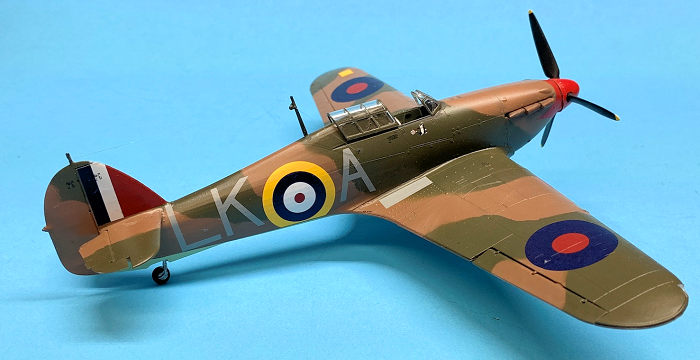
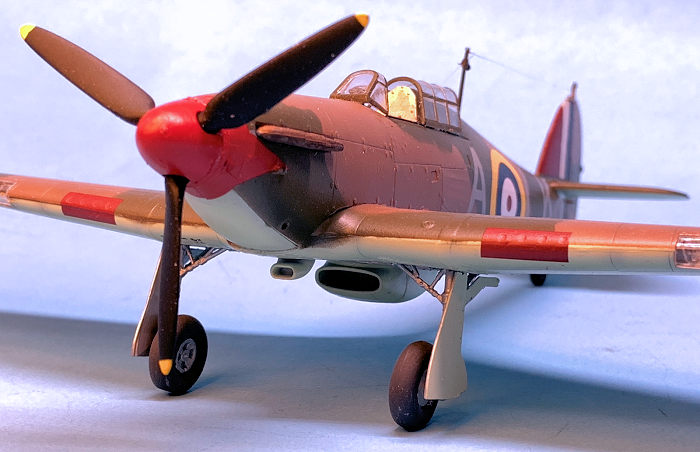 I first airbrushed the entire
model with Rustoleum flat white from a rattle can. Once this was dry, I
pre-shaded panel lines with Tamiya flat black acrylic paint. Next, I gave the
upper surfaces a coat of Tamiya XF-61 Dark Green. When this was dry, I used
modeling clay to mark off the demarcation lines for the dark earth (brown)
camouflage areas. For these areas, I used Tamiya XF-52 Flat Earth (Note: some
modelers may proclaim this color to be “too dark”, but I had the paint, and I
could find color pictures on the internet that closely resembled this color, so
I went with it!).
I first airbrushed the entire
model with Rustoleum flat white from a rattle can. Once this was dry, I
pre-shaded panel lines with Tamiya flat black acrylic paint. Next, I gave the
upper surfaces a coat of Tamiya XF-61 Dark Green. When this was dry, I used
modeling clay to mark off the demarcation lines for the dark earth (brown)
camouflage areas. For these areas, I used Tamiya XF-52 Flat Earth (Note: some
modelers may proclaim this color to be “too dark”, but I had the paint, and I
could find color pictures on the internet that closely resembled this color, so
I went with it!).
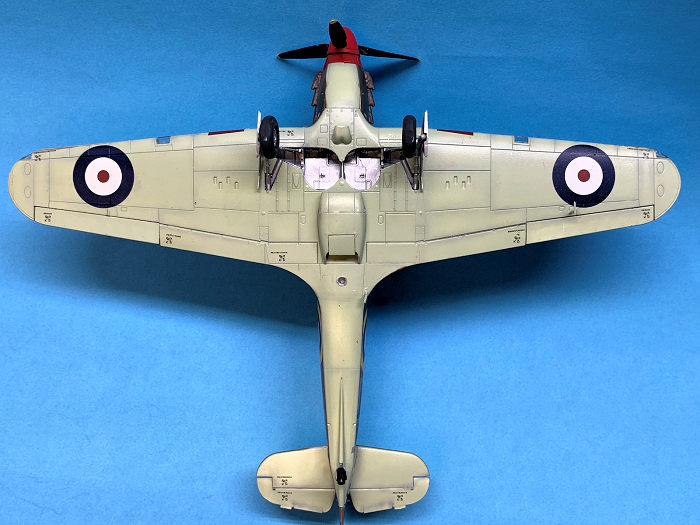
I masked off the upper surfaces and painted the lower surfaces with Tamiya XF-21 Sky. Once that was dry, I sprayed Future over the entire model in preparation for decaling. Where the Future seemed to have trouble amassing a nice glossy surface, I used a wide hobby paint brush and brushed additional Future on to those areas.
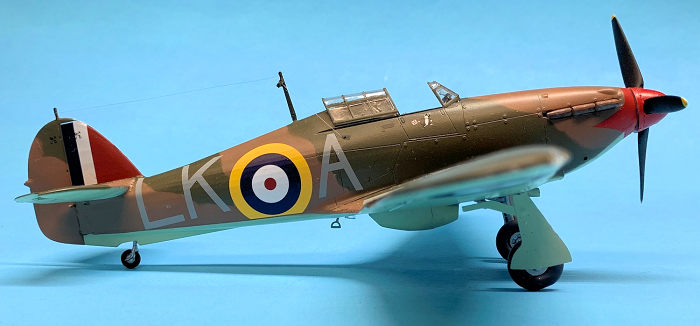
Once I was satisfied with the gloss finish, I applied the nicely done and appropriately thin Airfix decals, opting for the markings of the aircraft flown by Flt. Lt. Gleed.
As final steps, I coated the entire model with Rustoleum rattle-can clear flat and attached a fishing line antenna between the top tail and the radio mast.
| CONCLUSIONS |
Airfix is producing some nicely molded kits and reissuing some of its older kits using new tooling. I haven’t seen the newer Hobbyboss Mk.1 kit, but this one is better than the older Hasegawa and Tamiya kits, which I have built in the past. If you want an early Hurricane for your collection, you can’t go wrong by choosing this Airfix kit.
| REFERENCES |
Hawker Hurricane, Wikipedia, World-wide Web, June 2025.
Messerschmitt Bf109, Wikipedia, World-wide Web, June 2025.
Hawker Hurricane Mk.I, Scalemates.com, World-wide Web, June 2025.
17 June 2025
Copyright ModelingMadness.com. All rights reserved. No reproduction in part or in whole without express permission.
If you would like your product reviewed fairly and fairly quickly, please contact the editor or see other details in the Note to Contributors.