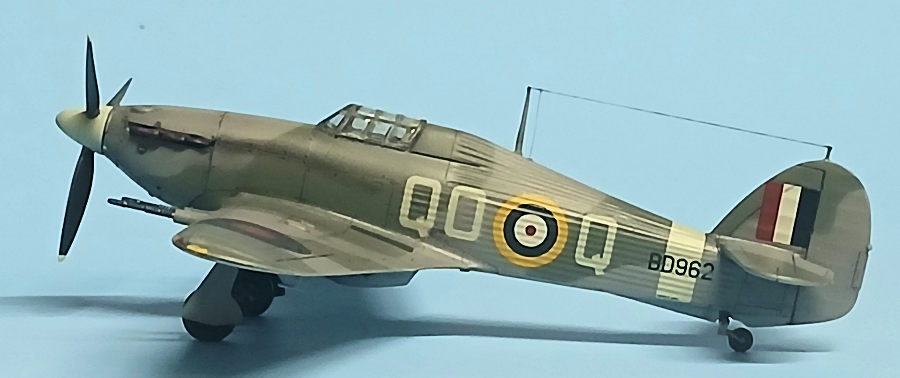
Hasegawa 1/72 Hurricane IIC
| KIT #: | 00620 |
| PRICE: | $15.00 |
| DECALS: | Two options |
| REVIEWER: | Ryan Grosswiler |
| NOTES: | Quickboost prop |
| HISTORY |
Most of us who frequent this site are well aware of this storied aircraft type: its hour of glory was the Battle of Britain, where it had to share the spotlight with the more charismatic Spitfire but was actually doing more than its fair share of actual combat and kills. Less well-known is its yeoman service down low during the rest of the war.
The
British aircraft industry demonstrated itself in the 1930s to be remarkably
resistant to adopting modern stressed-skin monocoque structures. So it was that
while the prototype Bf-109 first flew in mid-1935 had just such a
state-of-the-art airframe, the Hawker Hurricane would fly even later that year—a
monoplane, yes—but
structurally little different than the biplanes which had preceded it over the
decade prior. While its early fabric-covered wing was eventually superseded by
an entirely metal one des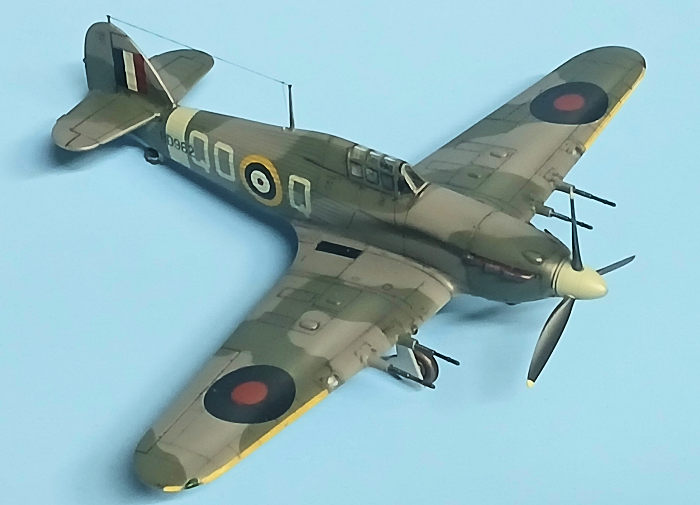 igned
and incorporated into production in the last weeks before the war, the overall
draggy aerodynamics had been baked in, so much so that even during its hour of
glory in the Battle of Britain the fighter was beginning to have a hard time
catching faster quarry such as the Ju-88 if the bomber had already dropped its
ordnance.
igned
and incorporated into production in the last weeks before the war, the overall
draggy aerodynamics had been baked in, so much so that even during its hour of
glory in the Battle of Britain the fighter was beginning to have a hard time
catching faster quarry such as the Ju-88 if the bomber had already dropped its
ordnance.
However, the apparently antiquated structure turned out to be rugged and easy to repair in the field, so the Hurricane began dispersing away from Northern Europe to the more remote points of conflict over the world. The first locations were Malta and Egypt to face the Italians, where it supplanted the Gloster Gladiator; there not a moment too soon, as the Macchi C.202 had arrived on the scene and proved itself superior to the Hurricane. Then on to Singapore and Sumatra, where it was given four more machine guns and faced with the Ki-43 and Zero.
From that point, the Hurricane transitioned quietly from daytime air-superiority gun platform to mostly one of close air support and other low-level forms of attack. By then the RAF had recognized that rifle-caliber machine guns are still rifle-caliber machine guns, no matter how many of them one sticks on an airplane to fire forward, so they were swapped for a quad set of 20mm cannons in the Hurricane Mk.IIc (or a pair of 40mm, in the -IId) which were accommodated almost entirely within that thick wing.
The subject of the kit is of No.3 Squadron, from the summer of 1941 while the unit was conducting Rhubarb attacks (along with No. 263's Whirlwinds) across the channel from southeastern England.
| THE KIT |
 Most
builders today will go for the outstanding Arma kit of this subject, or Airfix's
more beginner-friendly release, but Hasegawa's is the one I had in the stash so
out in came to my workbench when I felt the urge for a quick project. Standard
Hasegawa circa-1990s fare here, crisp, very fine engraved lines. Little interior
to speak of, but that's not
an issue with this subject if you model the canopy closed. Modular parts of this
release cover the 4-cannon wings and 'clean' nose of this variant; the fuselage
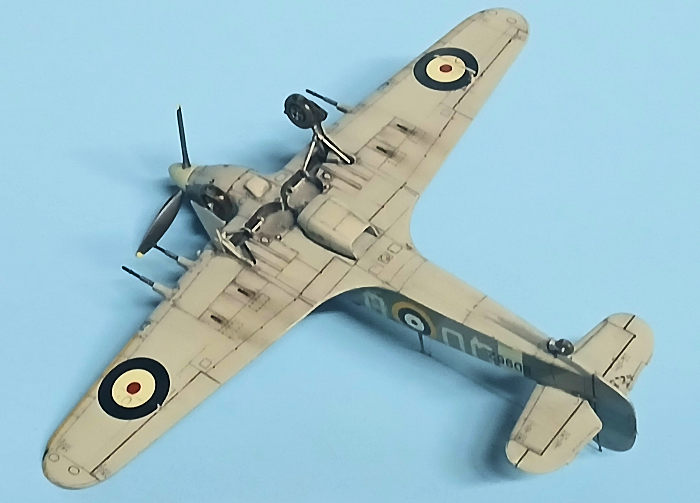
is split at the firewall for this option. The wheel well is thankfully deep
(unlike their P-51D of the same period), but being molded with the lower wing,
is simplified and lacks the undercuts of the real thing. Decals are for two
identical aircraft in the Dark Green/ Ocean Grey over Medium Sea Grey scheme
with a simplified set of stencils.
Most
builders today will go for the outstanding Arma kit of this subject, or Airfix's
more beginner-friendly release, but Hasegawa's is the one I had in the stash so
out in came to my workbench when I felt the urge for a quick project. Standard
Hasegawa circa-1990s fare here, crisp, very fine engraved lines. Little interior
to speak of, but that's not
an issue with this subject if you model the canopy closed. Modular parts of this
release cover the 4-cannon wings and 'clean' nose of this variant; the fuselage
is split at the firewall for this option. The wheel well is thankfully deep
(unlike their P-51D of the same period), but being molded with the lower wing,
is simplified and lacks the undercuts of the real thing. Decals are for two
identical aircraft in the Dark Green/ Ocean Grey over Medium Sea Grey scheme
with a simplified set of stencils.
| CONSTRUCTION |
 Easy
build. I had it assembled and ready for paint over a casual couple of weekend
mornings. With a closed canopy the cockpit interior is mostly invisible, so I
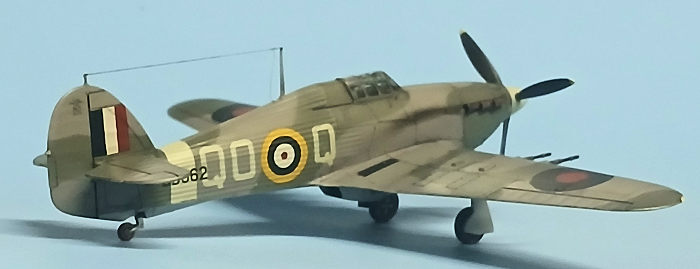
only added a set of lead foil shoulder straps. The only other improvement was
swapping in a QuickBoost Jablo propeller assembly, as the spinner provided by
Hasegawa is ridiculously long. The Hurricane canopy is also a really complex
masking project, particularly in 1/72, and there aren't any precut sets for this
kit(!)...so an hour and a half of quality time was spent here.
Easy
build. I had it assembled and ready for paint over a casual couple of weekend
mornings. With a closed canopy the cockpit interior is mostly invisible, so I
only added a set of lead foil shoulder straps. The only other improvement was
swapping in a QuickBoost Jablo propeller assembly, as the spinner provided by
Hasegawa is ridiculously long. The Hurricane canopy is also a really complex
masking project, particularly in 1/72, and there aren't any precut sets for this
kit(!)...so an hour and a half of quality time was spent here.
| COLORS & MARKINGS |
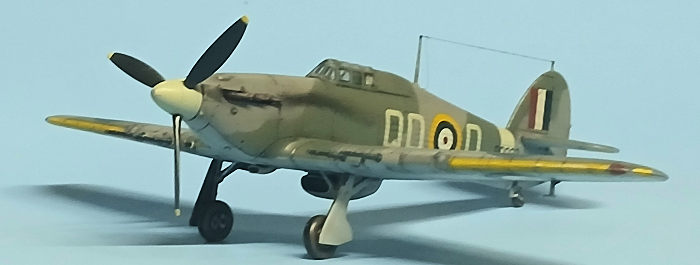 The
model was first shot with my favored primer, Tamiya white primer decanted,
outgassed, and cut 50% with Randolph butyrate dope thinner. The enamel greys
were then applied, masked when cured, and the Dark Green next. A gloss coat was
applied. The decals were next, and there's a bit of complexity here. I used the
RAF Sky tail band as a base for a masked and sprayed final coat to get it to
match the same color on the propeller spinner. The aircraft serial is then
applied over this band and the fuselage codes. Hasegawa's decals worked
wonderfully and responded well to Micro Set and Sol. Stencils were replaced with
the more comprehensive and finer TechMod set.
The
model was first shot with my favored primer, Tamiya white primer decanted,
outgassed, and cut 50% with Randolph butyrate dope thinner. The enamel greys
were then applied, masked when cured, and the Dark Green next. A gloss coat was
applied. The decals were next, and there's a bit of complexity here. I used the
RAF Sky tail band as a base for a masked and sprayed final coat to get it to
match the same color on the propeller spinner. The aircraft serial is then
applied over this band and the fuselage codes. Hasegawa's decals worked
wonderfully and responded well to Micro Set and Sol. Stencils were replaced with
the more comprehensive and finer TechMod set.
My usual finishing mantra followed: A semigloss protected them, wash and highlighting applied, another semigloss coat, then exhaust and gun smudges with pastels and oils, another clear coat, EZ-Line antennas and wheels went on, and that was it.
| CONCLUSIONS |
This simple, sound kit builds into an accurate model. Masking and painting were by far the two biggest time-consumers, taking 90% of completion time. Just because the Arma kit is outstanding doesn't mean this one is bad, and if you have it in your stash give it a go. Modelers who prefer a simpler build may actually still go-fer this one over the Polish product.
| REFERENCES |
Some lazy poking about the Internet.
15 August 2025
Copyright ModelingMadness.com. All rights reserved. No reproduction in part or in whole without express permission.
If you would like your product reviewed fairly and fairly quickly, please contact the editor or see other details in the Note to Contributors.