| KIT #: | 153 |
| PRICE: | $10-15.00 |
| DECALS: | Two options |
| REVIEWER: | Ryan Grosswiler |
| NOTES: | Resin engine, Falcon canopy, Kora prop and decals. Quickboost bits |
| HISTORY |
For an aircraft type whose production amounted to less than 750 units in total, the Gloster Gladiator certainly left an impression on history and historians far beyond its small numbers. Absolutely canonized in seemingly every postwar publication, it's apparently been forgotten that when it first arrived on the scene it was viewed with quite bit of skepticism by the RAF pilots who first flew it, for it was replacing Gloster's own popular and universally beloved Gauntlet. The extent to which the Royal Aircraft Establishment clung to 'proven' formulas can be witnessed in the profusion of bracing wires, a lot for a single-bay biplane. Monoplanes and stressed-skin construction may not have been well known at the time, but the principle of parasite drag certainly was—and this spiderweb of structure gave the airplane plenty. For the addition of a couple extra guns, that cockpit canopy, and a few other features it was 1200 lbs. heavier—with the same wing area and (albeit uprated) Mercury engine. This gave it the reputation of "a monoplane with a wing on top", and the airplane introduced a nasty tendency to spin. The most famous Gladiator pilot of all, Roald Dahl, remarked about the airplane only regarding its “magnificent inflammability.”
Still, for
small nations looking to build up their militaries with such 'proven' weapons as
the geopolitical situation in the late 1930s began to deteriorate, the
highly-available fighter was an attractive option, and the Gladiator was
exported all over the Eurasian land mass. One such recipient was Belgium. Having
learned an obvious, bitter lesson about foreign invaders in 1914, and now having
skin in the game by invading and seizing some German territory in the years
following, the little nation had fretted over various shades of neutrality
policy in decades since. This anxiety
 was
pitched upward by the dramatic political developments in their neighbor from
1933 onward. An offer from the French to extend the Maginot Line to shield
Belgium as well was refused on grounds of provocation, and a couple of would-be
alliances as a sacrificial partner were turned down. Finally, a ramshackle
solution was found with a hybrid pact involving France and the UK combined with
a vague notion of self-reliance.
was
pitched upward by the dramatic political developments in their neighbor from
1933 onward. An offer from the French to extend the Maginot Line to shield
Belgium as well was refused on grounds of provocation, and a couple of would-be
alliances as a sacrificial partner were turned down. Finally, a ramshackle
solution was found with a hybrid pact involving France and the UK combined with
a vague notion of self-reliance.
A desire for domestic weapons sourcing led to design and engineering cooperation between the UK and Belgium. Gloster delivered twenty-two Gladiators to their ally across the Channel: fifteen as complete aircraft, seven in kit form. All this was supposed to lead to license production but delays in the negotiations of this pushed the design into the timeframe where the newfangled monoplane was beginning to prove its own concept, so Belgium instead turned belatedly to the Hawker Hurricane for its meager fighter forces. Like the rest of its military the Belgian fighter force had been grown in warped fashion, a victim of changing priorities.
Given this confused setup, Belgium really didn't stand a chance, even disregarding the effect of numerical inferiority and meager real estate. The noise of mechanized war; the sudden onslaught of aerial bombardment, tanks, artillery fire, and infantry charges are terrifying for all healthy human souls, even those who've been at the front for a while. For reservists who desperately believed the week prior that war would never come to them, the effect is paralyzing.
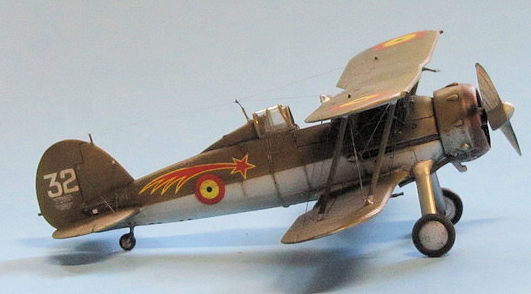
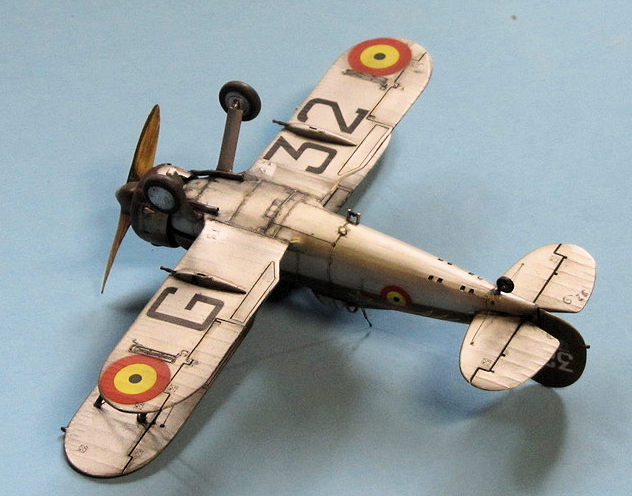
When all this broke out in the West on 10 May 1940, Capt. Max Guisgard, commander of 1/I/2 "le Comete' at least showed presence of mind by disregarding orders and evacuating the fifteen Gladiators under his command at Schaffen just minutes ahead of a low-level attack by Luftwaffe He-111s and Do-17s. Most of this retreating force arrived at its destination at Beauvechain, where five tangled immediately with Bf-109s from JG.26, losing three of their number. An hour or two later, another flight pursued a group of Stukas but were immediately set upon by more Messerschmitts and lost further aircraft before escaping into clouds. The following morning, the remaining Gladiators were thrown in to escort Fairey Battles in a desperate daytime attack against the bridges over the Albert Canal. Yet more Bf-109s found them and in the resulting running fight Sgt Denis Rolin in G-22 damaged a Messerschmitt and Sgt Winand in G-32 (modeled here) damaged another before both suffered their dismally predictable fate, and by the end of that second afternoon there was no more activity from the squadron. In 24 hours of combat the Belgian fighter force had been erased.
Apart from the Battle for France which immediately followed, the Gladiator would make one more appearance over Western Europe in British hands with the defense of Plymouth by a single squadron, No. 247, and very late in the Battle of Britain a single Gladiator from the unit chased and damaged an He-111. It would fall to a Finnish pilot at the beginning of 1943 to shoot down a Soviet Polikarpov R-5 caught on takeoff, scoring the Gladiator's last kill...and possibly the last biplane-to-biplane combat.
| THE KIT |
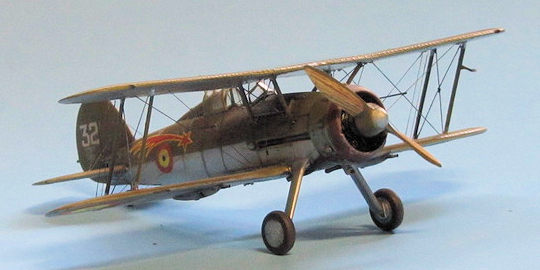 There
have been at least half a dozen Gladiator kits in 1/72 over the decades. Today's
modeler will reflexively go for the 2013 Airfix retool, but this one from Heller
was generally considered the best of the old bunch. Since I had an original copy
in my stash, I tacked on the Kora Belgian decals/prop with a mail order and
combined it with a few other goodies to get the old kit built up.
There
have been at least half a dozen Gladiator kits in 1/72 over the decades. Today's
modeler will reflexively go for the 2013 Airfix retool, but this one from Heller
was generally considered the best of the old bunch. Since I had an original copy
in my stash, I tacked on the Kora Belgian decals/prop with a mail order and
combined it with a few other goodies to get the old kit built up.
Nothing surprising here. 44 parts in Heller's distinctive dark grayish-green plastic make up this kit, 3 in clear for the canopy separated into segments. Very refined raised detail covers the whole surface, along with a slight burlap texture to define the fabric areas. Generations of modelers have lamented this texture and labored with wet-n-dry to remove it, but I found it charming and left it in place. Both a three blade and Watts two-blade prop are provided, along with bulged skis for a Finnish version. Decals provide options for an RAF 263 Squadron aircraft in Norway in 1940 and another for a Swedish volunteer in Finland the same year, though mine were unusable. Subtle aspects of the Gladiator airframe are well depicted. Other than the rather weak open-spoke wheels and (especially) the engine, the impression is of the best the raised-panel-line era had to offer.
| CONSTRUCTION |
The engine being the kit's weakest point; construction began by replacing it with a resin cast of the Frog Blenheim's part. This was trapped in the kit's three cowl components. The Kora decals set also includes a resin propeller, so while I was at it on my drill press, all this was bored for a new prop shaft arrangement of sleeved brass tube. The kit's cowl was assembled and the new engine/prop setup epoxied into place.
Turning to
the fuselage, the pilot's left entry door was cut open. I cemented Heller's
floor, rear bulkhead, and aft deck the right fuselage, temporarily taping the
other fuselage half in place to maintain
 alignment.
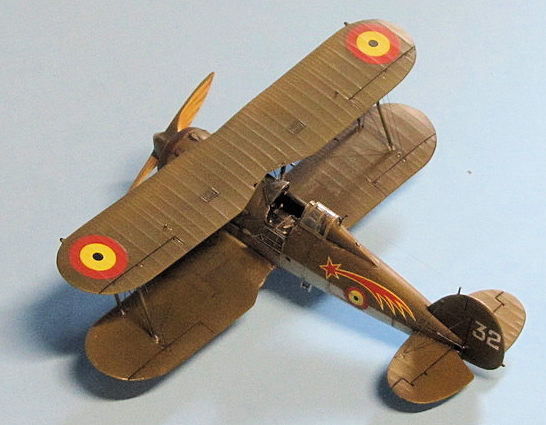
When this had cured the fuselage was parted again and the model received a full
cockpit comprised of Quickboost seat, control spade, compass, Yahu Mk.I
instrument panel, plus lots of styrene bits. This was painted and weathered by
the usual methods and the fuselage closed up.
alignment.
When this had cured the fuselage was parted again and the model received a full
cockpit comprised of Quickboost seat, control spade, compass, Yahu Mk.I
instrument panel, plus lots of styrene bits. This was painted and weathered by
the usual methods and the fuselage closed up.
The raised lines on top of the lower wing represent access panels for the guns. These were masked, filled with several coats of Tamiya primer applied with a brush, sanded almost—but not quite—flush with the surrounding surface, then polished, the result being a set of raised planes. Similarly, once the lower wing was attached and sanded, a couple selected panels on the model's belly around the center section received similar treatment to fair that wing in more convincingly. The gun pods were replaced with more Quickboost items.
Back to the fuselage, the cockpit was completed with minor detailing around the rear deck area and gunsight. A Falcon vac-formed canopy was glued in place, just the windshield and rear portion at this time. The reportedly overscale radiator, which had gone missing from my kit over the decades, was replaced with a little panel of scored styrene. Heller provides some of the holes for rigging; the rest were drilled at this time by studying drawings, photographs, and Heller's helpful rigging guide. General assembly followed (including interplane struts glued to the bottom wing), with the top wing being in place for strut alignment but left unattached for now.
| COLORS & MARKINGS |
The Kitmasx masking set, intended for the stock canopy, fit Falcon's quite well. A silver finish was applied. This was masked for the topside color. All sources indicate that the Belgian Gladiators were delivered in a very dark khaki topside something like US Olive Drab 41 that quickly faded to a hue near FS 24098. I found that MRP's JAAF Yellow-Green #7 (MRP-418) was a good match so this was given a dash of Brown and sprayed on the top surfaces, then locked in place with an overall coat of Mr. Color Gloss.
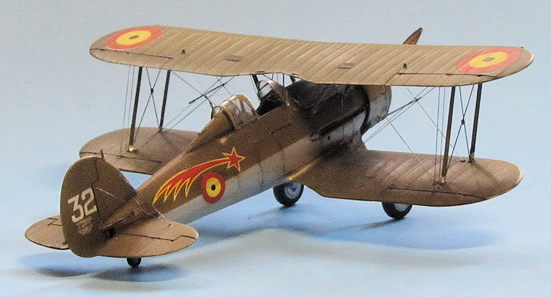 Kora's
decals are beautifully printed, but needed to be cut carefully from the
continuous backer sheet. Also, they proved extraordinarily resistant to decal
setting solutions—I resorted to soaking the hell out of them with Micro Sol,
applying and letting them sit on the model like that for about ten minutes or
so. I finished by pressing them firmly into the model's surface with my finger
wrapped in a fine tissue slightly dampened with more Micro Sol. Some leftover
Hurricane decals supplied the square RAF "W/T" airframe-component stencils on
the underside.
Kora's
decals are beautifully printed, but needed to be cut carefully from the
continuous backer sheet. Also, they proved extraordinarily resistant to decal
setting solutions—I resorted to soaking the hell out of them with Micro Sol,
applying and letting them sit on the model like that for about ten minutes or
so. I finished by pressing them firmly into the model's surface with my finger
wrapped in a fine tissue slightly dampened with more Micro Sol. Some leftover
Hurricane decals supplied the square RAF "W/T" airframe-component stencils on
the underside.
After another clear coat, a wash, assorted weathering and a semigloss finish coat the top wing was attached and the model rigged with EZ line (long wires) and Albion Alloys steel (short wires), the holes I drilled earlier making this step easier. The wheels, gun barrels, cockpit door, and open canopy went on and that was it.
| CONCLUSIONS |
An oldie but a goodie. This kit can stand some improvements in detail (around the engine and wheels, mainly) to bring it up to modern expectations. Because of this, most modelers will go for New Airfix's kit, but Heller's old classic has a certain charm and refinement the more recent kits do not. Perfect for a "crafting" project.
| REFERENCES |
https://www.belgian-wings.be/gloster-gladiator
Thomas, Andrew. Gloster Gladiator Aces. Osprey Publishing Ltd. Oxford, UK, 2002. ISBN 1-84176-289-X
Various Draftsmen. Aircraft Archive (Volume I) Fighters of World War Two. Argus Books, UK 1988
14 April 2026
Copyright ModelingMadness.com. All rights reserved. No reproduction in part or in whole without express permission.
Thanks to me for picking this one up when it was on sale.
If you would like your product reviewed fairly and quickly, please contact the editor or see other details in the Note to Contributors.