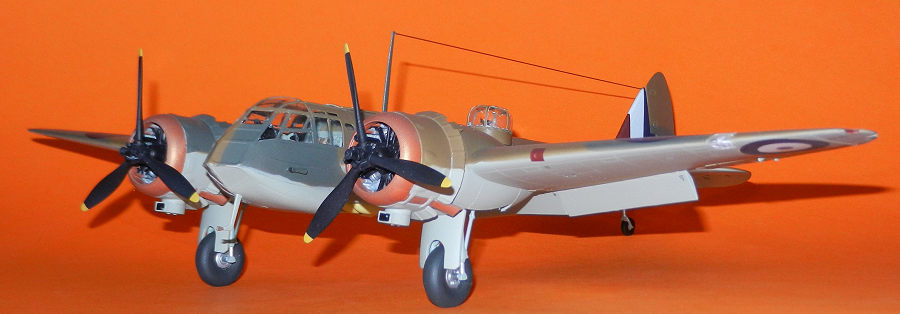
| KIT #: | 09190 |
| PRICE: | CAD$69.99 |
| DECALS: | Three options |
| REVIEWER: | Pablo Calcaterra |
| NOTES: | Xtradecal X022-48 |
| HISTORY |
Sqn Ldr James Richmond Gordon-Finlayson was born in 1914 and was the elder son of General Robert G-F KCB CMG DSO and Lady Mary G-F OBE. He became an artillery officer and a University Air Squadron pilot in 1934.
He became a Pilot Officer in 1936 and then Flying Officer in 1937 when he was assigned to 83 Sqn flying Hinds in RAF Turnhouse near Edinburgh.
In April 1938 he joined 113 Sqn and along with 211 Sqn they were moved to Leliopolis near Cairo. Having amassed more than 550 hours as pilot he was promoted to Acting Flying Officer late 1938.
After a few months as Aide-de-camp of the Governor of Keya he returned to Egypt on September 3, 1939. A week later he started converting to Blenheims Mk1 with his old Sqn. On September 21 he joined 211 Sqn.
T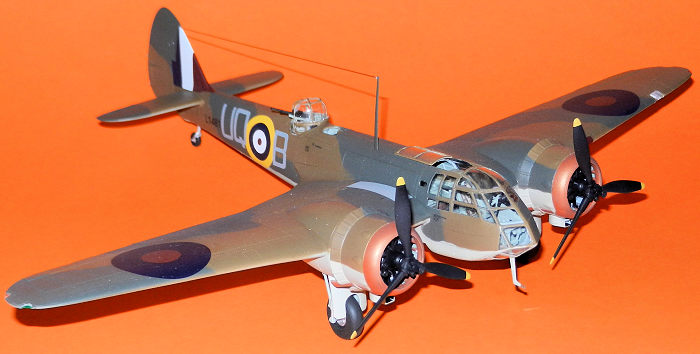 he
squadron trained hard during the first months of the war. ”HF” or “The Bish” was
commanding by now A flight (Feb 1940)
he
squadron trained hard during the first months of the war. ”HF” or “The Bish” was
commanding by now A flight (Feb 1940)
On June 11 1940 Italy declared was on France and Great Britain. He carried multiple operations against the Italians and on 4 times he had to crash land with his plane shot up (once at night, once with a dead engine, another time with the other engine on fire!). Along with P/O Davies and P/O Geary he flew to Greece on November 23 to support the defense of this country against the Italians.
By the he had already amassed 52 operations. On November 24 their Blenheim was hit twice by AAA and with no hydraulic gear they force landed near Corfu. Having been given as lost by the Sqn they returned to base after being stranded in the island for several days. He recounted: ”Just as we released our bombs we received direct hits from AA. One tore a large hole in the port engine cowling, but the motor continued to function despite the fact that oil was pouring out. The other engine was hit and stopped almost immediately…We flew on, though slowly, and unable to fain height on our one engine. The cockpit was full of petrol fumes, and I was afraid we should either pass out of that the aircraft would catch fire…We flew on for nearly two hours, and then we spotted an island just off the coast – Corfu. We had a look at I and decided there was only one place to attempt a landing – a strip of beach about 20 yards wide…we put the aircraft down all right, although we could not get the wheels out and had to make a belly landing. Some of our bombs were still on board, and they bounced along the beach behind us as we ploughed through the sand. Local fishermen took them to the mainland and after a trip that involved mule, car and train they arrived at Menidi.
The Squadron attacked targets in Derna, Tobruk, El Gazala LG, Ft Capuzzo, Sollum, Sidi Barrani, Bardia, Buk Buk, El Adem, Gambut in North Africa and then mostly Durazzo, Valona, Tepelene in Greece.
With at least 1,022 service hours he was awarded the first DFC of the Greek Campaign in January 1941. He went to celebrate to Maxim’s in Athens along with some RAF friends and colleagues. On the way back their car crashed and the Equipment Officer died. Others including GF suffered injuries but not severe.
 In
February the Squadron was moved to the idyllic Paramythia. On the 20th and
flying in a large formation of 211 and 84 Sqn with the escort of Hurricanes of
80 Sqn led by the famous Pat Pattle GF’s plane was attached by a Fiat G50.
Immediately one of the Hurricanes attacked the Italian which went down on fire
as witnessed by GF’s gunner. In this combat Pattle claimed a G50 that exploded.
It could have been very well the one seen by GF’s gunner.
In
February the Squadron was moved to the idyllic Paramythia. On the 20th and
flying in a large formation of 211 and 84 Sqn with the escort of Hurricanes of
80 Sqn led by the famous Pat Pattle GF’s plane was attached by a Fiat G50.
Immediately one of the Hurricanes attacked the Italian which went down on fire
as witnessed by GF’s gunner. In this combat Pattle claimed a G50 that exploded.
It could have been very well the one seen by GF’s gunner.
On March 3rd Gordon Finlayson took off in his Blenheim to drop a dinghy in the area where some Italian bombers had been shot down. Unable to find survivors in the water he returned to base. His last mission with his Squadrons was on March 11 after more than 100 missions. On March 13th he reported to Eleusis where the Air HQ was based. He was informed that he had been awarded the DSO while being in put in charge of the newly formed Easter Wing of British Air Forces Greece (11 Sqn, 223 Sqn, 37 Sqn, B and C flights of 30 Sqn, 33 Sqn and 73 and 208 Sqn soon to arrive from Egypt).
During the fateful raid on Easter Sunday on 13 April 1941 his normal crew Davies and Geary perished. G-F had not been part of the mission. The last 6 planes of the Squadron were lost and with them 211 Sqn had been wiped out.
He received the Greek Flying Cross and served in Syria and Libia until posted home to the Air Staff 1942-1945.
After the war he was posted to Guam and Burma among other destinations. He became Air Commodore in 1958 and two years later he was promoted to Air Vice Marshal.
He retired from the RAF in 1963 and wrote a book about his adventures with 211 Sqn. He passed away in 1990.
| THE KIT |
 Released a
few years ago this Airfix kit is everything we had been waiting for in terms of
accuracy and detail. With Sanger’s vacuum kit dramatically superseded by the
multimedia Classic Airframes then Airfix took the modelling of the short-nosed
Blenheim to a different level. Not that CA’s plane is bad but it takes a lot of
work (those resin pour blocks) and has some inaccuracies in the cockpit area.
Released a
few years ago this Airfix kit is everything we had been waiting for in terms of
accuracy and detail. With Sanger’s vacuum kit dramatically superseded by the
multimedia Classic Airframes then Airfix took the modelling of the short-nosed
Blenheim to a different level. Not that CA’s plane is bad but it takes a lot of
work (those resin pour blocks) and has some inaccuracies in the cockpit area.
Using just plastic and no resin Airfix delivers a much more detailed version of the famous wonder bomber (1936 I mean…). There are some parts that don’t need to be used based on your version (i.e. fuselage camera and support which are not mentioned in the instructions).
There’s a jig to help assembling the turret. My only two complaints are the clear parts (struggled a lot to get them to fit/close properly) and decals as the 211 Sqn version has the Squadron letters in red whereas Don Clark, the owner of 211Squadron, emphatically claims that these were grey…and I have followed his advice (or should I say his command based on the tone of his answer to my enquiring email?)
| CONSTRUCTION |
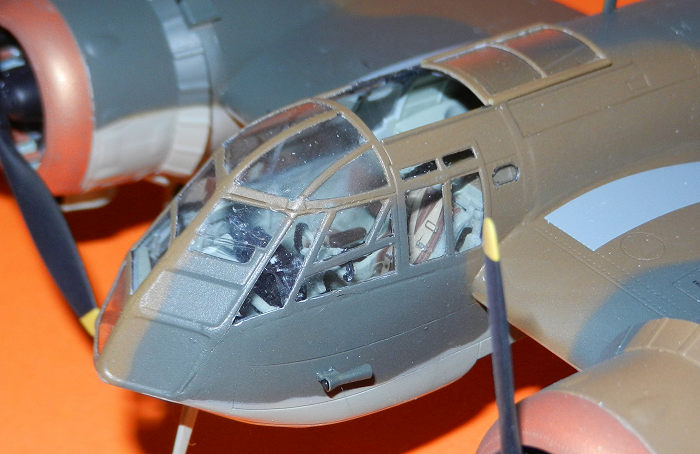
I originally intended to build this plane as MkIV by coping the clear parts of the CA kit that I have on my shelf. Having immersed it in plaster of Paris (minus the fixed gunsight) I worked my way and created a master for the scalloped nose and windshield. My friend Anthony Goodman created a base with perforations to be used in his vacuum machine. We made 2 or 3 copies (including the clear part of the turret which was copied from the Airfix one because Sanger’s is underscale) With one set ready and trimmed I found out that there’s a width difference between the CA nose and the Airfix fuselage which is narrower. Though a thin extra layer of plastic could have taken care of the gap I decided to use the copied parts with the Sanger model (review to follow). Sadly by then I had already cut out the walls of the Airfix nose…which now had to be reinstalled.
 After
priming them with Vallejo Light Grey all cockpit and main parts RAF Interior
Green (Vallejo) was sprayed. A bit of cleaning and trimming here and there was
all that I needed to have an excellent fit of parts. I added some PE seat belts
for the pilot and navigator/gunner seats.
After
priming them with Vallejo Light Grey all cockpit and main parts RAF Interior
Green (Vallejo) was sprayed. A bit of cleaning and trimming here and there was
all that I needed to have an excellent fit of parts. I added some PE seat belts
for the pilot and navigator/gunner seats.
Landing gear and turret are practically kits in themselves. There were no challenges here.
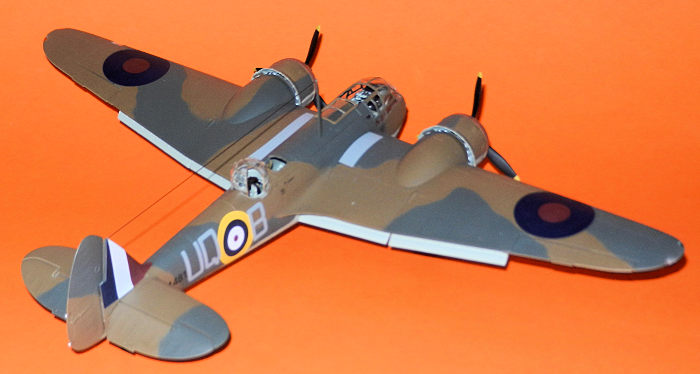
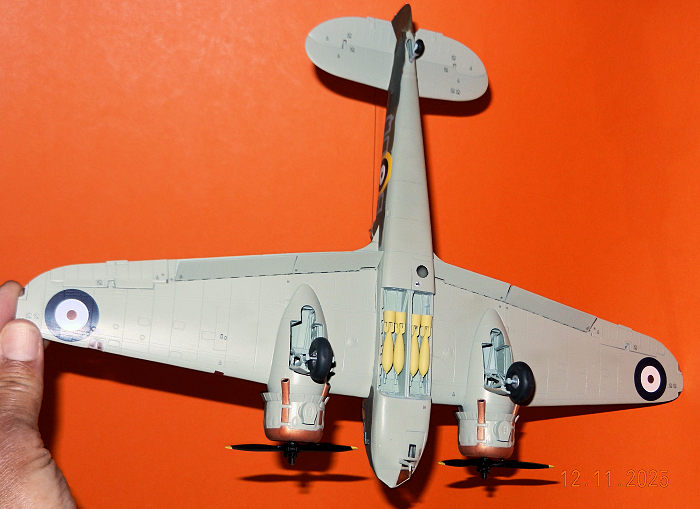
Knowing that the planes in this theater did not use the bomb bay doors I left these out and attached 4 x 250 lb bombs supplied by Airfix.
My only problem was attaching the nose clear parts. Most likely because there was a small incorrect angle on the walls due to my failed surgery mentioned above. With glue and Tamiya Liquid glue plus masking tape to hold the parts in place I managed to keep these multiple parts together as best as possible. I had to use a bit of putty here and there to cover some of the gaps I had created in some joints.
I glued the rudder slightly off and the elevators a bit dropped.
With the multitude of window panels masked and the landing gear/turret hole in the fuselage covered with damp tissue paper I started the painting process.
| COLORS & MARKINGS |
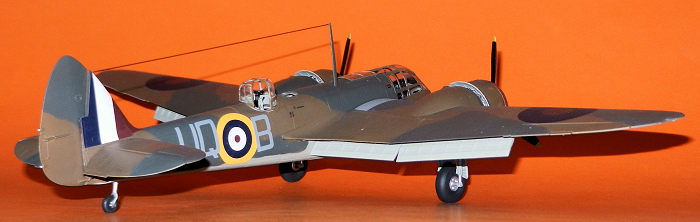
I primed the model with Vallejo Light Grey Primer. The top was painted first with Model Master Brown followed by Model Master Green. Undersides were painted in Vallejo Sky. Propeller tips in yellow and blades in black.
Quick Shine gave me a relatively smooth surface to apply the decals. For the most part these are the kit’s except for the Sqn letters and SN that came from Xtra Decals and Carpena. I used 211Squadorn.org for these as there are a couple of good images of Gordon-Finlayson’s plane in flight that show that the Sqn letters overlap the fuselage roundel.
 Model Master
clear sealed the decals.
Model Master
clear sealed the decals.
Exhausts painted in bronze (wrong! It should have been aluminum with notes/streaks of bronze/rust) and drybrushed with Rust paint.
I then unmasked the clear parts, bombs were glued in the bomb bay (no doors as the field conditions dictated that it was better not to have them installed), added the wheels with the paint scrapped off to read DUNLOP (I had to removed excess of plastic to form a U and P as they originally read DONLOR due to copyright issues?), attached small details including the antenna mast and navigation lights, placed the pilot hatch in the open position, added an antenna from the past to the tail using SS wire.
Finally, the propeller was added and the plane was finished.
| CONCLUSIONS |
An excellent kit that goes together very well…if only Airfix could issue the Mk IV…they are right now sitting on a gold mine and don’t care to exploit it (?!)
My tribute to 211 Sqn and the Allies in their fight in Greece in 1940/1.
| REFERENCES |
- 211Squadron.org
- Air War for Yugoslavia, Greece and Crete 1940-41 by Christopher Shores and Brian Cull with Nicola Malizia
17 February 2026
Copyright ModelingMadness.com. All rights reserved. No reproduction in part or in whole without express permission.
If you would like your product reviewed fairly and quickly, please contact the editor or see other details in the Note to Contributors.