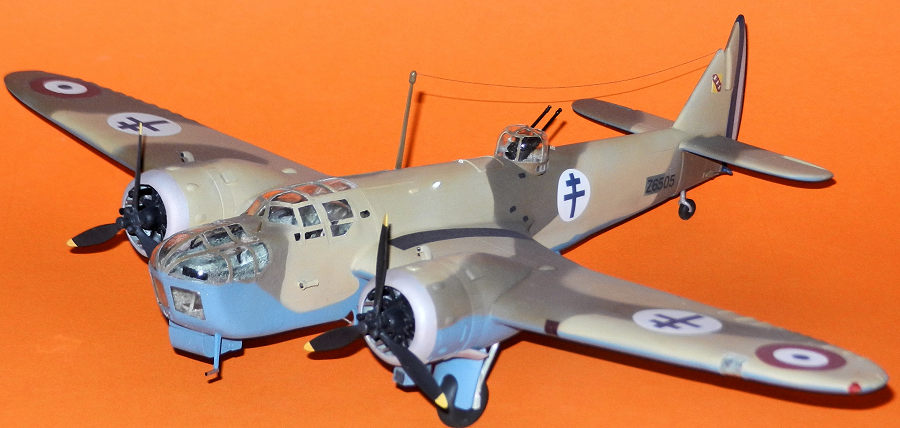
Sanger 1/48 Blenheim IV
| KIT #: | 15 |
| PRICE: | CAD$10.00 |
| DECALS: | None provided |
| REVIEWER: | Pablo Calcaterra |
| NOTES: | Self made decals. Lots of extra work. |
| HISTORY |
Charles-Felix Pijeaud was born In Sanary, France on December 12, 1904, only son of an artist and middle-class business family. His father died early in the Great War. Consequence of this Felix was then given formal education supported by the Government starting 1919. After completing his Elementary and High School studies with average performance Felix was one of the 300 students that joined the Ecole militaire at St.Cyr in 1924. Being 243 in the 300 two years later he had improved significantly and was 84 out of around 250 students. His evaluations stated that he was missing some zeal but that if well led he could become a very good officer.
On September 23 1926 he became an aviation cadet with the rank of sub lieutenant. Promoted to lieutenant two years later he married Colette in 1927. When he finished the Aviation Academy he chose to serve in North Africa by joining the 2nd Group of Aviation based in Oran. He received a positive assessment from his superiors flying as many missions as possible and always being a good pilot and navigator that showed enthusiasm. Colette and Felix had two kids: Jean Claude (1929) and Francoise (1932). The Pijeauds enjoyed family life among friends and family dinners. Strong friendships were made in Norh Africa.
Pijeaud missions became important for the French garrison in the area. He flew long recco missions over hostile territory, participated in low level attacks against “fugitives” and as a consequence he was awarded Croix de Guerre avec Palme for the TOE (Exterior Theaters of Operations) in 1931. He was well liked and appraised by his superiors who looked at him and his colleagues as having the right stuff to become the future new leaders of the French Air Force in line with their predecessors who fought in the Great War.
More missions followed in the coming months. A new medal followed in 1932 along with his promotion to Captain. His superiors stated that he was an officer of 1st quality, capable of leading a squadron, well known on all the matters pertinent to his role, enthusiastic and well liked by those around him.
 On June 22 1932 he
successfully completed a 3,400 km long endurance raid in a Potez 25 with an
average speed of 198 km/hr (Oran-Casablanca-Algier-Tunis-Setif-Oran)
On June 22 1932 he
successfully completed a 3,400 km long endurance raid in a Potez 25 with an
average speed of 198 km/hr (Oran-Casablanca-Algier-Tunis-Setif-Oran)
From February to April 1933, he received instruction to further improve his pilot skills at a course imparted in Etampes. Here he flew fighters, bombers and recco planes.
Pijeaud failed to enter the Ecole Superiore de Guerre in 1934. His superiors wrote that, though he was always a dedicated and knowledgeable officer, he was also very impulsive. After serving 6 years in North Africa he was transferred to Reims (12 demi brigade Arienne) with the intent of eventually joining the Ecole Superiore. In Reims the Pijeauds enjoyed a nice life with friends, going on vacation when possible while Felix continued with his studies. At the same time and while taking care of their 2 kids Collete studied and becomed a nurse in 1937.
By then war was looming and it could be felt in the air. Pijeaud egressed the Ecole as one of the best placed captains of his promotion. But to his disappointment he was not sent to a squadron but as part of the General Staff of the 5th Air Region (Algier) which was a non combat unit. There he used his skills to organize, plan, prepare…Collete and the kids, left behind in the Metropolis, moved to Chartres. She joined a Military Hospital to help during surgeries.
On September 2nd 1939 Felix was promoted to Commandant. Tied up in a Staff role he was frustrated reading day after day how his fellow promotion officers are killed or injured in combat. When the Armistice was signed the frustrated Pijeaud was the very first Air Force officer to escape to continue the fight. Aboard a British war ship he escaped France for Gibraltar. He tried to bring some of the Air Force cadets with him but did not succeed. Pijeaud could NOT accept defeat. On the other hand, having disobeyed the orders of the Vichy led Air Force, he was declared fugitive and eventually in 1941 he lost his French citizenship.
Pijeaud decided to join DeGaulle. In Gibraltar on July 2nd Muselier is name in command of the French forces there, with Pijeaud as his second in command and Peri in charge of the naval forces.
At the same time, frustrated Air Force officers were boycotted by their superiors who want to prevent them from joining the Free French. Famous escapes were made by several pilots, among them Rene Mouchette who manage to fly to Gibraltar in an almost disabled plane. In fact there were even 3 x D520 that escaped France and landed in England to continue the fight (more about these when I hopefully build one of these 3 using the Tamiya kit).
De Gaulle promoted Pijeaud to Lietuentant Colonel. Felix visited all the Free French bases in Africa while at the same time in England the first Free French squadrons made up with British warplanes were put together. He was named Free French Air Force Chief of Staff by DeGaulle. Pijeaud was actually the one who negotiated with the British, got the planes, organized the first squadrons…but in March 1941 Valin (who had been sitting on the fence originally) finally accepted the invitation of DeGaulle…and being more senior replaced Pijeaud in charge of the Air Force. The latter then become again part of the General Staff…while he was eager to fight.
 Neverthless during
this time he coordinated the formation of a fighter group with MS406 and
Hurricanes in Syria, and a bomber group with Blenheim (Lorraine) also based
in the Middle East. Moreover, he started to work in the creation of 341 Sqn
(flying Spitfires) and 340 Sqn in England.
Neverthless during
this time he coordinated the formation of a fighter group with MS406 and
Hurricanes in Syria, and a bomber group with Blenheim (Lorraine) also based
in the Middle East. Moreover, he started to work in the creation of 341 Sqn
(flying Spitfires) and 340 Sqn in England.
After the defeat of the Vichy forces in Syria and Lebanon these French groups were moved to North Africa. In November Pijeaud ceased to work in the General Staff and was put in command of the GB1 (Lorraine). As the Mediterranean is not safe it took Pijeaud more than a month to get to Egypt via the Atlantic. He presented himself to the British on December 17, 1941. Eager to actively participate in the war he immediately joined his Squadron.
December 20, 1941: Ignoring the advice of his men as he had not flown a warplane in a long time, Pijeaud decided to lead a box of 4 Free French Blenheims that are tasked along with 8 RAF bombers to attack an Axis transport group. He flew a Blenheim with Lt Guy Guigonnis as navigator and Sgt Delcross as gunner. The other planes were flown by Lt de Boisrouvray, Lt Ezanno and Lt Charboneau. The escort was provided by Hurricanes based in Gazzala. Taking off at 7:52 the crew found out that their intercom was faulty (I have no doubt that they should have turned back). Yet they pushed on. Guigonnis was forced to shout the directions to Pijeaud in his ear. Flying over Gazalla at 8:25 they were joined by 24 Hurricanes. At 9.15 they found the enemy convoy and they bomb it from 6,000 ft. Faced with a front of clouds the Blenheims tried to fly over them at full power. Suddenly the British Blenheims are attacked by 109s. The plane at the right went down in flames followed by others. At 9:25 Pijeaud then decided to dive into the clouds but these are very thin and they found themselves flying in clear air near Barce. At 9:32 and while Pijeaud was asking his navigator for a course for home the plane received multiple hits from the 109s and the cockpit caught fire from one end to the other. With no answer from the gunner Pijeaud kept the plane straight and level for his crew to bail out. Guigonnis jettisoned the rear facing lower machine guns and the escape hatch. He droped out of the plane. With a slightly burned hand he managed to evade the German and Italian patrols and was rescued by men of the 11th Indian Division. Talking to Italian prisoners he learnt that the plane came down on fire but before exploding upon hitting the ground two parachutes were seen. One managed to escape from them (Guigonnis) and the other was made POW. This was a colonel who was badly burnt in face and hands. The remains of Delcross were found in the plane. The navigator returned to Gambut on December 29.
Out of the 12 bombers and 20 fighters 9 were lost including two of the Free French (the other being that of Lt. de Boisrouvray)
While in hospital, blinded and unable to write Pijeaud dictated his report to a 1 Sqn RSAF pilot. He said that during the turns to avoid the AAA he lost contact with the formation and decided to press on with the attack. They found the convoy and dropped the bombs but these fell short. At the moment they were attacked by fighters from the left side and both engines caught fire. The navigator bailed out and Pijeaud left his seat to look for the gunner. Unable to see him and with the cockpit on fire he now went to the nose of the plane and jumped out being captured and put in a hospital.
As the British were approaching the town the Italians left the hospital unattended. He decided to escape and wandered for a couple of days. He was able to start to see a bit with his right eye. When he realized that the Axis forces were gone from the town he returned to the hospital. There he waited patiently for the Allies to arrive which happened 4 days later! Immediately put on a hospital ship (he was too injured to withstand a ride on a plane) he was delirious, saddened about his situation and was cheered on by the nurses. Finally, he succumbed to his injures on January 6, 1942 and was interred with full military honors the following day in Alexandria.
Pijeaud’s decorations include Chevalier de la Légion d'Honneur, Compagnon de la Libération - décret du 26 mars 1942, Croix de Guerre 39/45 avec palme, Croix de Guerre des TOE (2 citations), Médaille de la Résistance, Médaille Coloniale avec agrafes "Sahara", "Maroc", Croix du Combattant, Médaille des Services Volontaires dans la France Libre, Mention in Dispatch (GB), Officier du Nichan Iftikhar
In the meantime, Collette left their kids in Bretagne but every anniversary of the death of Felix the family attended Holy Mass. She returned to work in the hospital in Chartres where the Germans had also set up a POW camp. She helped some of the prisoners to escape. Collette joined the Resistance as part of the “Turma-Vengance” group. In 1943 the group was betrayed and she was captured. The last thing his friends saw of her was leaving her home, wearing her nurse uniform, and stoically walking to a waiting car with Gestapo members…She died of septicemia in Ravensbruck on December 6, 1943 a few days after arriving there.
Their kids survived the war and it had happened with Felix were taken care of by the French Government. Pierre Closterman, great admirer of Pijeaud, became their godfather supporting them as much as he could during their lives (notice that his story about the loss of Pijeaud in “Fire in the Sky” is plagued with errors…I would like to think that in 1955 he did not have all the information we now have).
Felix et Colette Pijeaud, morts pour la France, je n’oublie pas.
| THE KIT |
 This kit was released in the late 1980s. Main
parts are vacuum made in thick white plastic. They are the fuselage, wings,
tail, wheels and engine cowlings. A fairly large single piece has the Mk1
nose (two halves with no frames and somehow rounded edges) and a small
turret. In white metal you have the machine gun for the gunner, oversized
seat for the pilot, very small propeller blades, two small and inaccurate
engines (just the cylinders), tail wheel. Decals are of 1980 vintage…nothing
great. Instructions are very simple. The kit leaves a lot for the modelist
to scratchbuild.
This kit was released in the late 1980s. Main
parts are vacuum made in thick white plastic. They are the fuselage, wings,
tail, wheels and engine cowlings. A fairly large single piece has the Mk1
nose (two halves with no frames and somehow rounded edges) and a small
turret. In white metal you have the machine gun for the gunner, oversized
seat for the pilot, very small propeller blades, two small and inaccurate
engines (just the cylinders), tail wheel. Decals are of 1980 vintage…nothing
great. Instructions are very simple. The kit leaves a lot for the modelist
to scratchbuild.
| CONSTRUCTION |
I purchased this Sanger Blenheim MkI in 48 at our local IPMS South Western Ontario show a around May 2025 for CAD10. As I was working on the outstanding Airfix I started to use it as a template to copy parts for Sanger’s which would be converted to a Mk4 from the FFAF… This was my first vac kit ever.
I made some moulds using plaster of Paris to copy the Airfix and exhausts because those supplied by Sanger and made in metal are grossly undersized and wrong in shape. Cutting out the parts was much easier than expected. Tutorials on line are excellent.
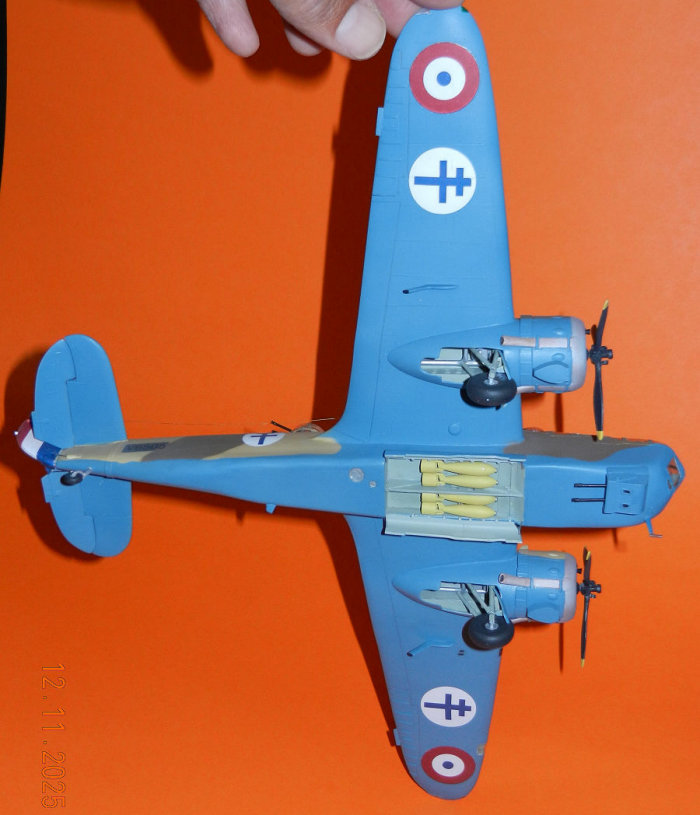
Early on I realized that the fuselage floor as supplied by Sanger’s is somehow oval and needs to be flat. To do this I had to remove the old half, make a new one with Evergreen. This was more challenging that I can describe because I had to not only ensure that the length and width were correct but also that the slope was accurate and the edges were rounded a bit. Bomb bay made as the FFAF planes flew minus the central bomb bay doors. I added several plastic tabs to get a firm attachment of the new fuselage bottom to the fuselage walls. Later on some of these would be in my way when I was attaching the wings…
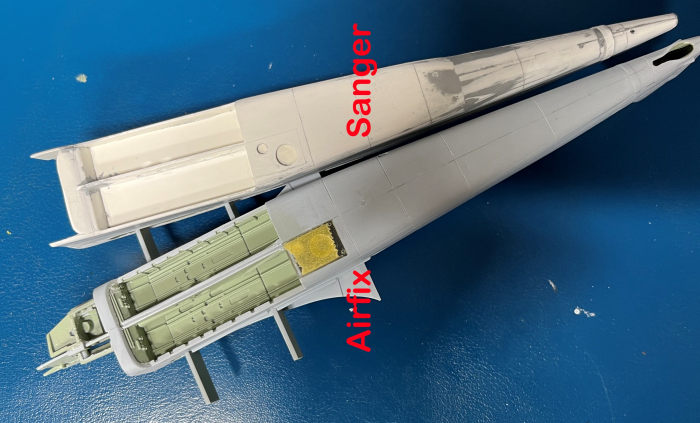 I made cut outs for side windows, support for
rotating turret which I glued in place inside the fuselage. Always coping
the Airfix parts somehow.
I made cut outs for side windows, support for
rotating turret which I glued in place inside the fuselage. Always coping
the Airfix parts somehow.
The wheel wells are extremely shallow and not
accurate at all. I removed them and using the model by Airfix scratchbuilt
the internal structure with as much detail as I dared (including for
instance the holes to reinforce the flat walls). The doors are too narrow
and the opening for these match the wrong design by Sanger. Luckily the
Airfix kit supplies two sets of landing gear doors: one for the landed and
one for the in flight position. I took these and enlarged the opening under
the engine housing.
Removed the rudder to position it “swinged” to one side. The original turret area was opened up. I have to
give credit to Sanger: though the plastic turret area is small the actual
scale plans supplied with the kit show the correct diameter. I removed an area on both wings and make a couple
of spars to hold them together in place.
I trimmed the root of the wings. I repanelled and
rescribed the entire surface of the plane (tail, fuselage, wings) adding
rivets to the fuselage always using the Airfix kit as a template.
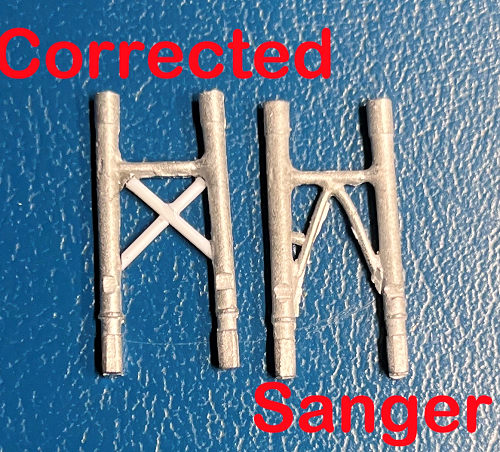 For the landing gear (too simplistic with an inexistent wheel bay by Sanger)
I found some very decent chromed rods of very good cross section. But not
enough for all links. I put them together with cyano gel. It was not
extremely accurate but simple and sturdy attachment points inside the wheel
wells. Idea being to attach the landing gear to these “runners” towards the
end of the build. The original legs were too short because that length was
enough for the fake wheel wells ceiling made by Sanger. Oil tanks above
landing gear made with stuff from spares and small plastic rods. Not great
but they will go deep into the nacelles…out of view for ever
For the landing gear (too simplistic with an inexistent wheel bay by Sanger)
I found some very decent chromed rods of very good cross section. But not
enough for all links. I put them together with cyano gel. It was not
extremely accurate but simple and sturdy attachment points inside the wheel
wells. Idea being to attach the landing gear to these “runners” towards the
end of the build. The original legs were too short because that length was
enough for the fake wheel wells ceiling made by Sanger. Oil tanks above
landing gear made with stuff from spares and small plastic rods. Not great
but they will go deep into the nacelles…out of view for ever
Though I had made very good copies of the sand filters (from Airfix) I realized I also still had in my spares those original in resin supplied by CA. Not only did I find them but also a CA resin seat with straps that is very similar to a Blenheim’s. Miles above the metal ones supplied by Sanger.
Top of wing’s needed a couple of small blisters behind the engine. These came from parts I took from spares and shaped/filed as needed. Clear window for landing lights came from spares…I believe from a CA Battle. Rudder with added “border of attack” on only one side to glue it swinged to the right. All moveable surfaces lack ribs. I cut short strips, glued them and when dry sanded them practically smooth.
Moving on to the nose: Used the Classic Airframes
instructions where you can see the parts to scale. Knowing the cockpit floor
is 45 mm long (left from parts not to be used from the Mk1 kit) I was able
to print the “map of parts” to scale. Then used it to scratchbuild the
navigator table, the cockpit walls with the different instruments and
consoles plus wiring and ribs, the console down on the right side of the
pilot and started to work on the wall behind the pilot where I added a
parachute and the navigator seat.
Parachute was made from plumbing 2 part epoxi (the solid type) along with
support for it that goes behind the pilot was scratchbuilt.
The external wall and floor of the nose was made up with sheets of Evergreen and the union was rounded with a lot of careful sanding. At this point I realized that the floor going all the way to the bomb bay had been recreated with too much slope delivering a too tall fuselage cross section. I then had to cut some parts out, sand others and ended with a difference of 2 to 3 mm more depth than needed…but better than the 7 I had originally made.
Then the complicated choreography to put the clear parts together along the internal sidewalls took a while to think about because not doing it properly would have left the plane with a crooked look.
I attached the windows by the pilot to use them as
a reference for the rest of the nose. Sliding hatch and side windows masked
and glued in place. A lot of putty and sanding were required before
installing the windshield…especially also to achieve the correct curvature
of the union of walls and floor. The frame for the access of the rear gunner
was made with thin pieces of Evergreen.
By sheer luck I visited the Canadian Warplane Museum in Hamilton, ON at this
time where they are beautifully restoring (or more accurately putting
together one by using 8!!! airframes) a Bolingbroke. And there I found out
that Classic Airframes floor for the Mk4 is wrong, wrong, wrong. It is not
flat on one level. The pilot sits above the main floor (as properly depicted
by Airfix in their Mk1 I am building in parallel). Thus I was forced to re
do all the work I had done inside the cockpit in the area around the pilot.
Seat to fire the FN54 along with telescopic gunsight and handles were
scratchbuilt along with the bombsight. Canopies were now masked leaving gaps where the
frames would be attached.
 Having sanded out a bit too much of the walls left
the canopies a bit wide. Normal plastic glue worked great. Then added putty
to make a smooth transition to the walls. It was a real struggle to cut,
sand, measure and cut again followed by more sanding the clear blister on
the nose, the front panel window for the navigator and the windshield. It
was extremely frustrating but eventually and carefully I was able to attach
firmly all the parts on the nose. The union of clear panels and walls was
covered using Tamiya self adhesive foil. Re mask areas that the sandpaper
damaged a bit, remove all the frames made with tape, primer in black and
then attach the frames made with foil. Nose was primed with strips of Tamiya
foil added in the sequence/overlap per the plane being restored at the
Canadian Warplane Heritage Museum. Marked gently with the rivetter.
Having sanded out a bit too much of the walls left
the canopies a bit wide. Normal plastic glue worked great. Then added putty
to make a smooth transition to the walls. It was a real struggle to cut,
sand, measure and cut again followed by more sanding the clear blister on
the nose, the front panel window for the navigator and the windshield. It
was extremely frustrating but eventually and carefully I was able to attach
firmly all the parts on the nose. The union of clear panels and walls was
covered using Tamiya self adhesive foil. Re mask areas that the sandpaper
damaged a bit, remove all the frames made with tape, primer in black and
then attach the frames made with foil. Nose was primed with strips of Tamiya
foil added in the sequence/overlap per the plane being restored at the
Canadian Warplane Heritage Museum. Marked gently with the rivetter.
The small bump under the nose for the navigator floor was made with a rectangle of Evergreen then sanded and covered in 2 part epoxy. To this I attached the Classic Airframes FN54 turret.
The engines were inserted in the cowls. Amazingly the grills supplied by Airfix (closed ones as the opened ones were used in the 211 Sqn model) fit perfectly at the back of the Sanger cowls. Same diameter. Perfect fit. Good job on Sanger here! Connectors to the ring were made with short pieces of Evergreen rod previously painted in Rust.
Added Tamiya foil to make the flat area of exhausts. These then were crossed over with flat pieces of thin Evergreen shaped as supports for the exhausts.
I then moved on to modifications to propellers
from spares (Sanger’s look 1/72ndish) and finalizing the turret which was
totally scratchbuilt using the Airfix one as a reference.
Small air intakes sticking out on top of engine came the from spares. Don’t
recall from what plane but really looks the part.
Navigation lights on the wingtips were made by cutting out the plastic and gluing large blobs of clear plastic which were then sanded and shaped as needed.
Bottom ring of the turret was scratchbuilt. Foil to cover the union of plexiglas and ring…like in the actual plane. And completely scratchbuilt internal structure of the turret. Added the boxes for the ammo, the collecting boxes for the spent cartridges, the base for the twin Brownings, protection for gunner….
After 6 months of work the Blenheim wase ready for washing and masking before priming
| COLORS & MARKINGS |
 Top side primed in white with Tamiya rattle can
for the French Lorraine cross and roundels that I masked before applying the
cammo
Top side primed in white with Tamiya rattle can
for the French Lorraine cross and roundels that I masked before applying the
cammo
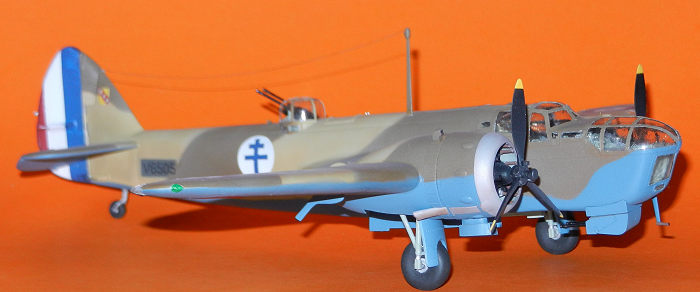
The top colours are Vallejo MidStone (mixed with 20% white) and Model Master RAF Dark Earth. For the undersides I used Vallejo RAF Mediterranean Blue
A very diluted coated of Sand was applied to the
top surfaces with a much lighter spray to the fuselage walls.
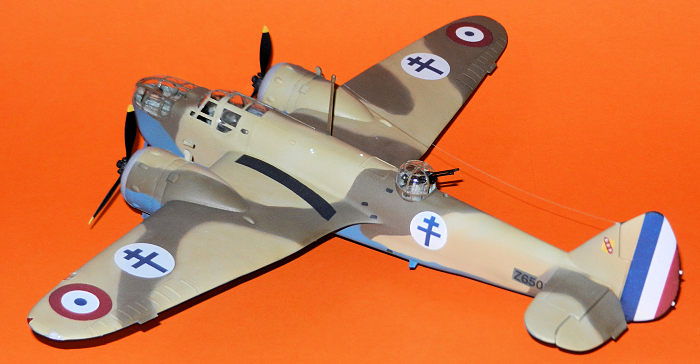
All decals were designed and printed by myself. I received help from the
forum members of the French site called FIGHTERS. I want to thank Pityforty
for this uninterested advice in terms of serial numbers and colours of the
Lorraine cross.
The only hiccup was than when sharing the images
with the guys of the French forum called FIGHTERS they pointed out that the
collector rings are not copper but have a hue based on how much burnt /used
these are. Images on the net and that I took at the Hamilton ON museum
(doh!) corroborate it. Thus I had to mask the rest of the model with tape
and a very thin clear bag (veggies from the supermarket) exposing just the
rings. Mixed Vallejo light grey primer with aluminum in 50/50 ratio and
sprayed it gently allowing some of the copper underneath to show thru. Then
when dry drybrushed some brown-red pastels
Decals were sealed with MM dull clear varnish
Unmasked the clear parts, attached blisters for
pilot (self made vac as well). Turret machine guns scratchbuilt this way:
Body copied in 2 part epoxy, muzzle taken from CA, middle part from Tamiya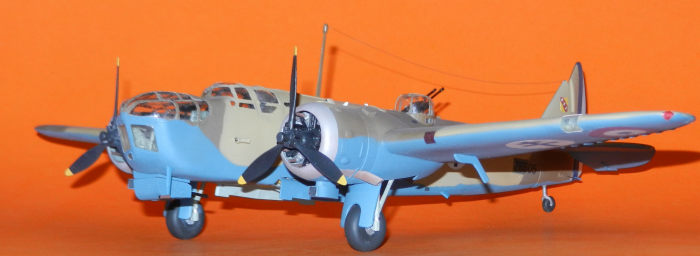 ’s
Lanc unused engine mounts
’s
Lanc unused engine mounts
Too many scratch built parts to list here…bombs from a Trumpeter Wellington, landing gear and bomb bay doors donated from Airfix, navigation lights painted in clear red and green, tail nav light from scratch painted in white, actuators for rudder made with short pieces of wire, insulator on fuselage made with a tiny piece of piece pained white, bead of gunsight glued in front of pilot windshield…among others…
Aerial was « slacked » in real life. These were 2nd hand planes
| CONCLUSIONS |
Upon finishing the model I realized that something was not right with the look of the nose. It then dawned on me that the very tip of the glazed area should have been shallower and that I should have sanded out more out of it. The nose is missing the slope on the scalloped side making my pilot unable to see ahead while taking off…Besides the frames for the windshield are too thick and left the clear parts too short…Add this to the 2 mm deeper fuselage in the nose area and my model is more bulbous and less streamlined than what it should have been…I did put a lot of effort to make my tribute to Pijeaud and instead of being proud of my effort now I look at the model from afar and through the side of my eyes… don’t want to look at it too much because the nose attracts my attention…
Overall and even with all my efforts the model is still rough and does not deliver delicate details as the beautiful Airfix version…
| REFERENCES |
- Felix et Collete Pijeaud. Deux heros oublies de la France Libre by Andre Martel
- Fire in the Sky by Pierre Closterman
- Ciel de Gloire
- Traces of War
5 March 2026 Copyright ModelingMadness.com.
All rights reserved. No reproduction in part or in whole without express
permission. If you would like your product reviewed fairly and
fairly quickly, please
contact
the editor or see other details in the
Note to
Contributors.