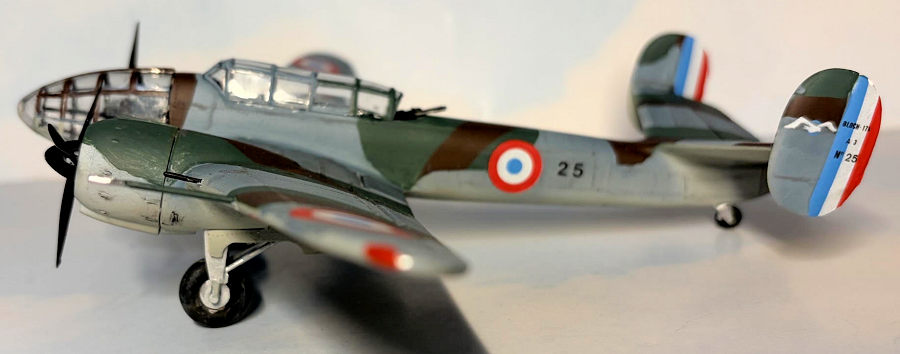
| KIT #: | 80312 |
| PRICE: | Free from club meet |
| DECALS: | One option |
| REVIEWER: | Joe Essid |
| NOTES: | Rudimentary but fun build |
| HISTORY |
Bloch’s MB.174, a development of the MB.170, was a high-speed aircraft with graceful lines used for reconnaissance and light bombing duties. The type was very promising, offering a maximum velocity of 330 mph and a cruising speed of 290 mph; it would prove able to outrun most German aircraft, except the Bf 109E. Perhaps for that reason, only three were shot down during the Battle of France. Others got destroyed on the ground, by the enemy or their own crews to keep them from falling into German hands. Many escaped to France’s North African colonies where they served until the end of the war.
 Ironically, as with many French
projects of the 1930s, the 174 suffered from a problem that also beset the
Luftwaffe throughout the war: bureaucratic infighting delayed or canceled
promising designs. Thus some aircraft that might have altered the course of the
conflict came too little, too late, or not at all.
The 174 could have entered service as early as 1937, but a precious year was wasted before the maiden flight; as a result, only 50 aircraft were in squadrons in 1940, when the sky quite literally fell on the Armée de l'air. The author Antoine de Saint-Exupéry flew 174s and wrote Flight to Arras about a combat mission he completed in one, as the German steamroller crushed Allied forces.
After the war, production resumed with the MB.175, which had a lengthened fuselage and greater bomb load. A few 175s had served in 1940 and some 175s remained in service until 1960.
In early 1940, was it the best-performing operational twin-engine aircraft in the world? The Beaufighter did join squadrons late in the year, while the Lightning, Mitchell, Marauder, and Mosquito had yet to enter squadron service. One wonders if the Bloch 174 might have rivaled its better-known contemporaries, had France not fallen. The plane clearly had more development potential and appears to have been a far superior aircraft to the Bf 110.
I can find no records of surviving examples. Quel dommage.
| THE KIT |
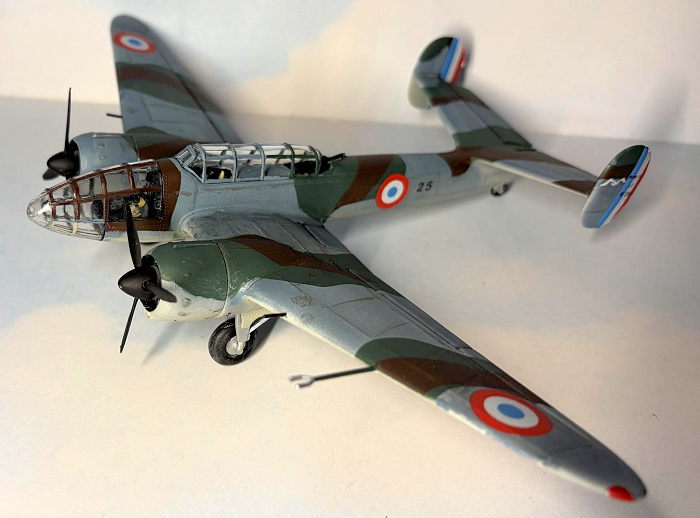 I’ve seen images of these planes
before and really like their lines, as I have a fondness for sleek twin-engine
aircraft such as the Lightning or Tigercat. I was surprised to find no reviews
or previews of the kit, which has been around a long time, at the MM archives.
Perhaps its age, basic nature, or sink marks (read on) account for this
omission.
I scored this model at our monthly IPMS meeting, from a member who brought in a huge pile of free kits. We also had a raffle that night for more. I found that my Bloch had been partly and well built, demonstrating good fit and a very basic interior, lacking even a control panel. The kit has raised panel lines, which do not bother this builder.
The instructions were missing, but those I located online; I mostly needed them for placing the decals.
| CONSTRUCTION |
Since the model was mostly done, with fuselage joined, wings and tail glued on, and landing gear in place, I began by sanding out a step where one wing joined the fuselage. I found some sink marks on the control surfaces and the tops of the engine cowlings. I puttied and sanded these as well as on one propeller blade, which I discovered late in the game.
Still, I got lucky! I’ve seen examples of this kit with very deep sinkholes in the plastic; one builder at Britmodeler likened them to the trenches at Verdun. I’ve also read that other examples have fewer sink marks. If you are buying an open-box kit, check to see how bad the moldings are. The molds at Heller are likely quite old, so a vintage 174 may serve you better.
 With some masking tape and
jeweler’s wire I fashioned seat belts and buckles. I also cut a control panel
decal into the inverted U shape found in the Bloch’s cockpit. With some
stretched sprue I fashioned a rudimentary control column and wheel for the
pilot.
With the gear already in place, I could not follow my usual practice of painting them first and installing them later. Luckily for my clumsy self, the landing legs are sturdy and remained intact.
One weak point is the two-part front transparency for the observer. It has a thick seam that needs attention. I was unable to confirm definitively if the real thing had framing at the top and bottom. I painted it in anyhow, to hide that seam. It cannot be done where the clear bubble sits at the very front. You simply must live with it or cut it off and find a replacement from packaging plastic (I am hunting for one).
The good side of the thick transparencies is their clarity. I managed to muddy up the front a bit, but even so, it and the cockpit greenhouse are clear. The smaller of two bottom windows had a sink-mark, so I used clear-parts cement to make a replacement in the opening.
The wing guns and rear gun went on, along with the pitot tube (it has a unique shape like a two-tined fondue fork. Don’t lose it). I added a second barrel to the rear gun, as seen in photos of some 174s.
| COLORS & MARKINGS |
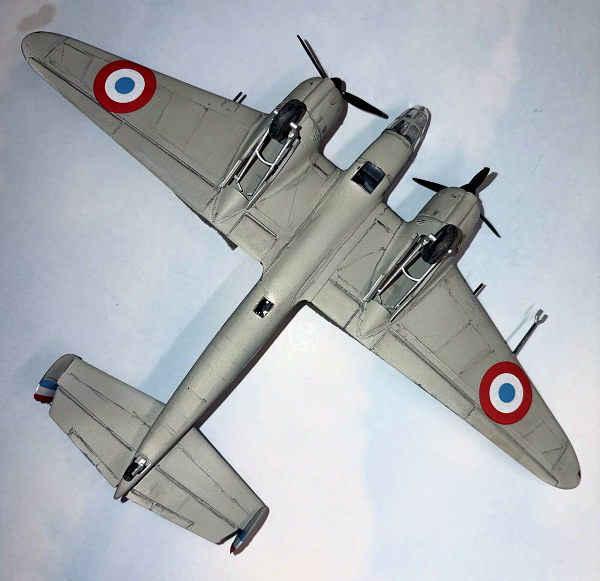
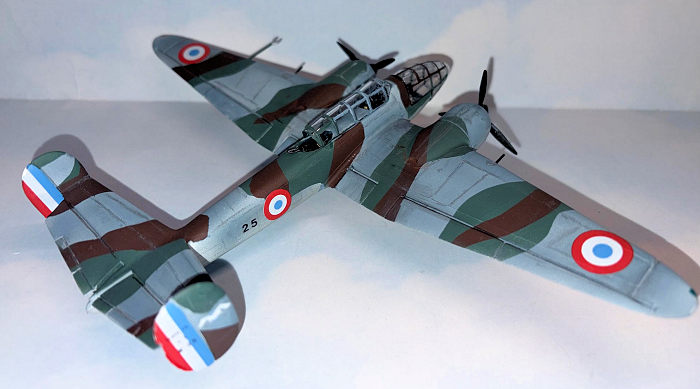
The interior had already been painted a midnight blue. I used Mission gray-blue for the undersides and sprayed the top with Mission’s USN blue-gray, which I have in quantity from an F-14 Tomcat (another sleek twin!) build a few years ago. They appeared close enough to colors on the box, as well as those listed at a few online sites about French paint codes. Moreover, I’ve enough left for three French single-engine fighters in the stash.
I’ve read that French camo patterns varied from aircraft to aircraft, so I didn’t sweat getting things on-spec for a particular plane. As I like to do when airbrushing Mission (which is quite fragile) I top-coated it all with Tamiya flat, waited overnight, then used a new #11 blade to cut camo masks from low-tack yellow masking tape. I then shot Vallejo Dark Green, following it with their Dark Brown (looks like milk chocolate. I prefer dark but yum). Once the paint cured, I used a damp cotton swab to remove overspray and did some touch ups before top-coating it again in flat.
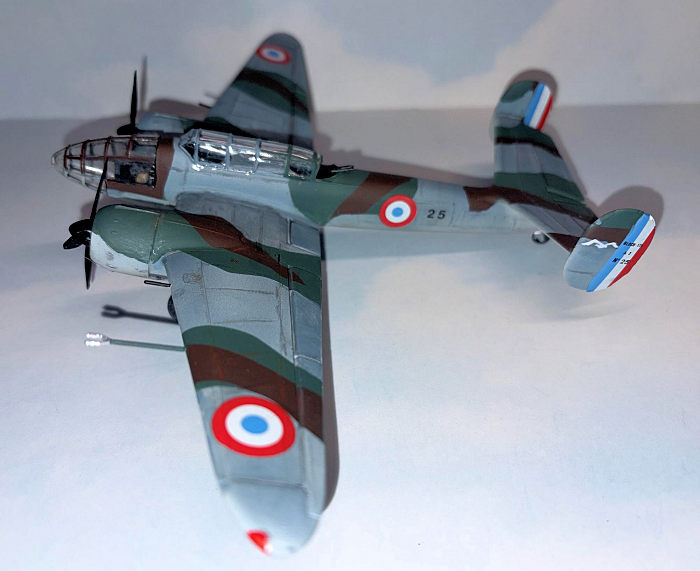 After an overnight cure, I then
used dry and wet artist’s pencils to highlight the raised panel lines and
engraved control surfaces. Using an old brush that was damp and not wet, I
blended the pencil in. Again, I’m glad to have joined our local IPMS chapter. A
recent demo on this technique came in handy. Other than some exhaust stains and
light chipping, I skipped weathering as these planes were fairly new in 1940 and
not in combat very long.
Heller’s decals surprised me. By pairing opacity and thinness, they went down over chocolate-brown paint without any bleed-through on white areas. They required no setting solutions to settle down over the raised panel lines. The drawback was that the markings are printed on one continuous sheet of decal film. Cut carefully. That said, with the thin film I saw no edges and got no silvering over Future. When they dried I applied another Future topcoat, then sealed the works a few days later in Tamiya Flat.
Canopies are vexing on most kits for me, and this one is really something. Usually I would employ pre-painted strips of masking tape, but the complex greenhouse and observer’s compartment show off the interior framing, so my green or yellow tapes were out of the question. I took my time, masking one section at a time, then brush-painted the frames in midnight blue. When that dried, I cleaned up the borders of the frames with a toothpick, then followed with camo colors.
The gear got silver Vallejo paint while the tires got painted black and dry-brushing with dark gray. Then transparent parts went on, as well as the guns and pitot. Then I called it a day.
| CONCLUSIONS |
This is an aircraft that I’ve long wanted to build. It provides a nice intro to twin-engine builds for a novice modeler. Its size in scale surprised me; it’s about the same dimensions as a P-38.
Unless raised panel lines and that front transparency make you clutch your pearls, give this little antique kit a try. Now I need to finish more French planes in that great camo scheme to be on the tarmac with this one, plus some aircraft from France’s allies who fought against long odds to halt Nazism in 1940.
Shout-out to Mike Lyons, who set up the IPMS chapter’s free-kit table and our raffle, where I scored other vintage delights to torture with glue and paint.
| REFERENCES |
Aviator Data Bureau, https://aviatordb.com/encyclopedia/aircraft/mb0
Wikipedia, https://en.wikipedia.org/wiki/Bloch_MB.170
Joe Essid
3 November 2026
Copyright ModelingMadness.com. All rights reserved. No reproduction in any form
without express permission from the editor.
If you would like your product reviewed fairly and fairly quickly, please
contact
the editor or see other details in the
Note to
Contributors. Back to the Main Page
Back to the Review
Index Page
Back to the Previews Index Page