| KIT #: | FR0061 |
| PRICE: | $50.00 |
| DECALS: | Three options |
| REVIEWER: | Ryan Grosswiler |
| NOTES: | Aftermarket decals for 'Miss Latrine'. |
| HISTORY |
It was an all-out attack, nearly suicidal in execution. Six large twin-engined aircraft, assembled in the United States but wearing the jarring orange-and-black war triangles of the Netherlands over green camouflage, winged their way northbound in the last few days of 1941 over the hot jungle canopy of Borneo just a couple thousand feet below. Objective: destroy the British oil-processing station at Kuching, a port on the opposite side of the island, which is on the verge of falling into the hands of the relentlessly advancing Japanese. The crewmen, exhausted by the six-hour inbound flight, amp up on adrenaline as their coastline target comes into view and the newly-arrived defenders begin shooting back.
The Dutch press their attack, pushing down low to strafe Japanese small craft on the nearby waterways before leveling off to release their bombs on the tanks and transfer gear of the facility. The attackers are hit. One aircraft goes down in the harbor with both engines on fire. A second makes a forced landing on a rubber plantation, and a third bomber falls disintegrating into the jungle as the halved formation turns back south for base. Upon landing hours later, the awestruck squadron commander counts two dozen 20mm hits and over 300 bullet holes on the airplane that had carried he and his crew home.
The
aircraft type in question was the Martin 166, the final iteration of the
remarkable Martin 139; the "Martin Bomber" famous through the early 1930s, and
this slaughter marked the aircraft as an ironic victim of
its own success. The overall story of this aircraft type is told better
elsewhere on this site, but suffice to say that Glenn Martin was forced in 1932
to risk his ailing company on a tremendous technological leap in aircraft
design. The resulting ‘Model
139’
is still noted
for its remarkable
performance advance, as it combined for the first time all-metal stressed skin
constructio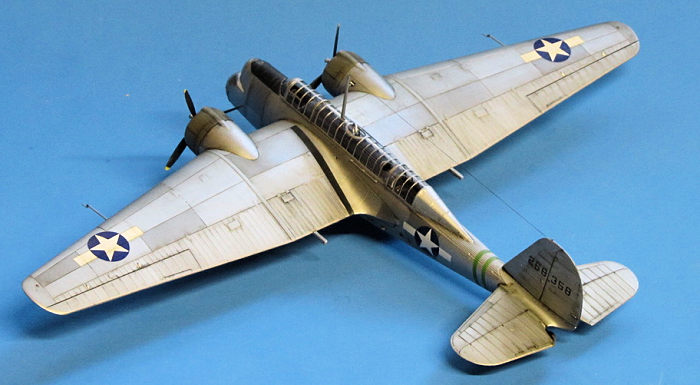 n,
retractable landing gear, revolving gun turret, internal bomb bay, and enclosed
cockpits. The US Army Air Corps was pleased with the result, and the 139 entered
production and service as the Martin B-10.
n,
retractable landing gear, revolving gun turret, internal bomb bay, and enclosed
cockpits. The US Army Air Corps was pleased with the result, and the 139 entered
production and service as the Martin B-10.
However, the state of-the-art leap had triggered the imagination of the USAAC, who in 1935 requested even greater performance figures for its next-generation bomber in a new competition. Martin tried to keep pace with the Model 146, basically an enlarged B-10 with proper side-by-side seating and a more spacious fuselage featuring greater payload capacity, but the entry was beaten ultimately by Boeing's Model 299 (a.k.a. the B-17)...though such was the soundness of the original Martin design that it equaled the Boeing prototype in every way except range, at half the cost.
This loss did mean that the B-10 was finally released for export, and Martin made lots of foreign sales. The single best overseas customer (and best customer overall, as Holland would ultimately operate more Martin Bombers than the US ever did) were the Dutch. With the rise of Japan as a regional power, the old European colonial empire looked around, and all that oil, sugar, rubber trees and—soon—the van Halen brothers, began to look awfully vulnerable. The Netherlands resolved to build up its separate air arm there, the ML-KNIL. From the outset it was recognized that an all-metal airplane would be required for operation in a tropical climate, so the indigenous mixed-construction Fokker T.V just about to enter service would not suffice. At first the more or less standard B-10 was ordered from Martin, with about 40 entering service starting in mid-1936, but better performance and capability were desired.
An arrangement for Fokker to license the failed-against-the-B-17 Model 146 fell through on account of Fokker's incapacity to work in aluminum and lack of production floor space. But the defense needs of their rich East Indies colonies remained so pressing that the Dutch settled on one more major revision of the basic B-10 design.
This was the Martin 166, modeled here. While indeed a development of the B-10, it was nonetheless a substantial redesign, with a deeper fuselage for more bomb bay volume; outer wing panels swept a few more degrees aft and tail surfaces enlarged, both of which implied that the basic B-10 still had lingering stability problems. However, its most distinct feature was a new and rather weird, extraordinary, and cartoonishly long cockpit canopy. With regional tensions continuing to rise, this revised model was fast-tracked into production and the first Model 166s were accepted in the Netherlands East Indies during the fall of 1938. 78 were delivered by March of 1940. Wisely, the Dutch put this period to use not only in hardware acquisition but also intensive navigational training and exercise among these far-flung islands. The shortage of aircrew was such that even civilian pilots were recruited and placed into the regimen. Sensing the way the impending war might unfold, the ML-KNIL began to train and model individual squadrons to act in a semi-independent way, so they might respond to local developments in a timely fashion.
By the time World War II proper broke out a year later and the Netherlands fell to the Nazi Blitzkrieg, the Martin bombers of both versions were actually quite numerous among the islands of the East Indies, and with their mother nation now under occupational control of an Axis power, the Netherlands East Indies entered into an odd existence as a sort of independent neutral country. Training and combat organization continued, however, as Japanese intentions were beginning to become obvious.
 War
finally came on December 8, like it did for other Western powers in the region,
with the Japanese pushing initially on two axes: the first through the
Philippines toward Borneo, the second down the Malayan peninsula to Singapore
and Sumatra, with Java as the combined objective. The Dutch threw their bomber
force for the first time against the Japanese toehold in northern Borneo on
December 17, inconclusive at first, but a second attack later in the day scored
hits on warships and transports supporting the invasion force. The third sortie
on the 18th sunk the destroyer Shinonome and left a cargo ship on fire for the
loss of one Martin and its crew.
War
finally came on December 8, like it did for other Western powers in the region,
with the Japanese pushing initially on two axes: the first through the
Philippines toward Borneo, the second down the Malayan peninsula to Singapore
and Sumatra, with Java as the combined objective. The Dutch threw their bomber
force for the first time against the Japanese toehold in northern Borneo on
December 17, inconclusive at first, but a second attack later in the day scored
hits on warships and transports supporting the invasion force. The third sortie
on the 18th sunk the destroyer Shinonome and left a cargo ship on fire for the
loss of one Martin and its crew.
Annoyed, the Japanese discovered and hit the ML-KNIL's main base of Singkawang II on the 23rd with a large bomber force. The loss of Dutch aircraft was surprisingly light, most aircraft simply being damaged, but the runway was put out of action as every able-bodied male had to be drafted to fill the bomb craters. The runway became useable again just in time for an evacuation to Palembang, Sumatra, the last damaged aircraft receiving a temporary wingtip of bamboo and linen just to get it out of there.
Regrouping, the Dutch resumed action in the last week of 1941, continuing to hit the advancing Japanese and their supply line or destroying facilities that were on the verge of being lost. The ML-KNIL bomber losses are surprisingly light initially, as their tactics are thoughtful and training standards set in the last year of peace pay off. Unlike their compatriots in such fighters as the Brewster Buffalo and Curtiss CW-21 being shredded by that most unexpected Japanese weapon, the Zero, the Dutch bomber crews are well-prepared and able to maintain pressure on Gen. Terauchi’s advancing forces.
However, the big picture unfolding in the background became a bleak one. In January, the Japanese evolved tactics and split their advance away from a unified front. To paraphrase an earlier historian, the movement forward was now gradual, insidious, like the many varying tentacles of an octopus reaching out and gently grasping here and there, as the Japanese commandeered small craft and schooners to establish many little toeholds throughout the islands at the platoon level, with reinforcement happening incrementally. The Dutch were being driven inexorably backward, just as the British and American lines were crumbling in that region and elsewhere. Worse, they are unable to replenish their losses and the loss of two or three aircraft at a time are beginning to add up. Redundant Dutch crewmen began to be rotated out to Australia to receive their much-anticipated B-25s, due any week now.
Falling back to their final base of Tasik Malaya, on the island of Java, in the first week of March, the last three functioning Martin 166s were prepared for an evacuation to Australia as permission to do so was urgently sought by radio from what was left of ML-KNIL command. In the critical hours waiting for the reply the waiting aircraft were spotted by the Japanese and promptly destroyed on the ground. Miraculously, a fourth Martin, damaged but basically intact, was found in a hangar on a far corner of the field. With an auxiliary fuel tank jury-rigged in the bomb bay and other necessary odds and ends cannibalized from wrecked Buffalo fighters, this aircraft was frantically made flyable. Navigational data for an escape to the nearby continent was apparently not available, so a flight plan was improvised based on oral testimony by a pilot familiar with the route and a page torn from a world atlas found at a nearby school.
 From the undoubtedly
hundreds of Dutch personnel milling about, anxious to escape impending capture
by the Japanese, one would have hoped in this circumstance that specialties who
could contribute to the continuing fight against the Japanese most
directly—namely, aircrew and mechanics—would have been selected for the flight,
but rank was pulled and senior officers and staff boarded the aircraft instead.
A further exploration of this basic human malfunction is to be found in a movie
which would appear nine years later: "When Worlds Collide".
From the undoubtedly
hundreds of Dutch personnel milling about, anxious to escape impending capture
by the Japanese, one would have hoped in this circumstance that specialties who
could contribute to the continuing fight against the Japanese most
directly—namely, aircrew and mechanics—would have been selected for the flight,
but rank was pulled and senior officers and staff boarded the aircraft instead.
A further exploration of this basic human malfunction is to be found in a movie
which would appear nine years later: "When Worlds Collide".
On the night of March 8, with general capitulation just hours away, the rickety 4-place bomber was crammed with fourteen people and managed to stagger into the air, taking up a southeast heading. The island fell as the lone aircraft escaped, and the peoples of Indonesia traded one colonial master for another even more brutal one. The 1200 miles of open-ocean flight should have been within the bomber's normal range, but in such an extreme overload condition the route had to be flown at very high RPM/manifold pressure settings and with that came gluttonous fuel consumption. At any rate, the fleeing aircraft was saved by a fortuitous 30-knot tailwind. The aircraft and its exhausted occupants made it to the dirt airstrip at Broome, Western Australia, early that afternoon.
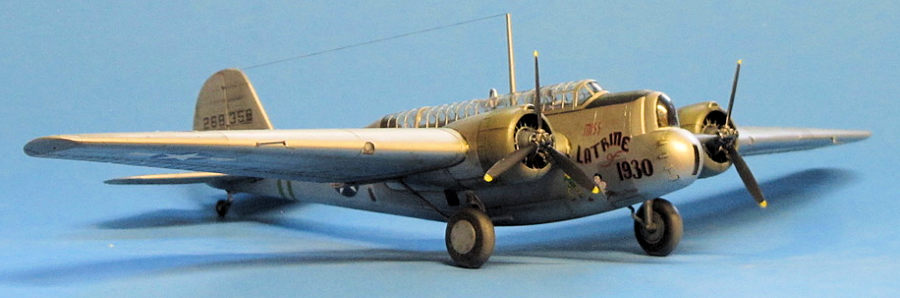
The adventured, alien airplane is an instant celebrity upon landing in the Anglosphere, and plans are immediately made to send the bomber and its crew back to the United States on a War Bond tour. However, history would have a more ignominious fate in store for it: such was the need for second-line aircraft in Australia at that desperate point in the war that it was instead short-sold to the United States government. Stripped of paint and overhauled, it entered into the USAAF inventory as the sole ‘Martin RB-10MA’. The aircraft was referred to as The Flying Shithouse by the general who used it most often, garnering the marginally more palatable "Miss Latrine of 1930" as time went by. It was used this way for the next two and a half years until, presumably supplemented by surplus C-47s, B-25s, Lodestars, and the like finally available in large numbers, it was taken out of service and scrapped in late 1944.
| THE KIT |
We have a no-kidding pioneer here! While there have been previous kits of the B-10 going all the way back to the impressive 1940s Cleveland 1/16 balsa example, the Rareplanes vac-form from the '70s, to the tried-and-true (and still good) Williams Bros kit, and finally the earlier Azur-FRROM releases of the Martin B-10/139, this is the first specifically of the '166 I am aware of in any medium whatsoever.
Lifting
the lid which depicts the Borneo attack scene in the opening paragraphs above,
five sprues in dark gray and one in clear are found within. Check the bag for
loose bits before you spill the contents; I once again located a little piece
floating about (which turned out to be the retraction track from the wing
trailing edge; more on this later). Nice, clean presentation otherwise, fine
recessed and raised detail where appropriate. Wisely, the fuselage is split on
the horizontal plane, averting the fearful task of filling in a seam among those
corrugations. There are no build options, but the decals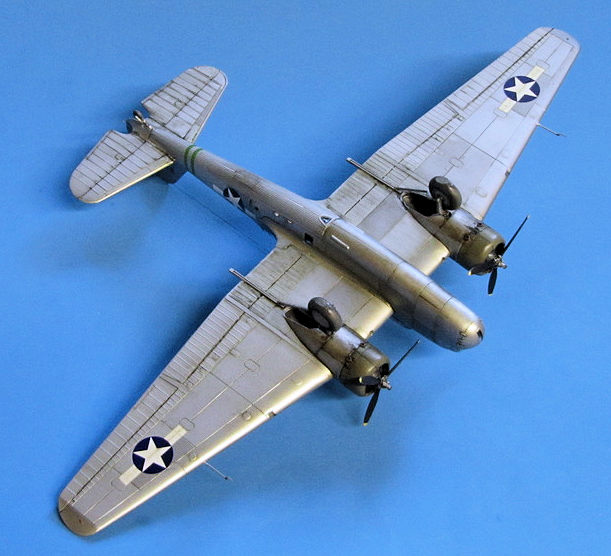 include three intriguing schemes for Dutch aircraft at two different stages of
the early war period and an example captured by the Japanese and passed to
Thailand, this last bearing layered evidence of all three owners.
include three intriguing schemes for Dutch aircraft at two different stages of
the early war period and an example captured by the Japanese and passed to
Thailand, this last bearing layered evidence of all three owners.
Given all the airframe changes to the Martin 166 over the earlier B-10, only the three 'detail' sprues are in common to FRROM's earlier Model 139/B-10 releases, with lots of unused parts among these. My sole criticism of the molds upon initial inspection is the two gear retraction-jack tracks which extend beyond the wing trailing edge: they are molded integrally with the lower wing parts, are quite vulnerable, and in fact were broken off on my sample with one found floating about the bag as stated, the other missing completely. I also dislike the glue-in-place prop arrangement. One peculiar omission is the piston for the prominent variable-pitch mechanism on the prop hub. This varied between production batches, and it could be that FRROM was planning to provide these in 3D print but didn't get around to it. They are nonetheless absent and will need to be scratch built. There is in fact no photoetch or resin in this kit, just conventional plastic.
Nitpicks, really, and in the box this is a nice kit has that possesses the mystical quality that just screams BUILD ME!!! It's been released in two boxings with several fascinating color schemes. Here, you have two Dutch aircraft (one with the early orange triangles, one with the late-campaign Netherlands tricolor flags), and a Thai example. I initially had wanted to do the Thai aircraft with peeling paint layers giving evidence of the various owners and guises. However, along with the review kit, Scott foisted FRROM's own aftermarket decals (FR0X26) for "Miss Latrine of 1930". I took this as a strong hint.
| CONSTRUCTION |
Before construction itself started, I decided to make a few improvements which I felt would make a difference on the finished model. First, I created a proper prop shaft arrangement with brass tubing and 10 minutes on the drill press, made up some ignition wiring harnesses on the engine faces from fine solder, and shaped that very tall (read: ‘vulnerable’) antenna mast in K&S brass stock. Next, I carved out openings for those peculiar engine instrument clusters on the inside face of each nacelle, as I felt the included decals wouldn't do this unique feature justice on their own. The broken retraction tracks were cut away in their entirety and replaced with layered brass and styrene. This was in addition to the modifications to the nose for the chosen subject, which I'll go into shortly.
All five windows in the aircraft's belly are oversized for their openings, and after a somewhat frustrating experience sanding them down and cleaning up the openings, I ended up replacing the two largest (CP10 and 11) with clear sheet plastic, which was quicker, easier and gave a more elegant result to boot. I'll replace them all like this when I build the kit again.
These
windows are a
foretaste of things to come: overall fit is okay but not outstanding as with
FRROM's own Bloch 210 I built last summer. In keeping with limited-run kits, I
found most joints required a little prep with a medium-grit sanding stick and a
couple rounds of dry-fitting. Naturally, I spent quite a bit of time with the
sand-prime-sand mantra on the prominent seams down the fuselage sid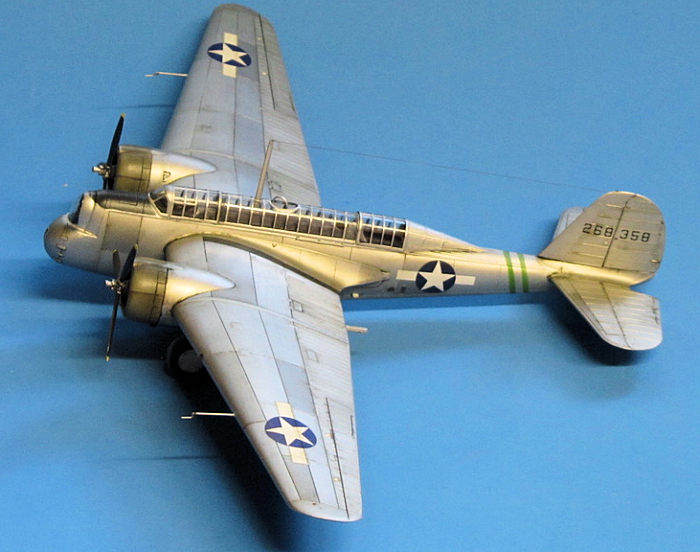 es
to make them go away, then rescribing the lost panel lines. I anticipated—and
received—'ghost' lines appearing along the fuselage sides a couple weeks after I
joined them, so these were filled again and sanded with progressively finer
grades of wet n' dry.
However, I still
credit the kit engineering choices at FRROM: all this was far preferable than
having to do same ‘midst
those corrugated panels top and bottom!
es
to make them go away, then rescribing the lost panel lines. I anticipated—and
received—'ghost' lines appearing along the fuselage sides a couple weeks after I
joined them, so these were filled again and sanded with progressively finer
grades of wet n' dry.
However, I still
credit the kit engineering choices at FRROM: all this was far preferable than
having to do same ‘midst
those corrugated panels top and bottom!
The instructions would have you attaching the main landing gear legs (I9 and I10) at an early stage, causing the modeler to have to work around them for the rest of the build. I found that by opening up the lateral slots in the nacelles in the aft direction that I could create a snap-fit, and thus was able to attach the gear much later. With all the wet sanding and polishing for the natural metal finish that I'd end up doing, I was really glad I'd figured out a way to leave the gear off!
The biggest booby trap, however, occurs at the wing roots: the spar/bulkhead (part K10) is too deep and the complex wing-fuselage joint doesn't quite line up. Don't join the wing halves (Step 14 and 15) until you have this resolved! This is the one hitch that I encountered in the build that threatens to make this project go into the 'round file'. Omitting part K10 entirely should simplify the problem. I spent about an hour or two whittling, dry-fitting, and sanding until I was satisfied with this joint and closed the wings, attaching them to the fuselage over a grid-patterned work mat (to check vertical alignment) two days later. There still followed a few sessions of gap-filling/sand/polish to restore the root joint. Anticipating the natural metal finish, the basic model was then sanded to about 4000 grit.
As stated above, I wasn't satisfied with the engine instrument clusters on the nacelles as mere decals, so I actually took the time to cut them out and box them in, referring to the photograph on Page 9 of the Laureau book. I also filled and redrilled the wing root cabin air intakes in their more correct below-the-leading-edge position. Finally, the missing prop bosses, scratchbuilt and cast in resin, were each placed with a dab of J&B Weld.
Modeling notes regarding "Miss
Latrine of 1930": Some changes were made to the airframe's nose during its
overhaul. In English-language references Miss Latrine's nose is described as
"the turret was mov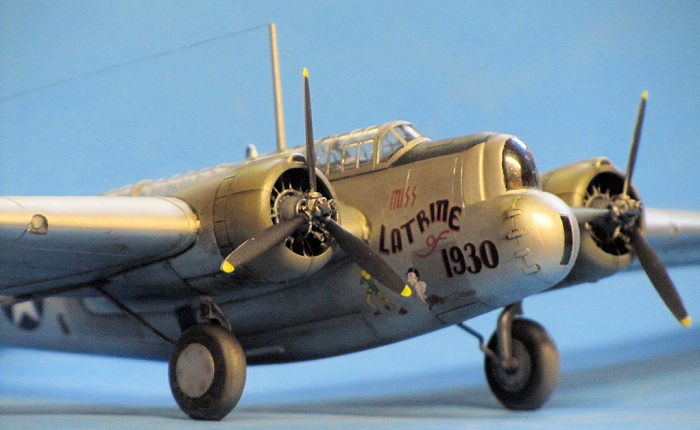 ed
aft and partially plated over". The Laureau book demonstrates otherwise, as
there are two photographs (Pages 79 and 81) taken of a standard turret
installation and the nose of the American modification from the same angle.
Comparing the two, one realizes Miss Latrine's upper nose was neither the
turret, nor moved aft. It appears to be an entirely new transparency (it's too
narrow to be the turret, evidenced by the extemporaneous flared fairing joining
it to the fuselage aft, and the clear space is too wide) taken from something
else, probably with a lot of work done to turn the interior space from a bombardier's
compartment into passenger accommodation.
ed
aft and partially plated over". The Laureau book demonstrates otherwise, as
there are two photographs (Pages 79 and 81) taken of a standard turret
installation and the nose of the American modification from the same angle.
Comparing the two, one realizes Miss Latrine's upper nose was neither the
turret, nor moved aft. It appears to be an entirely new transparency (it's too
narrow to be the turret, evidenced by the extemporaneous flared fairing joining
it to the fuselage aft, and the clear space is too wide) taken from something
else, probably with a lot of work done to turn the interior space from a bombardier's
compartment into passenger accommodation.
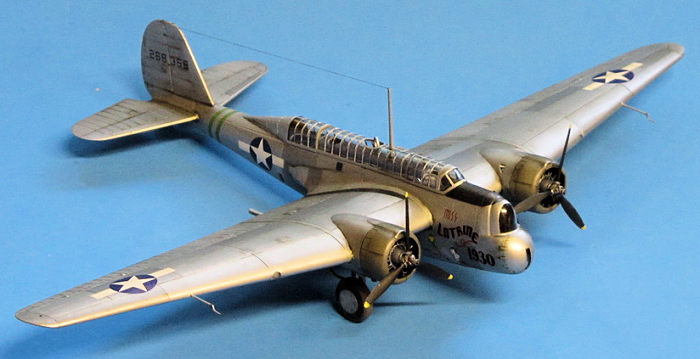
Once I saw this, I could not unsee it. So…I carved a new piece out of a scrap G4M Betty gunner canopy, basswood, and epoxy putty, recast it in resin, then vacuformed a new transparency over this. The new piece was then attached and faired in. The same photograph shows tiny but prominent reinforcement straps around nose circumference; these were represented with bits of lead wine foil. Finally, FRROM's decal instructions state that the aft canopy segment—the part that hinged down to expose the rear machine gun—was plated over with aluminum. In looking at the one photograph I know of that shows this (Laureau, Page 79), it could be as claimed or simply the effect of sunlight glare reflecting off this area. Take your pick.
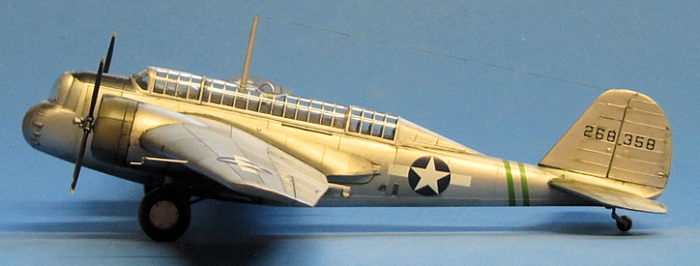
With the basic airframe done, all the little parts and canopy were attached. Some omitted details were scratchbuilt and added on the left side fuselage around the wing trailing edge. The hole for the antenna mast in the canopy is flashed over and needs to be drilled out: be very, very careful here! Also, with the main landing gear finally attached, note that they sweep slightly aft, so that they're almost vertical with the airplane resting in a three-point attitude. The D/F loop was refined with some gentle sanding. Pitot tube appearance and installation varied greatly between B-10/139/166 production batches: I made mine up from Albion Alloys brass tubing, and they're my best guess.
| COLORS & MARKINGS |
The model was prepped for painting by masking with bits of foam rubber stuck into the engine, D/F loop port, and landing gear well openings, and then Special Hobby's own masking set (M72066) for the various little windows and that canopy. I have mixed feelings about Special Hobby's mask sets; both on the Bloch 210 and (especially) this one the elements are not quite cut through and it helps to make another cut with a sharp blade for them to come free from the backing sheet without tearing. Still, masking that canopy is a long, tedious progression which probably would have driven me batshit crazy had it not been for that set.
The base coat was Tamiya AS-12
lacquer straight from the can, then various AK and Alclad metallics to represent
the high-contrast aluminum paneling. The diagonal green stripes on the fuselage
were (very painstakingly) masked and shot with Testor's enamels. The pilot's
anti-glare panel and wing root wa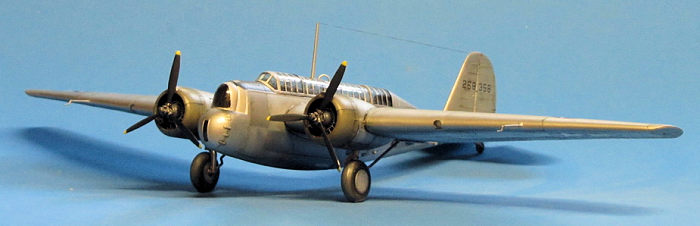 lkways
followed. The engine cowls are photographed in a color that was not metal yet
lighter than said black antiglare panel, so I guessed US Army OD and spayed that
with MRP Olive Drab. Main colors now complete after five mornings' work, the
model was given an overall coat of Mr. Color clear gloss in preparation for the
decals.
lkways
followed. The engine cowls are photographed in a color that was not metal yet
lighter than said black antiglare panel, so I guessed US Army OD and spayed that
with MRP Olive Drab. Main colors now complete after five mornings' work, the
model was given an overall coat of Mr. Color clear gloss in preparation for the
decals.
In addition to its unflattering nickname, Miss Latrine carried some of the most truly vulgar and revolting nose art images ever painted...thankfully in this case tucked discreetly under the wing leading edge and not really discernable in 1/72. FRROM's aftermarket decals are quite thin and require careful handling, though they suck down into every little nook and cranny beautifully when drying when treated with Micro Set and Sol. The wing and fuselage star 'n' bars are the same size which means that the latter are much, much too large, but I was thankfully able to find replacements in the decal dungeon on an old Meteor Productions P-39 sheet. Yes, these markings are in six positions.
The decals' instructions assert that Miss Latrine was a very filthy airframe, shuttling frequently as it did from dirt airstrip to dirt airstrip throughout Australia, so a heavy weathering was applied with oils and MiG "Starship Wash". Finishing touches were the D/F loop semi-recessed into the canopy, an array of EZ Line antennas, and a set of wingtip position lights from Quinta Studios.
| CONCLUSIONS |
Whew! I’m happy with the finished model, and it doesn’t look like anything else in my lineup: the natural-metal finish really emphasizes the baroque look of the airplane. As I stated above someday I intend to return to this kit to make one up as a Thai aircraft. While obscure, it saw a lot of early-war action and is a really neat subject.
However, this is NOT an easy build! The fit problems at the wing roots are significant enough to give me pause recommending this kit: don't try this kit until you have built several multi-engine limited-run kits. Also—locate and secure that mask set.
My thanks to Azur/FRROM (via the Editor) for the review kit and decals.
| REFERENCE |
Patrick Laureau. B-10, B-12, Export Type 139/Type 166. FFROM, Laignes, France 2025. ISBN 978-83-68377-22-4
J. Breihan, Stan Piet, and Roger Mason. Martin Aircraft 1909-1960. Narkiewicz/Thompson, Santa Ana, CA 1995. ISBN 0-913322-03-2
The Internet
7 August 2026
Copyright ModelingMadness.com. All rights reserved. No reproduction in part or in whole without express permission from the editor.
If you would like your product reviewed fairly and fairly quickly, please contact the editor or see other details in the Note to Contributors.