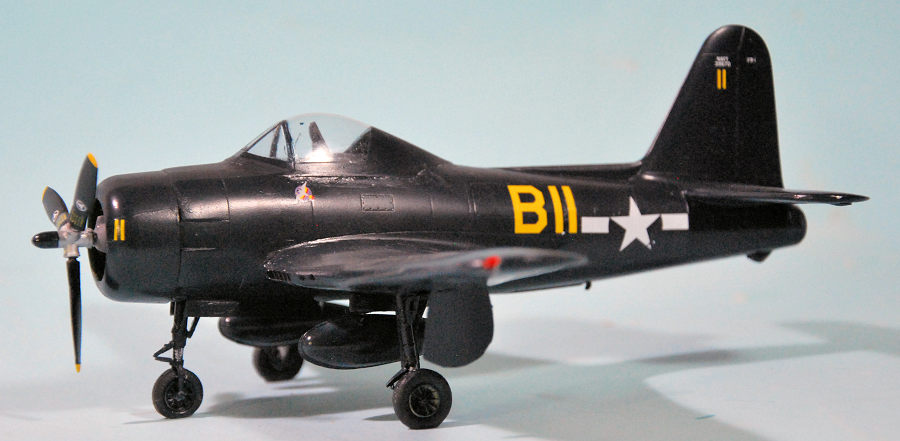
Czech Model 1/48 FR-1 Fireball
| KIT #: | 4815 |
| PRICE: | $ |
| DECALS: | Two Options |
| REVIEWER: | Tom Cleaver |
| NOTES: | Short run with resin and vacuform parts |
| HISTORY |
Design of the FR-1 began in 1943, responding to a proposal for a mixed-powered fighter; this was because early jet engines had sluggish acceleration considered unsafe for carrier operations. Ryan received a contract for three XFR-1 prototypes and one static test airframe on 11 February 1943 with the first two prototypes delivered April 1944. Another contract was placed for 100 aircraft on December 2, 1943 and a later contract on January 31, 1945 increased the total of FR-1s on order to 700; by that time, the fighter was seen as providing low altitude defense against the deadly kamikaze attacks.
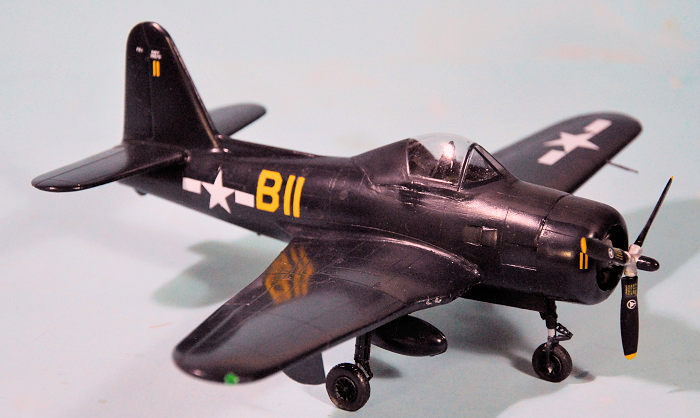 The
XFR-1 was a single-seat, low-wing monoplane with tricycle landing gear.
Power was a 1,350hp Wright R-1820-72W Cyclone radial engine in the nose
while a 1,600 lbf GE I-16 turbojet was mounted in the rear fuselage, fed by
ducts in each wing root; this meant the wing had to be relatively thick to
house the ducts and the outward-retracting main landing gear. To simplify
the fuel system, both engines used the same grade of avgas. The cockpit was
positioned just forward of the leading edge of the wing and the pilot was
provided with a bubble canopy which gave excellent visibility. The XFR-1 had
the first laminar flow airfoil in a navy carrier aircraft.
The
XFR-1 was a single-seat, low-wing monoplane with tricycle landing gear.
Power was a 1,350hp Wright R-1820-72W Cyclone radial engine in the nose
while a 1,600 lbf GE I-16 turbojet was mounted in the rear fuselage, fed by
ducts in each wing root; this meant the wing had to be relatively thick to
house the ducts and the outward-retracting main landing gear. To simplify
the fuel system, both engines used the same grade of avgas. The cockpit was
positioned just forward of the leading edge of the wing and the pilot was
provided with a bubble canopy which gave excellent visibility. The XFR-1 had
the first laminar flow airfoil in a navy carrier aircraft.
Armament was four .50-cal M2 Browning machine guns with 300 rpg, mounted immediately outboard of the air intakes for the jet engine. Four 5-inch rockets could be carried under each outer wing panel and two hardpoints were provided under the center section for 1,000 lb bombs or 100 gallon drop tanks. Armor was provided in front and behind the pilot's seat and for the oil cooler.
The first XFR-1 flew for the first time on June 25, 1944 without its jet engine, but this was installed shortly afterward. The second prototype first flew on September 20, 1944. Test flights confirmed wind tunnel tests that revealed a lack of longitudinal stability because the center of gravity had been miscalculated. In addition, the circular rear fuselage of the FR-1 gave less stability than the fuselage of the Grumman F4F Wildcat which had been used as a model for the stability calculations. A new tail with enlarged vertical and horizontal stabilizers was designed and retrofitted to the prototypes. The original Douglas double-slotted flaps proved unsatisfactory during flight testing, but all three prototypes and the first 14 production aircraft were built with them before they were replaced with a single-slotted flap.
The first prototype was lost in a crash at NAS China Lake on October 13, 1944. Investigation revealed the wing structure was not strong enough to resist compressibility effects. This was cured by doubling the number of rivets in the outer wing panels. The second prototype crashed on March 25, 1945 when the pilot failed to recover from a dive from 35,000 feet, due to compressibility effects. The third prototype crashed on April 5, when the canopy blew off during a high-speed pass over Lindbergh Field.
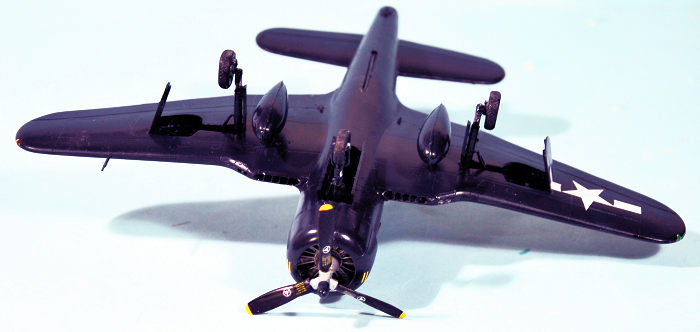 Operational
testing by the NATC at NAS Patuxent River that included carrier
acceptability tests revealed additional problems: The R-1830 tended to
overheat until electrically operated cowl flaps were installed; the catapult
hooks had to be moved; and the nosewheel oleo shock strut had to be
lengthened by 3 inches. Carrier suitability tests began aboard USS Charger
in January 1945. The aircraft successfully made five catapult takeoffs using
the piston engine as well as three takeoffs using both engines. No problems
were reported when landing aboard the carrier.
Operational
testing by the NATC at NAS Patuxent River that included carrier
acceptability tests revealed additional problems: The R-1830 tended to
overheat until electrically operated cowl flaps were installed; the catapult
hooks had to be moved; and the nosewheel oleo shock strut had to be
lengthened by 3 inches. Carrier suitability tests began aboard USS Charger
in January 1945. The aircraft successfully made five catapult takeoffs using
the piston engine as well as three takeoffs using both engines. No problems
were reported when landing aboard the carrier.
VF-66 received its first FR-1s in March 1945. On May 1, three FR-1s were craned aboard USS Ranger (CV-4) to qualify seven pilots, but two were damaged while landing. One missed the arresting gear and hit the crash barrier while the other's nose gear collapsed. The following month the pilots qualified and were on pre-embarkation leave when the Japanese surrendered. The squadron was decommissioned on 18 October with all pilots and aircraft transferred to VF-41.
The squadron was attempting to qualify its pilots for carrier operations during this time, but only 14 of its 22 pilots made the six required takeoffs and landings. A number of accidents occurred when the nose gear failed on landing, but the pilots were at least partly responsible as they were slamming the nose gear onto the deck after landing on the main gear.
The squadron qualified on the escort carrier USS Bairoko in March 1946, but nose gear problems persisted and cut the cruise short. Ryan installed a steel fork for the nosewheel, but inspections also revealed evidence of partial wing failures; the remaining FR-1s were limited to maneuvers not to exceed 5 Gs. VF-41 suffered three fatal accidents in 1946 before being redesignated VF-1E on November 15, 1946. One ensign collided with the target banner during gunnery practice and spun into the water. A few months later, the squadron commander was performing a barrel roll when his wing broke off and he struck another Fireball, killing both pilots.
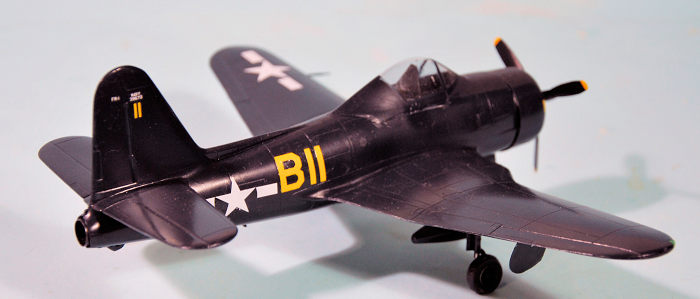 VF-1E
conducted carrier qualification in March 1947 aboard USS Badoeng Strait.
Only eight pilots successfully qualified. The FR-1s proved to be too fragile
to endure repeated carrier landings. During one brief deployment in June
aboard USS Rendova, one aircraft broke in two during a hard landing.
Subsequent inspections of the aircraft showed signs of structural failure.
The FR-1s were withdrawn from service by August 1, 1947.
VF-1E
conducted carrier qualification in March 1947 aboard USS Badoeng Strait.
Only eight pilots successfully qualified. The FR-1s proved to be too fragile
to endure repeated carrier landings. During one brief deployment in June
aboard USS Rendova, one aircraft broke in two during a hard landing.
Subsequent inspections of the aircraft showed signs of structural failure.
The FR-1s were withdrawn from service by August 1, 1947.
While many have assumed the FR-1 was a failure, this is not the case. Flying against F4U Corsairs, F6F Hellcats and F8F Bearcats, the FR-1 proved to be the most maneuverable fighter in the Navy’s inventory, while it was 100mph faster than any of the three main fighters at altitudes below 18,000 feet - where the majority of anti-kamikaze battles occurred. Additionally, the pilots developed a different landing procedure that emphasized landing on the full tricycle gear rather than the mains as was the procedure with all other carrier aircraft, that the bounce was reduced and the nose gear was undamaged. A former VF-66 pilot spoke at Planes of Fame (which houses the only surviving FR-1) and told how the pilots reveled in finding other Navy planes in the air in 1945; they would shut down the R-1830 and feather the prop, flying past the others apparently without power, then accelerate away in a climbing turn with the prop still feathered.
| THE KIT |
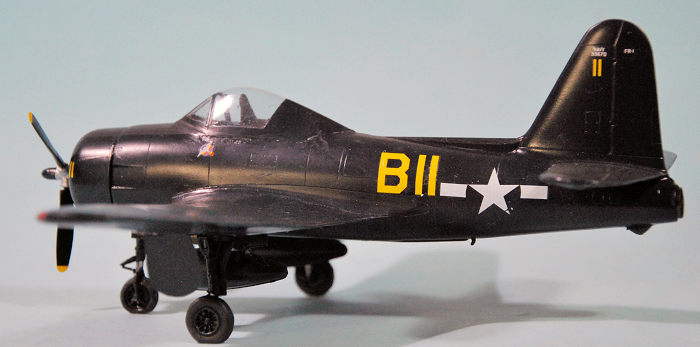 Czech
Model - a subsidiary of MPM created to provide kits for sale by Squadron Shop -
released the FR-1 with several other aircraft most people never expected to see
as kits, in the first years of the Aughts. These are all “limited run” kits as
that term was understood in the 90s; this means they need test-fitting five
times before gluing once and carefull assembly of parts that may be too large,
too small, or otherwise difficult to fit. The kit provides parts for a resin
cockpit, jet intakes, and the main gear wells. A single vacuformed canopy is
provided, so care is needed in working on it since there is no replacement.
Decals are provided for an FR-1 in VF-66 markings and one in VF-1E markings. The
national insignia in both is too large and needs replacement. The kit is now
available only from specialty shops or collectors selling off kits on eBay. It
is unlikely anyone else will ever release a kit of this airplane.
Czech
Model - a subsidiary of MPM created to provide kits for sale by Squadron Shop -
released the FR-1 with several other aircraft most people never expected to see
as kits, in the first years of the Aughts. These are all “limited run” kits as
that term was understood in the 90s; this means they need test-fitting five
times before gluing once and carefull assembly of parts that may be too large,
too small, or otherwise difficult to fit. The kit provides parts for a resin
cockpit, jet intakes, and the main gear wells. A single vacuformed canopy is
provided, so care is needed in working on it since there is no replacement.
Decals are provided for an FR-1 in VF-66 markings and one in VF-1E markings. The
national insignia in both is too large and needs replacement. The kit is now
available only from specialty shops or collectors selling off kits on eBay. It
is unlikely anyone else will ever release a kit of this airplane.
| CONSTRUCTION |
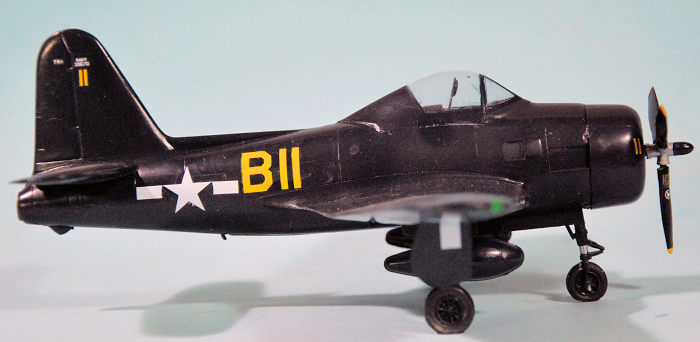 I began
by cutting all the resin parts off their backing with the good old trusty Dremel.
I then assembled the wing sub-assembly and the horizontal stabilizers and set
them aside.
I began
by cutting all the resin parts off their backing with the good old trusty Dremel.
I then assembled the wing sub-assembly and the horizontal stabilizers and set
them aside.
Given the fact there is a lot of kit aft of the main gear, getting a nose-sit takes some planning. I found that after I assembled the engine, there would be space for flattened fishing weights between it and the firewall. I also figured that I could fill the space in the fuselage ahead of the cockpit and around the nose gear well with additional flatened fishing weights. I added more inside the wing ahead of the main gear well behind the jet intakes.
I assembled the cockpit and painted it, using an Eduard p-e seatbelt. After attaching it to the left fuselage half and also attaching the nosewheel bay, I proceeded to fill the space with weights. I taped the fuselage together and attached the wing (which needed some modification to obtain good fit) and checked balance. With all the weights in as described, the model was nose heavy enough to assure nose sitting.
I assembled the fuselage and wing together and attached the horizontal stabilizers. Having worked on modifying things for good fit, I only had to use a little Mr. Surfacer 500 on the various seams and sand lightly to get a smooth finish overall.
The canopy took quite a bit of effort to fuit, I scraped out the inner surface of the lower edge to get a “knife” edge, and also thinned that from the outside. I was able to attach the canopy and only needed a little Mr. Surfacer around the lower edge to get a smooth attachment.
| COLORS & MARKINGS |
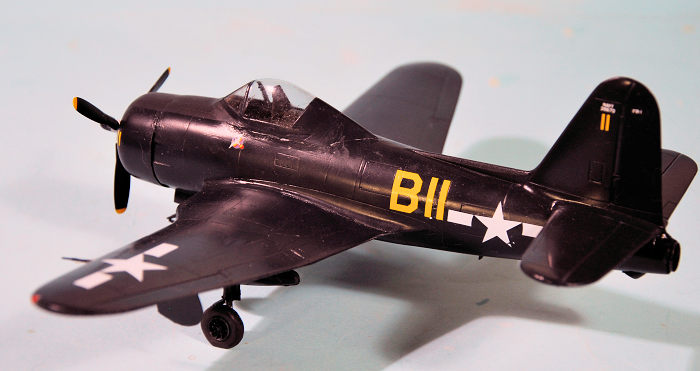 Fortunately,
the model only required a coat of Glossy Sea Blue overall, with a flat black
anti-glare area ahead of the canopy. I used Mr. Color C-365 “Glossy Sea Blue.”
Fortunately,
the model only required a coat of Glossy Sea Blue overall, with a flat black
anti-glare area ahead of the canopy. I used Mr. Color C-365 “Glossy Sea Blue.”
Studying photos and placing the national insignia in position will on its backing, I realized the insignias were about 25% too large. I was able to get a sheet of USN insignia for B=Glossy Sea Blue by Techmod from RebelAlpha on eBay and used those. I used the kit decals for the “B-11" and the designators - these were also too large but not so obviously, and besides - there were no alternatives.
I attached the landing gear, the drop tanks, and the prop, and declared the proceedings finished.
If you are a fan of US Navy fighter aircraft, the FR-1 is important as the “bridge” between props and jets. This kit - which I managed to find at J-Bar Hobbies in Tecumseh MI for only $37 delivered - is the only FR-1 available in 1/48 (there are also two 1/72 FR-1 kits which may still be in production, but they are also “rough” limited run kits). The likelihood of any other company doing this airplane is remote (but never say never with the Eastern Europeans and 3D printing). With “some modeling skill required,” an acceptable model can result.
17 July 2025 Copyright ModelingMadness.com. All rights reserved. No
reproduction in part or in whole without express permission from the editor.
If you would like your product reviewed fairly and fairly quickly, please
contact the editor or see other details in the
Note to
Contributors.