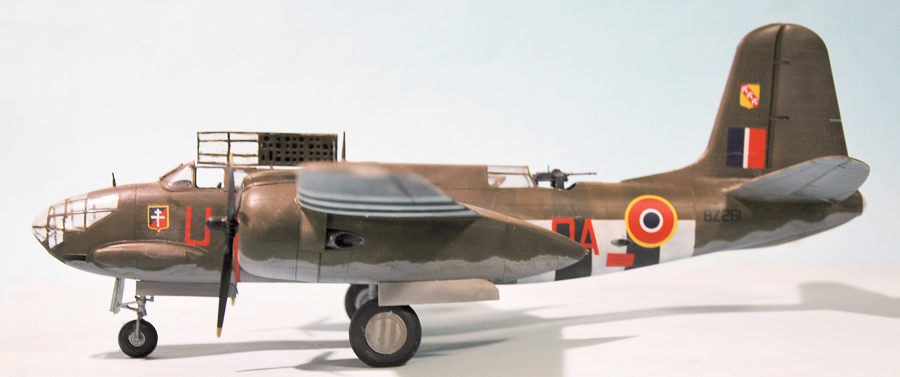
HK Models 1/48 Boston IIIA
| KIT #: | 01F105 |
| PRICE: | $99.95 from most retailers. |
| DECALS: | Two options |
| REVIEWER: | Tom Cleaver |
| NOTES: |
| HISTORY |
The prototype Model 7B first flew on October 26, 1938. It attracted attention from the French Purchasing Commission visiting the United States. The Model 7B crashed on January 23, 1939 while demonstrating single-engine performance, killing the pilot and seriously injuring a French observer aboard. The presence of a foreigner on a test flight for an aircraft still under development caused a scandal. Despite the crash, the French were impressed enough to place an order for 100 aircraft on February 15, 1939, following this with an order for 170 more in October 1939.
 As a result
of the French order, Heinemann carried out another major redesign revision,
creating a new deeper but narrower fuselage, accommodated a pilot, bombardier
and gunner. The wing was mounted lower than on the Model 7B, while the engines
were mounted in nacelles slung under the wings. Normal bombload was 1,410 lb, or
1,800 lb in overload, with a defensive armament of single 7.5mm MAC 1934 machine
guns in dorsal and ventral mounts and four fixed forward-firing guns in the
nose.The revised aircraft, now called the DB-7, first flew on August 17, 1939.
As a result
of the French order, Heinemann carried out another major redesign revision,
creating a new deeper but narrower fuselage, accommodated a pilot, bombardier
and gunner. The wing was mounted lower than on the Model 7B, while the engines
were mounted in nacelles slung under the wings. Normal bombload was 1,410 lb, or
1,800 lb in overload, with a defensive armament of single 7.5mm MAC 1934 machine
guns in dorsal and ventral mounts and four fixed forward-firing guns in the
nose.The revised aircraft, now called the DB-7, first flew on August 17, 1939.
The Air Corps liked the DB-7 as an attack bomber, and in June 1939, ordered 186 aircraft powered by Wright R-2600 engines, under the designations A-20 and A-20A; the A-20s powered by 1,700 hp turbosupercharged R-2600-7 engines and the A-20As powered by 1,600 hp supercharged R-2600-3 or -11 engines. These had a larger vertical tail to cope with the increased power, a longer nose to give room for the bombardier/navigator, and more fuel. France ordered 100 DB-7As powered by the R-2600 but with the short nose of the DB-7 in October 1939, and 480 long-nosed DB-73s, equivalent to the A-20A, in April 1940. Britain ordered 300 DB-7Bs equivalent to the A-20A in February and April 1940.
A test pilot report to the A&AEE at Boscombe Down stated the airplane "has no vices and is very easy to take off and land ... The aeroplane represents a definite advantage in the design of flying controls ... extremely pleasant to fly and manoeuvre." Pilots often considered it their favorite aircraft of the war due to the ability to toss it around like a fighter. The A-20 series found a role in every combat theater of the war, and excelled as a true "pilot's airplane".
After the Fall of France, there were still a substantial number of DB-7s which had not yet been delivered to the Armée de l'Air. The remainder of the order which was to have been delivered to France was instead taken up by the UK via the British Purchasing Commission. In the course of the war, 24 squadrons operated the Boston in Britain, the Mediterranean and North Africa.
The French
had originally intended to use the DB-7 as a short-range tactical attack
aircraft, but its range was too short for the RAF to be able to use it as a
light bomber against German targets in Europe. Eventually the British Purchasing
Commission ordered a British version as the DB-7B and the RAF named it Boston
III. The Boston III was the first to operate with the RAF as a light bomber.
They were sup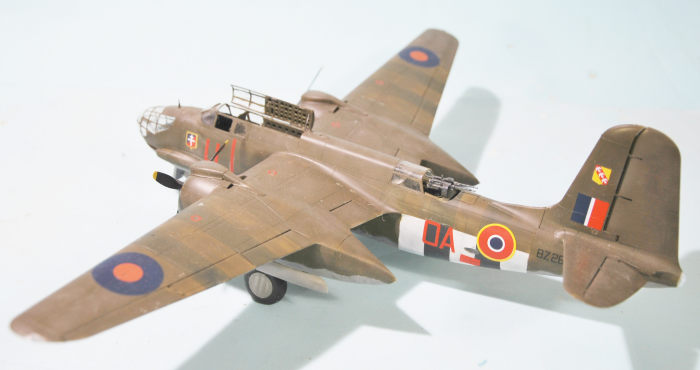 plied to squadrons in the United Kingdom and Middle East. The A-20C
was an attempt to develop a standard, international version of the
DB-7/A-20/Boston, produced from 1941. It reverted to the slanting nose glass,
and it had RF-2600-23 engines, self-sealing fuel tanks, and additional
protective armor. Once Lend-Lease began these were delivered as Boston IIIA, to
distinguish their source. The Boston IIA was visually distinguishable by dust
filters fitted as standard.
plied to squadrons in the United Kingdom and Middle East. The A-20C
was an attempt to develop a standard, international version of the
DB-7/A-20/Boston, produced from 1941. It reverted to the slanting nose glass,
and it had RF-2600-23 engines, self-sealing fuel tanks, and additional
protective armor. Once Lend-Lease began these were delivered as Boston IIIA, to
distinguish their source. The Boston IIA was visually distinguishable by dust
filters fitted as standard.
Free French squadron I/120 Lorraine, No. 342 Squadron was formed on 7 April 1943 at RAF West Raynham with personnel from the Free French Air Forces transferred from the Middle East. The squadron was part of No. 2 Group RAF and equipped with Douglas Mk IIIA Bostons.They later moved with their sister squadron No. 88 Squadron to RAF Hartford Bridge. While flying Bostons, 342 Squadron was featured in the film “The Way to the Stars.” The squadron flew low-level bombing and strafing missions (nicknamed "hedgehopping"), over France and the Netherlands, in particular against V-1 bases in Northern France and selected sites connected with the preparation for the Allied invasion. In October 1944 the squadron relocated to France, where they saw action against the remaining isolated German pockets where they occupied the French Channel Ports. In March/April 1945 the Boston IIIs and IVs were replaced by Mitchell IIIs and the squadron relocated to the Netherlands. The squadron was transferred from RAF control to the Armée de l'Air on 2 December 1945.
| THE KIT |
 AMT
released 1/48 kits of the A-20B, G and J/K, and the Boston III in the mid-1990s.
These were the only 1/48 kits of this airplane until H-K Models released the
DB-7B Boston III last summer. The kit is totally different from the AMT kits
(now released by Italerei), and is a scale-down of H-K’s 1/32 A-20G and A-20J
kits.It is fully detailed inside and out, with more accurate engines that the
AMT kit, and has the best surface detail I have seen on a plastic kit. The kit
is riveted, but the rivets are so petite that under a coat of paint they can
only be seen when the light is at the right angle. Part fit is so good that I
used no filler anywhere on the kit. Decals are provided for two aircraft of 228
Squadron, one of them used by a USAAF crew in the first mission flown by Eighth
Air Force on July 4, 1942.
AMT
released 1/48 kits of the A-20B, G and J/K, and the Boston III in the mid-1990s.
These were the only 1/48 kits of this airplane until H-K Models released the
DB-7B Boston III last summer. The kit is totally different from the AMT kits
(now released by Italerei), and is a scale-down of H-K’s 1/32 A-20G and A-20J
kits.It is fully detailed inside and out, with more accurate engines that the
AMT kit, and has the best surface detail I have seen on a plastic kit. The kit
is riveted, but the rivets are so petite that under a coat of paint they can
only be seen when the light is at the right angle. Part fit is so good that I
used no filler anywhere on the kit. Decals are provided for two aircraft of 228
Squadron, one of them used by a USAAF crew in the first mission flown by Eighth
Air Force on July 4, 1942.
| CONSTRUCTION |
As with most H-K Models kits, one cannot go wrong following the very detailed instructions, resulting in an excellent model. The kit comes with weights that fit inside the fuselage to either side of the nose gear well; this guarantees a nose sit. The kit also includes white metal landing gear, but I have found that the plastic landing gear in H-K kits is sufficiently strong that this is not really needed. YMMV
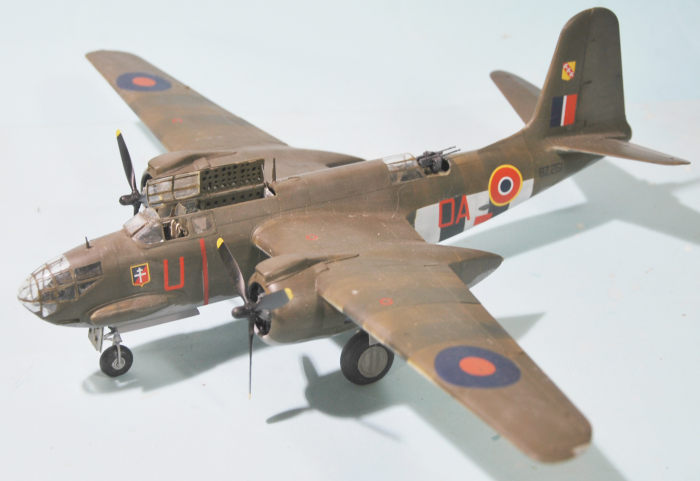 I began
with the wings and engine nacelles. The control surfaces are all separate and
the flaps can be posed down, but I have never seen a photo of a A-20 on the
ground with the flaps down. The rudder and elevators are also separate. Due to
the design of the landing gear, one must assemble the gear at the outset and
attach them in position. Yes, it’s possible to damage them as construction
continues; learn to take your time and watch what you are doing and it won’t be
a problem even if you’re ham-fisted. The nice thing is H-K continues with the
slide tab on the wing, so that the wings can be slipped of the model for storage
and travel. Fit to the fuselage is tight and you really do not need to glue the
wings to the fuselage.
I began
with the wings and engine nacelles. The control surfaces are all separate and
the flaps can be posed down, but I have never seen a photo of a A-20 on the
ground with the flaps down. The rudder and elevators are also separate. Due to
the design of the landing gear, one must assemble the gear at the outset and
attach them in position. Yes, it’s possible to damage them as construction
continues; learn to take your time and watch what you are doing and it won’t be
a problem even if you’re ham-fisted. The nice thing is H-K continues with the
slide tab on the wing, so that the wings can be slipped of the model for storage
and travel. Fit to the fuselage is tight and you really do not need to glue the
wings to the fuselage.
Turning to the fuselage, I pre-painted all the interior parts before assembly. A complete interior is provided, including the lower gun, which can be displayed with the hatch open. Eduard has already made SPACE 3-D decals for the cockpit instruments and I highly recommend you use them; they really pop the interior when applied. The bomb bay is provided and it can be displayed open. Four British-style 250-lb Bombs are provided. The cockpit glass is almost as thin as a vacuform, and I had no trouble fitting the rear canopy in the open position. The kit has the pilot’s side windows open, but the windows - which fit easily if you don’t want them open - are too thick to use in the assembled cockpit. I used thin clear acetate plastic I got from a cake box cover and cut the windows to size.
The only place I had any real problem - and it wasn’t much of one - was in getting the nose glass to fit properly to the fyuselage. You need to carefully attach it and insure it is properly fitted all around, then rubber band it in position till the glue sets up.
| COLORS & MARKINGS |
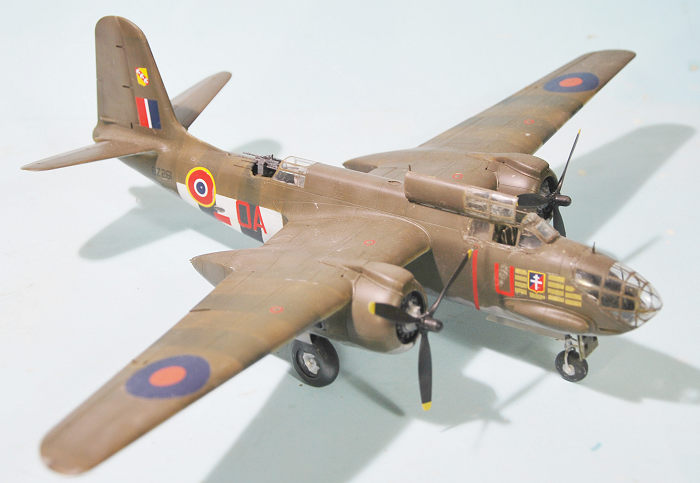
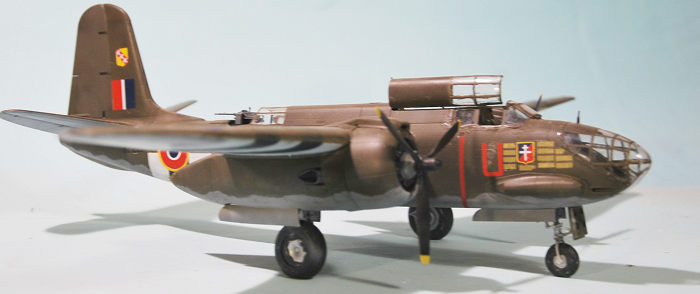
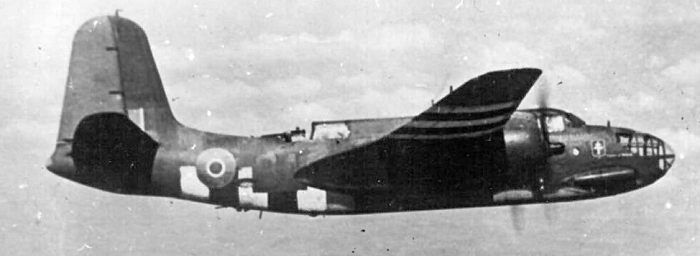 I found a
photo of a 342 Squadron Boston III post-D-Day, and decided to do that. By that
point, the invasion stripes on the upper wing and fuselage had been painted
over, but could still be distinguished under the later paint. I painted and
masked the D-Day stripes (24 inches wide for multi-engine aircraft), then
painted the rest of the model with Dark Olive 41 (Gunze H-50) and Neutral Grey.
I painted the control surfaces with “faded OD, using light grey to change the
paint tone.. I then unmasked the D-Day stripes on the upper surfaces and painted
them with thinned OD-41 unfaded, leaving the top cover paint thin enough to see
the stripes underneath. I also used Eduard’s canopy mask set, which given all
the small windows is highly recommended.
I found a
photo of a 342 Squadron Boston III post-D-Day, and decided to do that. By that
point, the invasion stripes on the upper wing and fuselage had been painted
over, but could still be distinguished under the later paint. I painted and
masked the D-Day stripes (24 inches wide for multi-engine aircraft), then
painted the rest of the model with Dark Olive 41 (Gunze H-50) and Neutral Grey.
I painted the control surfaces with “faded OD, using light grey to change the
paint tone.. I then unmasked the D-Day stripes on the upper surfaces and painted
them with thinned OD-41 unfaded, leaving the top cover paint thin enough to see
the stripes underneath. I also used Eduard’s canopy mask set, which given all
the small windows is highly recommended.
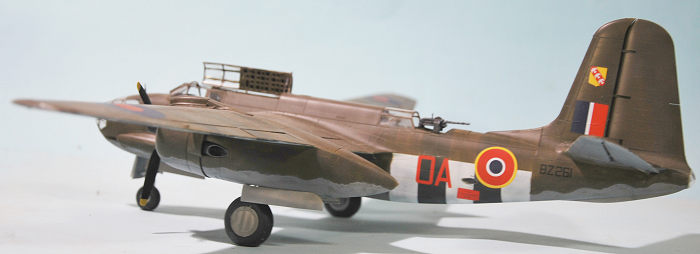 I used the
Aeromaster sheet “Havoc Collection Pt. II” 48-164C. The 342 Squadron airplane is
incorrectly shown painted RAF Ocean Grey, Dark Green, Sea Grey Medium. No A-20
was ever painted in that scheme and one is once again reminded the nickname for
Aeromaster was Errormaster. The decals, however, are fine and went down without
trouble under Micro-Sol, despite being 30 years old.
I used the
Aeromaster sheet “Havoc Collection Pt. II” 48-164C. The 342 Squadron airplane is
incorrectly shown painted RAF Ocean Grey, Dark Green, Sea Grey Medium. No A-20
was ever painted in that scheme and one is once again reminded the nickname for
Aeromaster was Errormaster. The decals, however, are fine and went down without
trouble under Micro-Sol, despite being 30 years old.
I gave the model and overall coat of Tamiya Flat Clear Lacquer (be sure to thin this, it is too thick out of the bottle). I have several photos of 342 Bostons, and they don’t appear to be badly dinged so I did minimal weathering. I unmasked the canopies, attached the props and dorsal machine guns, and declared victory over plastic.
| CONCLUSIONS |
This is one of the very best plastic kits I have had the pleasure of doing. H-K’s design provides good fit, the surface detail is the best I have seen on any riveted kit. I like the kit enough I will likely get another one once Bozo the Clown’s tariffs are in File 13 where the Supreme Court told him to put them. Or I might pay Squadron’s price, which isn’t really that much more than BNA’s price with shipping. It’s a really great kit. Commit to the radical act of following the instructions and you cannot go wrong.
Review kit courtesy of all you book buyers (“Bloody Skies: XV Fighter Command Against All Odds” drops on March 10 - thank you for your support)
Tom Cleaver
26 February 2026
Copyright ModelingMadness.com. All rights reserved.
No reproduction in part or in whole without express permission. If you would like your product reviewed fairly and fairly quickly, please
contact
the editor
or see other details in the
Note to
Contributors.