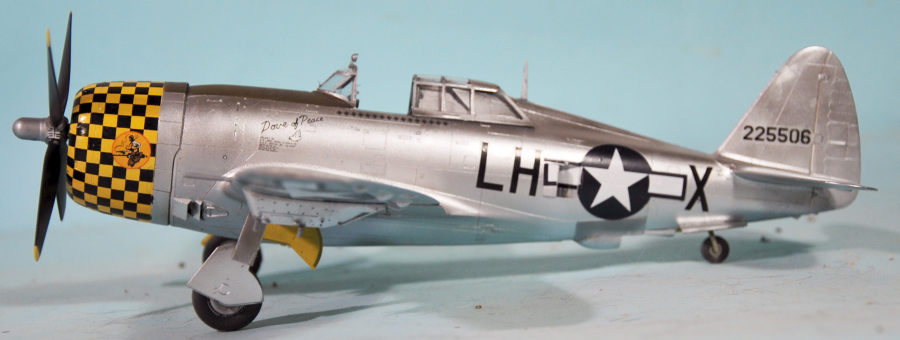
Tamiya 1/48 P-47D Thunderbolt
| KIT #: | 61086 |
| PRICE: | `$35-45.00 |
| DECALS: | Two options |
| REVIEWER: | Tom Cleaver |
| NOTES: |
Co |
| HISTORY |
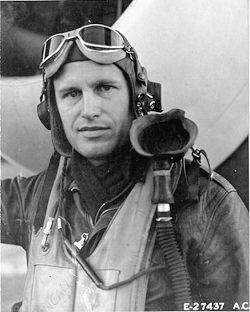 Glenn E.
Duncan, born and raised in Bering, Texas, arrived in the 353rd Fighter Group as
a 24-year old Major during the group’s initial arrival in England in March 1943,
assigned as Group Executive Officer. He had joined the USAAF in the summer of
1940 and completed flight training in October 1940, then served a year as a
flight instructor before spending December 1941-January 1943 in Panama.
Glenn E.
Duncan, born and raised in Bering, Texas, arrived in the 353rd Fighter Group as
a 24-year old Major during the group’s initial arrival in England in March 1943,
assigned as Group Executive Officer. He had joined the USAAF in the summer of
1940 and completed flight training in October 1940, then served a year as a
flight instructor before spending December 1941-January 1943 in Panama.
Duncan scored his first victory - a Fw-190 over Nantes - on September 23, 1943, and became an ace with the destruction of a Fw-190 over Rastede on December 20, 1943. He would go on to become the 353rd group’s top scorer by June 1944, with 19.5 aerial victories and nine strafing victories.
On July 7,
1944, while leading an aerial attack on a Luftwaffe airfield at Wesendorf, his
P-47 was hit by anti-aircraft fire. His crip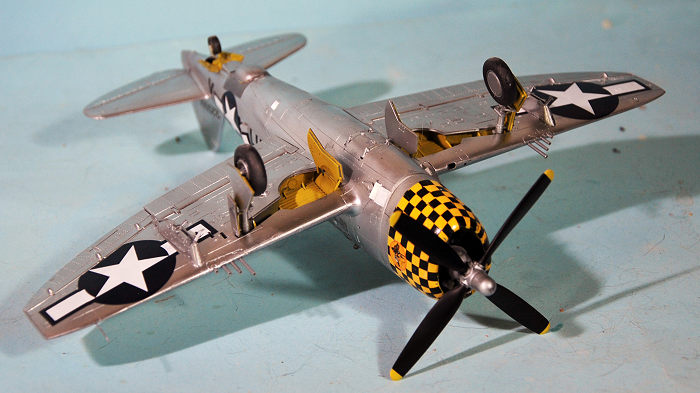 pled P-47 continued to fly on until
he belly landed near Nienburg. He then evaded capture on foot and walked towards
Netherlands. He joined the Dutch resistance, before being liberated by the
Allied forces 10 months later, in April 1945. He returned to the 353rd and
became the last group commander of the war.
pled P-47 continued to fly on until
he belly landed near Nienburg. He then evaded capture on foot and walked towards
Netherlands. He joined the Dutch resistance, before being liberated by the
Allied forces 10 months later, in April 1945. He returned to the 353rd and
became the last group commander of the war.
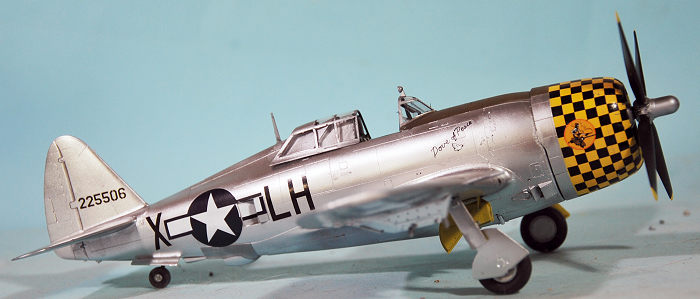
After a taxiing accident in February 1944 resulted in needed replacement of a wingtip on Duncan’s P-47D “Dove of Peace VII,” he ordered the other tip removed, and found in flight test that the Thunderbolt ad a better roll rate and higher speed than a standard P-47. He kept the “clipped tips” on Dove of Peace VI and the two later P-47s he would fly, Dove of Peace VII and VIII in this configuration before he was shot down on a low level attack on July 5, 1944.
| THE KIT |
Tamiya’s P-47s first appeared 23 years ago, and became the “gold standard” for P-47s. The kit is well-designed and everything fits. Construction is simple, and if a modeler pays attention in construction, the process can be accomplished in a day.
| CONSTRUCTION |
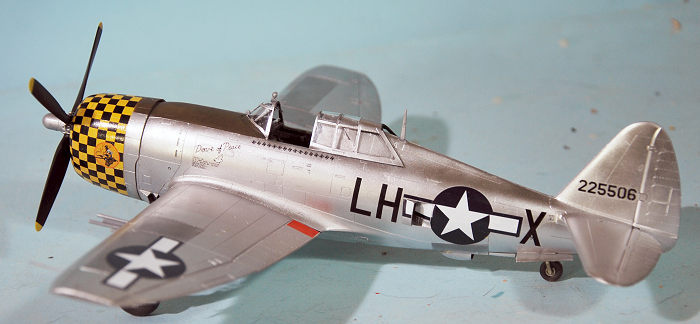 I began
with painting the cockpit, the wheel wells and landing gear on their sprues. I
then assembled the wings and set them aside after clipping the tips. Next I
detailed and assembled the cockpit followed by the fuselage. I attached the
wings and horizontal stablizers, then turned to the engine and cowling, which I
had also pre-painted. I attached that sub-assembly to the fuselage and set the
model aside to set up overnight.
I began
with painting the cockpit, the wheel wells and landing gear on their sprues. I
then assembled the wings and set them aside after clipping the tips. Next I
detailed and assembled the cockpit followed by the fuselage. I attached the
wings and horizontal stablizers, then turned to the engine and cowling, which I
had also pre-painted. I attached that sub-assembly to the fuselage and set the
model aside to set up overnight.
| COLORS & MARKINGS |
I masked the canopy with Tamiya tape, then painted the cowling white as a base coat, then yellow, using Tamiya lacquers. I then masked that off and painted the anti-glare panel and masked it off.
I painted the whole model with Tamiya Silver LP-11 as a primer base coat, then painted it with Super Metalics “Duraluminum,” SM-208. I set that aside to cure overnight, then masked off areas ib the fuselage and wings and used Super Metallics SM-205 for panel differentiation.
 I unmasked
the model to find all was well with no lift-off. If you use the LP-11 as a base
and apply Super Metallics over that, masking on the SM paint is no problem.
I unmasked
the model to find all was well with no lift-off. If you use the LP-11 as a base
and apply Super Metallics over that, masking on the SM paint is no problem.
I had managed to find one of the last copies of Aeromaster’s 1996 decal set, “Big Beautiful Jugs Pt. III” 48-277, which has “Dove of Peace VI”. Studying photos, I realized this airplane had the very large underwing insignia associated with VIII Fighter Command, so I used the Tamiya national insignia decals, which required repeated hits of Micro-Soll to go down but eventually settled into the surface. The only problem I found with the Aeromaster decals was that they had been designed in 1996 for the Monogram P-47 - at the time the only one out there - which has an engine cowling slightly smaller than the Tamiya kit (which is right), which made fitting the black checker decals difficult; I neded up painting the checkers on the bottom side to all connect. It wouldn’t be an Error-master decal if it wasn’t incorrect - the airplane had the lower cowling below the cooling flaps painted yellow with black checkers. I didn’t have any replacements in the decal dungeon the right size, so I left things as is, secure in the knowledge 99.99% of viewers wouldn’t know.
I attached the landing gear and prop and posed the canopy open.
| CONCLUSIONS |
The Tamiya P-47 is “comfort food” - a hot dog with fries and a coke. You know what’s there, and with care the model can be easily assembled. There are still a plethora of P-47 decals out there, making it hard to ever run out of modeling possibilities with this kit.
Review kit courtesy of all you book buyers.
2 October 2025 Copyright ModelingMadness.com. All rights reserved. No
reproduction in part or in whole without express permission. If you would like your product reviewed fairly and fairly quickly, please
contact the editor or see other details in the
Note to
Contributors.