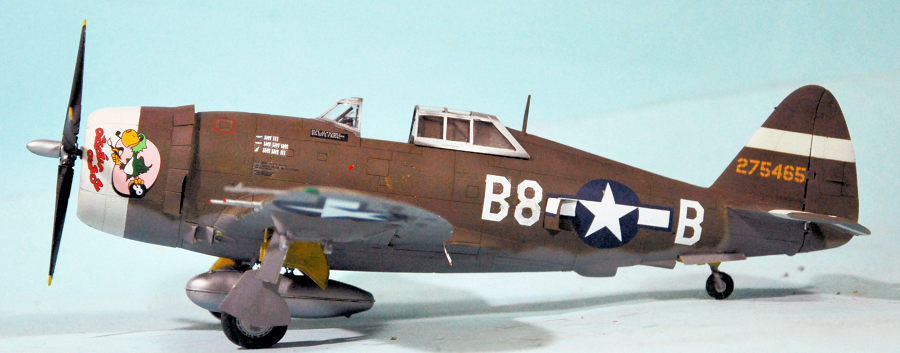
MiniArt 1/48 P-47D-11 Thunderbolt
| KIT #: | 48037 |
| PRICE: | $54.00 |
| DECALS: | Tw0 options |
| REVIEWER: | Tom Cleaver |
| NOTES: | 'Basic' release. Aeromaster decals |
| HISTORY |
400 P-47D-11RE Thunderbolts were built at Republic’s Farmingdale NY factory. They were powered by the 2,300 hp R-2800-63 engine with an improved GE C-23 supercharger introducdd with the P-47D-10. Additionally, the P-47D-11 had an automatic water injection procedure in place of the manual control of the previous blocks. This was the last P-47 sub-type produced without the underwing pylons that could carry either additional fuel or bombs, introduced on the following P-47D-15RE. The P-47D-11s serving with VIII Fighter Command were rapidly fitted with the pylon kits in the field followingt the arrival in England of the Dash-15 Thunderbolt in November 1944.
The 362nd Fighter Group arrived in the UK in early November 1943, and was assigned to VIII Fighter Command. In February 1944 - following the decision to equip VIII Fighter Command with the longer-ranged P-51B while new P-47-equipped groups would go to the newly-arrived Ninth Air Force where they would be used as fighter-bombers in support of the American armies in the invasion of Europe - the 362nd FG was transferred to the Ninth Air Force, though they went on operations in late February and continuing through March flying escort missions for VIII Bomber Command in the Operation Pointblank, the Eighth Air Force campaign against the Luftwaffe.
 In April
1944, with all P-47s in the group now equipped with the underwing pylons,
the 362nd group’s 377th, 378th and 379th Fighter Squadrons began taking part
in the Ninth Air Force’s pre-invasion campaign against the road and rail
transport systems in northwest France.
In April
1944, with all P-47s in the group now equipped with the underwing pylons,
the 362nd group’s 377th, 378th and 379th Fighter Squadrons began taking part
in the Ninth Air Force’s pre-invasion campaign against the road and rail
transport systems in northwest France.
A notable member of the 379th squadron was Captain George W. “Dad” Rarey, so nicknamed because at age 27, he was one of the oldest pilots in the squadron. “Rarey” - as he was known to friends and family - had a successful pre-war career in New York City as a commercial artist and cartoonist, before he joined the USAAF in February 1942. He was one of the original pilots in the 379th FS when the 362nd group was formed in February 1943. In one of his letters he wrote his wife during flight training, he said:
“When the whole world beneath you looks like a patchwork quilt, it’s a little difficult to know just where you are and what direction you are flying in relation to the airport. You must also be continually aware of what direction the wind is in.
“Now for a guy who invariably comes out of subways in the wrong direction and can’t even navigate himself through Greenwich Village without getting lost, this can be tough!”
“So funny, all my life I’ve avoided routine, ordered procedure and mental discipline and these are the very qualities that are most important in a good flyer”.
Given his artists background, Rarey became the squadron artist, and created some of the most distinctive noseart of any fighter squadron in the ETO. His particular specialty was a cartoon parrot character called the “Rareybird,” which appeared in many guises on the noses of the Thunderbolts.
Rarey was a notable pilot and a born leader. Squadron commander Lt. Colonel Joe McLaughlin made him a flight commander soon after the squadron went on operations.
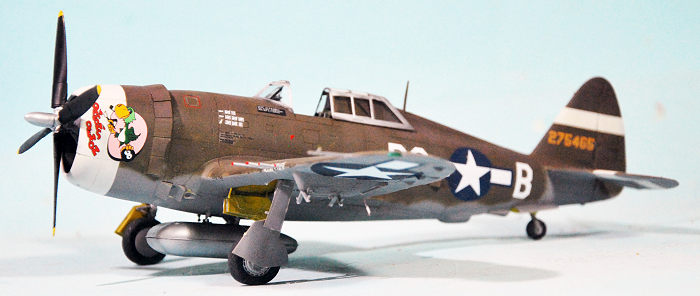
Receiving notice that his son Damon had been born on March 18, 1944, Rarey painted special artwork on his P-47D-11RE 42-275465 of a Rareybird carrying an artists palette and paintbrushes, smoking Rarey’s pipe, with the aircraft named “Damon’s Demon.”
 By D-Day,
Rarey was a solid veteran as a fighter-bomber pilot, He and the rest flew
every day the weather in the rainy summer of 1944 allowed.
By D-Day,
Rarey was a solid veteran as a fighter-bomber pilot, He and the rest flew
every day the weather in the rainy summer of 1944 allowed.
On June 27, 1944, Captain Rarey was leading his flight on a search and destroy mission over Normandy. The mission had been fruitless until - just before they would turn around and return to base - the Thunderbolts were over the village of Villers- Bocage. They spotted a truck carrying about 40 German soldiers, and decided to make it their target. As they rolled in on the target, they quickly realized they had attacked a flak trap when several 20mm Flak 38 anti-aircraft guns opened up on the diving P-47s. All four were hit, but George Rarey took a direct hit in his engine and cockpit; he was likely immediately killed, then the Thunderbolt blew up in midair and crashed. The men in the 379th considered his death the worst thing that happened to them in the war, quite an achievement in a fighter group that had 70 pilots KIA btween D-Day and V-E Day. Captain George Rarey is now buried at the Normandy American Cemetery, in Colleville-sur-Mer, Plot F, Row 14, Headstone 25.
Damon Rarey grew up to follow the father he never knew into art. He was graphics director for Hugh Down’s PBS talk show “Over Easy,” before becoming involved with the development of Dr. Ricghard Shoup’s SuperPaint computer program. Out of this he became a pioneer of computer animation one of the original pioneers in the creation of computer animation. He was one of the first people I befriended on the net when I went online in 1996. In September 2002 he experienced a “vertigo-like” ever. He died two months later on December 15, 2002 of Kreuzfeldt-Jakob Disease, a variant of “mad cow disease”.
Chris Bucholz, who also became a friend of Damon’s was able to produce a decal of “Rarey Art” on 379th FS P-47s for the 1998 IPMS-USA Nationals. I’ve finally used my sheet to do this a pilot and fellow artist I never met but was greatly impressed by.
| THE KIT |
 After producing
just about every sub-type of the bubbletop P-47, Mini-At of Ukraine released
this P-47D-11RE at the end of June this year.
After producing
just about every sub-type of the bubbletop P-47, Mini-At of Ukraine released
this P-47D-11RE at the end of June this year.
The kit also features their superb surface detail, which looks very much like what I have seen among the P-47s that have been resident at different times over the years out at Planes of Fame. Different detail parts - like the underwing pylons - specific to the D-11 are included on separate sprues.
The kit art includes a Rarey - the P-47D-11 flown by Lt. Ted Jensen in the 379th shortly before D-Day - as well as Captain Mike Quirk’s P-47D-11 62nd Fighter Squadron of the 56th fighter Group.
| CONSTRUCTION |
These notes from the first Mini-Art P-47 I built two years ago are still relevant for this new released:
Like all other modern kits designed with CAD, parts fit is very precise, and a modeler must be certain all mating surfaces are “as clean as a hound’s tooth” to avoid cascading fit problems in construction. The kit is detailed with lots more pieces than the Tamiya kit has, and a modeler is well-advised to take the revolutionary act of reading and following the instructions; they are not “somebody’s opinion.”
Construction starts with the cockpit, which is much more detailed than the Tamiya kit. I painted the main parts with Tamiya Dark Green (RLM-70) a good replacement for Dull Dark Green, then painted all the other small parts before assembling them. I departed from a fully OOB build by using Eduard seatbelts. Once the cockpit was assembled, I installed it in the right fuselage half and proceeded to assemble the other detail parts for the fuselage, then glued the two halves together. Fit is so tight that all I had to do to lose the centerline seam was a light scrapedown, followed by rescribing rivet detail across the seam with my pounce wheel.
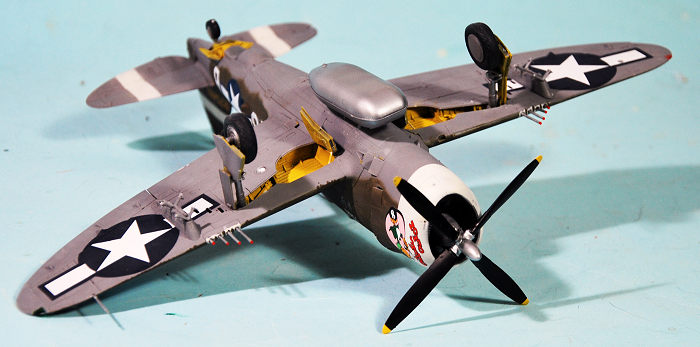
 The gear well
in each wing is made up of individual pieces. I painted these Yellow Zinc
Chromate. Unlike the Tamiya kit, the gun barrel assembly is attached at this
point before further assembly. Several of the Psychic Kit Reviewers over at The
World’s Most Wonderful Modeling Site, who are able to suss out all the failings
of a new kit without ever having to open an actual kit and assemble it, have
declared these gun barrels are unacceptable because they are not “horizontal to
the ground” in the wing as they should be; however, when I finished the assembly
of the wings, the gun barrels were magically in the proper position.
The gear well
in each wing is made up of individual pieces. I painted these Yellow Zinc
Chromate. Unlike the Tamiya kit, the gun barrel assembly is attached at this
point before further assembly. Several of the Psychic Kit Reviewers over at The
World’s Most Wonderful Modeling Site, who are able to suss out all the failings
of a new kit without ever having to open an actual kit and assemble it, have
declared these gun barrels are unacceptable because they are not “horizontal to
the ground” in the wing as they should be; however, when I finished the assembly
of the wings, the gun barrels were magically in the proper position.
All the control surfaces are separate, and the flaps cannot be dropped; this is actually the proper way they should be. Several pilots in the 78th group who I interviewed for my books told me that the fine for not raising flaps immediately after touchdown was 10 Pounds - $70 out of a 2nd Lieutenant’s pay at the time of $250; as one said, “you only forgot once.”
The wings do not have carry-through spars like the Tamiya kit, but the extended spar on each side will help align them properly and the part design won’t allow a close fit without the wing being properly aligned. If you are going to have the underwing pylon and the rocket tubes, be sure to open the alignment holes before gluing the wing halves together.
The R-2800 engine in the kit is the best I have seen as an injection-molded plastic part. There is more detail in the engine and the assembly of the cowling than in any earlier kit. For this kit, one only uses the two piston rings and the front parts of the engine, leaving the very complete exhaust system on the sprue since that is for the “advanced” kit. I had no problem assembling the engine cowling accurately, following the kit instructions as to the sequence of attachment.
| COLORS & MARKINGS |
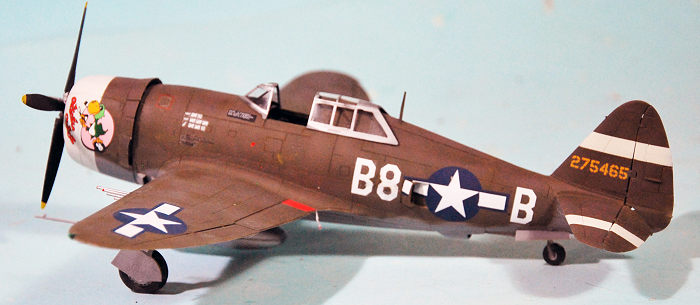
I decided to do “high altitude weathering” as was experienced by most airplanes flying in northwest Europe, where the sun mostly shined above the cloud decks. This was all done with post-shading rather than pre-shading.
I painted the lower surfaces with Tamiya LP-89 “Medium Air Gray,” which is “Neutral Gray. I went over the surfaces twice with addition Light Grey and then White added in to change the surface color.
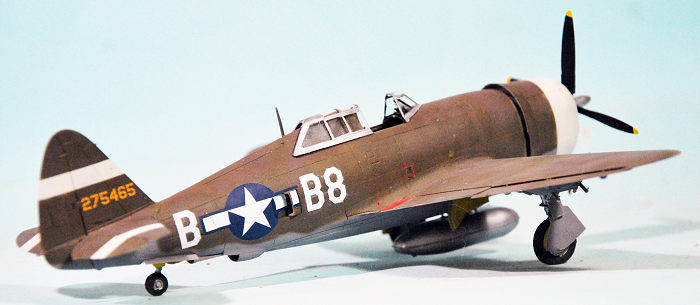 I used Mr.Color
Aqueous acyllic H-52 “Olive Drab (1)” as the base color for the upper surface. I
then added in a bit of Light Gray and thinned some more, then went over the
surfaces. I then added in Tamiya “Dull Red” LP-18, and a very small bit of
Tamiya X-6 “Purple,” thinned some more and went over the surface to bring up the
“UV fading.” I followed that with a bit more Light Grey and more thinner, and
went over the surfaces most exposed to the sun. The result is, I think, a pretty
good rendition of “UV-faded OD”.
I used Mr.Color
Aqueous acyllic H-52 “Olive Drab (1)” as the base color for the upper surface. I
then added in a bit of Light Gray and thinned some more, then went over the
surfaces. I then added in Tamiya “Dull Red” LP-18, and a very small bit of
Tamiya X-6 “Purple,” thinned some more and went over the surface to bring up the
“UV fading.” I followed that with a bit more Light Grey and more thinner, and
went over the surfaces most exposed to the sun. The result is, I think, a pretty
good rendition of “UV-faded OD”.
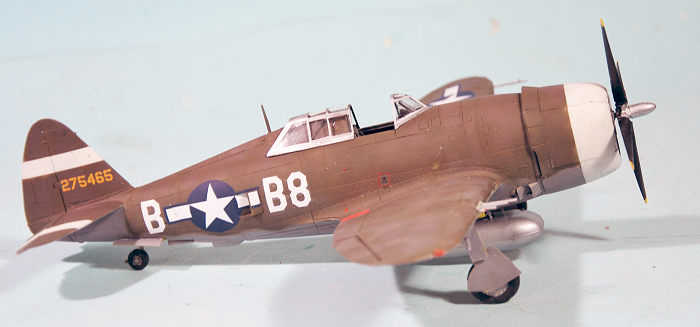
The decal sheet has the airplane as it most likely looked the day Rarey was shot down, with full D-Day striping. I found a photo in “Thunderbolts Triumphant” of Rarey and Joe mcLaughline taking off in May 1944, and decided to do that. I did paint the canopy aluminum, thus placing the airplane after the May 23 mission, when they caught a lot of light flack and “Damon’s Demon” took some hits and got the plexiglass holed, with the canopy and windshiled replaced with unpainted parts. I used the kit’s national insignia markings. I’m glad I decided to put the 1998 Nats sheet to use now, because even with very hot water it took quite a while to coax the decals off the sheet.
I attached the landing gear and prop, and unmasked the caopy parts and attached them. I then declared victory and put the model on the P-47 shelves.
| CONCLUSIONS |
I think the Mini-Art P-47s are the best out there. They are more fiddly than the Tamiya kits, the same way the Eduard P-15s are when compared to the Tamiya kits. The end result is more finely detailed.
If you are going to order kits from Ukraine, you had best do so over this next week, so that the kits can be shipped before September 1. On that date, the Idiot’s Crazy Tariff scheme starts not working. DeMinimums ordering (what we have done for as long as we have been buying kits overseas) will no longer be in effect, and there will be a “Standard Tariff” of approximately $100 PER ORDER imposed on model stuff coming from Europe. Hannant’s has already announced they are not shipping to the U.S. AS OF September 1, and several other smaller companies in Europe have made similar announcements. Adding $100 per kit to the price of anything coming from Ukraine will effectively kill the most interesting and “bleeding edge” kit industry. Similar tariffs will be in effect for orders from Japan. Welcome to “America Alone.” I hope you have a good stash, because that’s what you get to model from for the forseeable future.
Review kit courtesy of you book buyers. Better order them quick, too.
22 August 2025
Copyright ModelingMadness.com. All rights reserved. No reproduction in part or in whole without express permission of the editor.
If you would like your product reviewed fairly and fairly quickly, please contact the editor or see other details in the Note to Contributors.
Back to the Main Page Back to the Review Index Page Back to the Previews Index Page