| KIT #: | 11185 |
| PRICE: | $97,95 SRP (can be found for less) |
| DECALS: | Ten options |
| REVIEWER: | Tom Cleaver |
| NOTES: | Dual Combo boxing |
| HISTORY |
The Aleutian Tigers:
Six days after the Pearl Harbor attack, on December 13, 1941, Major John Chennault left Selfridge Field, Michigan, headed for McClellan Army Air Depot in Sacramento, California, at the head of 24 Army Air Forces would-be fighter pilots. Their orders were to pick up Curtiss P-40Es and head for Alaska to join the 18th Pursuit Squadron and provide air defense for the territory. At McClellan, they found half the P-40Es were still “pickled.” After raising hell, the technicians at the air depot worked around the clock to prepare the Warhawks, and by the first week in January 1942, they were ready. As Chennault later recalled, “We started out in January, 1942, and the situation was like this: my three flight commanders each had less than eight months’ experience since graduating flight school; 18 of my younger pilots averaged less than 8 hours apiece on the P-40, the others had less than three.”
 Two of the P-40s
were out of action before the group got out of California, with five more lost
enroute to their destination at Fairbanks, Alaska. Once there, they found
conditions were worse than “primitive.” Chennault recalled: “This was the first
time modern fighters had operated in Alaska and the airfields were nothing but
cleared spaces in the wilderness. We fueled our planes from drums with pumps,
slept in crude huts and froze all the time.”
Two of the P-40s
were out of action before the group got out of California, with five more lost
enroute to their destination at Fairbanks, Alaska. Once there, they found
conditions were worse than “primitive.” Chennault recalled: “This was the first
time modern fighters had operated in Alaska and the airfields were nothing but
cleared spaces in the wilderness. We fueled our planes from drums with pumps,
slept in crude huts and froze all the time.”
By June 3, 1942, the pilots had come to understand that flying conditions were terrible throughout Alaska, a part of the world that could lay claim to some of the worst weather conditions anywhere: dense fogs that arrived without warning and “williwaws,” high winds that arrived with intense winter cold. Mechanical items showed unusual behavior at 40 degrees below zero. Oil became almost solid, metal and rubber became brittle and fractured easily. The “airfields” were little more than muddy clearings, while the long distances between rudimentary air bases coupled with the complete absence of aerial navigation aids made what flying was possible nearly impossible and certainly dangerous at all times.
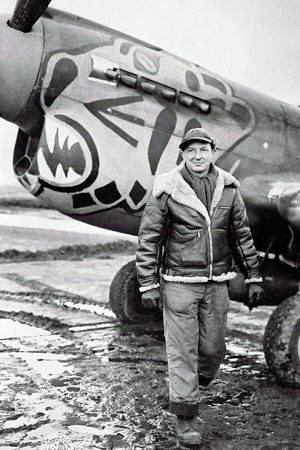
In April 1942, Life Magazine published a major publicity article by Claire Boothe Luce about the “Flying Tigers,” the American Volunteer Group commanded by John Chennault’s father. As a result, the 11th Pursuit Squadron decided to call themselves the “Aleutian Tigers,” and a distinctive tiger design was created as their insignia, worn on the noses of the P-40Es. As with the Tiger markings of the AVG, no two of these were exactly the same.
 As part of
the attack on Midway Island, a carrier-based Japanese task force centered around
the light carriers Junyo and Ryujo was sent to attack Alaska and invade two
islands in the Aleutian chain, Attu and Kiska. On June 3, 1942, the carriers
attacked Fort Mears and Dutch Harbor. P-40s were scrambled from Fort Randall,
but the Japanese were gone by the time they reached Dutch Harbor. On June 4, the
Japanese again hit Dutch Harbor, but the P-40s were ready and one bomber was
shot down. Unknown at the time, the anti-aircraft fire also holed the gas tank
of one of the escorting Zeros, which would crash land on Akutan Island to become
one of the most valuable prizes of the war when it was discovered and brought to
the United States to be exhaustively test-flown.
As part of
the attack on Midway Island, a carrier-based Japanese task force centered around
the light carriers Junyo and Ryujo was sent to attack Alaska and invade two
islands in the Aleutian chain, Attu and Kiska. On June 3, 1942, the carriers
attacked Fort Mears and Dutch Harbor. P-40s were scrambled from Fort Randall,
but the Japanese were gone by the time they reached Dutch Harbor. On June 4, the
Japanese again hit Dutch Harbor, but the P-40s were ready and one bomber was
shot down. Unknown at the time, the anti-aircraft fire also holed the gas tank
of one of the escorting Zeros, which would crash land on Akutan Island to become
one of the most valuable prizes of the war when it was discovered and brought to
the United States to be exhaustively test-flown.
The Attu-Kiska Campaign now began as the Japanese occupied these two islands on June 7, 1942. It would last more than a year before the Japanese were expelled from the two most westerly islands in the Aleutian archipelago, their only conquests of American territory.
Air raids against the main base on Kiska began in July, 1942. Operations were difficult, due to the extreme weather in the Aleutians, and many missions were scrubbed or aborted due to weather throughout the campaign. On August 30th, US Army troops landed on Adak in a howling gale. By September 10, a PSP runway had been constructed and the fighter force, by now expanded from the 95 P-40s on hand June 4 to include a squadron of P-39s and another of P-38s, began moving forward to bring Attu and Kiska within range. The first raid, a strafing attack by P-38s, P-39s and P-40s led by Major Chennault, hit Attu on September 11, 1942.
On September 25, 1942, nine B 24 Liberators, 12 P-39 Airacobras and 20 P 40 Warhawks attacked Kiska. Four of the P-40s were flown by RCAF pilots from 111 (Fighter) Squadron, RCAF, in company with the 16 P-40s of the 11th Fighter Squadron (as the 11th PS had been renamed in May), now part of the newly-formed 343rd Fighter Group.
Taking off from the forward airstrip in Adak Island just before noon, the raiders attacked gun positions, ships, a radar installation and the main camp, with the P-39s using their heavy armament for strafing.
Two A6M2-N “Rufe” floatplane fighters attempted to attack the P-40 escorts. RCAF Squadron Leader Ken Boomer attacked the leader and shot it down in flames, the only “home” victory scored by an RCAF pilot outside of the European and Mediterranean Theaters. Major Chennault shot down the wingman a moment later. For his action, Squadron Leader Boomer was awarded the U.S. Air Medal and the British DFC.
In January 1943, Amchitka Island was occupied and a new air base constructed, which allowed attacks against Kiska to begin that February.
Eventually, on May 11, 1943, an American invasion force of 12,000 troops attacked Attu and faced fanatic Japanese resistance in an 18 day battle in which the Japanese lost 2,380 dead and 28 taken prisoner. American losses were 552 dead and 1,140 wounded. This was the first action by what would become the 10th Mountain Division. The costly victory boded ill for the invasion of Kiska. On July 27, 1943, a USN battleship task force began softening up the fog-shrouded target. When a force of 34,000 U.S. and Canadian troop finally landed on August 15, they discovered the Japanese had abandoned the island, evacuating 5,000 troops under cover of darkness on July 28.
The 343rd Fighter Group and its component squadrons were inactivated in August 1944, with the Japanese no longer a threat to Alaska.
| THE KIT |
 I am always
interested when Eduard brings out a new line of kits, to see how they advance
the kit production state of the art. From the merline-60 series Spitfires on,
each release has taken them to new heights of detail and accuracy. The new P-40s
do not disappoint. The surface detail is amazing, even more petite yet accurate
than the P-51Bs that preceded them. For those purists who say you cannot “see”
surface detail in 1/48 and why are they doing all those rivets, I will say from
the experience of having been around five different P-40s out at Planes of Fame
- P-40B, P-40E, P-40F, P-40M and P-40N - the only part of the P-40 airframe that
is flush rivited is the leading edge of the wing back to the mainspar. Raised
rivets predominate everywhere else, and they’re obvious from a distance of 15-20
feet in good light. This Eduard P-40 gets the surface detail right, as will
those that follow. They even get the difference between a P-40E and a P-40E-1,
providing the early non-protruding gun openings as well as the later, more
familiar, version.
I am always
interested when Eduard brings out a new line of kits, to see how they advance
the kit production state of the art. From the merline-60 series Spitfires on,
each release has taken them to new heights of detail and accuracy. The new P-40s
do not disappoint. The surface detail is amazing, even more petite yet accurate
than the P-51Bs that preceded them. For those purists who say you cannot “see”
surface detail in 1/48 and why are they doing all those rivets, I will say from
the experience of having been around five different P-40s out at Planes of Fame
- P-40B, P-40E, P-40F, P-40M and P-40N - the only part of the P-40 airframe that
is flush rivited is the leading edge of the wing back to the mainspar. Raised
rivets predominate everywhere else, and they’re obvious from a distance of 15-20
feet in good light. This Eduard P-40 gets the surface detail right, as will
those that follow. They even get the difference between a P-40E and a P-40E-1,
providing the early non-protruding gun openings as well as the later, more
familiar, version.
This kit takes things to a new level. The windscreen - like that of the P-51s, includes the fuselage surrounding it, and the rear panels are two part, over the rear fuselage, done along a panel line. In other words, no more gaps at the bottom of the clear parts, which are also molded so thin they are nearly as thin as the Squadron/Falcon P-40 vac canopies I have that have been de rigeur on all other P-40 kits aspiring to become accurate models. All parts, not just the clear ones, are joined on panel lines.
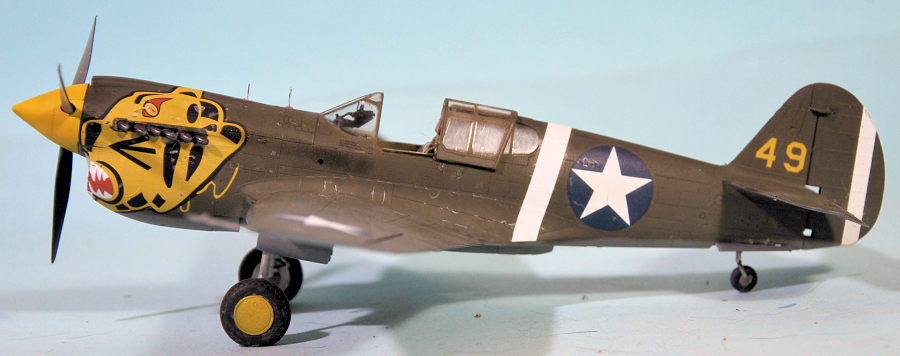
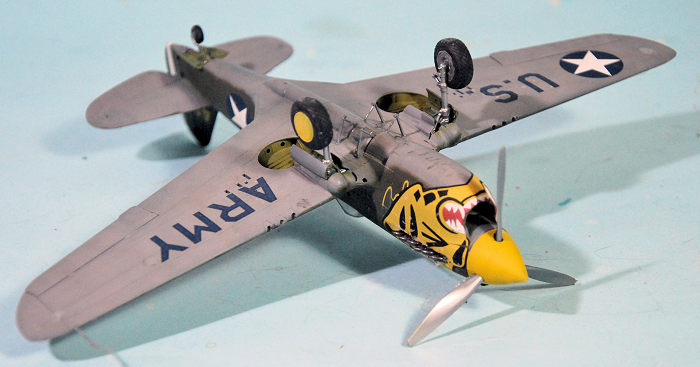
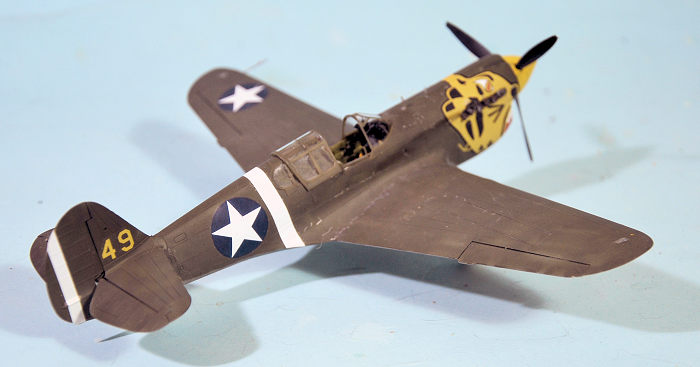
There are ten decal options that cover US P-40Es used in China, Darwin and New Guinea, and the Aleutians, plus RAAF Kittyhawks from the New Guinea campaign. I chose to do Major John Chennault’s “Aleutian Tiger.”
As usual, Eduard does 3d printed resin replacements for the cockpit parts, as well as offering wheels with alternative tire ribbing. I used the resin cockpit on this model, as well as the resin excaust stacks. I have to say they do not provide more detail in the parts to the plastic parts in the kit (as is the case with the P-51s), and are expensive enough that by not buyinfg them you can afford the single P-40E Profipack kit as well as this kit.
| CONSTRUCTION |
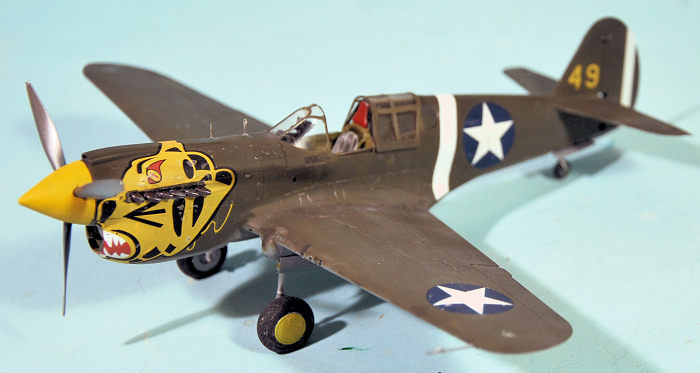 This
first kit is a “getting to know you” model. As is usual with Eduard
kits, MAKE THE REVOLUIIONARY DECISION TO FOLLOW THE DAMN INSTRUCTIONS.
They’re not “somebody’s opinion.” NOTE: When doing the P-40E “Aleutian
Tiger,” photos clearly show these aircraft were all early P-40E Warhawks
with the early gun opening in the wing.
This
first kit is a “getting to know you” model. As is usual with Eduard
kits, MAKE THE REVOLUIIONARY DECISION TO FOLLOW THE DAMN INSTRUCTIONS.
They’re not “somebody’s opinion.” NOTE: When doing the P-40E “Aleutian
Tiger,” photos clearly show these aircraft were all early P-40E Warhawks
with the early gun opening in the wing.
After separating the parts from their 3D “backing forests,” I painted them Interior Green, with other details painted per the instructions. I did use one of the LOOK instrument panels and those are always right.
I began assembly with with the cockpit, and the air over the modeling bench was soon a darkening shade of purple with hints of lightning bolts to come as I assembled the cockpit with CA glue that always ends up with half the parts being removed from my finger with nail polish remover to deal with the @#@!$$%#!!! cyanoiacrylate. Theres another good argument for using the plastic parts - Tamiya Ultra Thin never has this problem.
I assembled the radiator parts in the fuselage and glued the fuselage togther. Everything fit perfectly and all I had to do was scrape down the excess glue along the centerline.
I then assembled the wing, which was the essence of simplicity. After I brought the wing and fuselage together, I attached the horizontal stabilizers and the elevators and rudder. I let the model set up overnight.
| COLORS & MARKINGS |
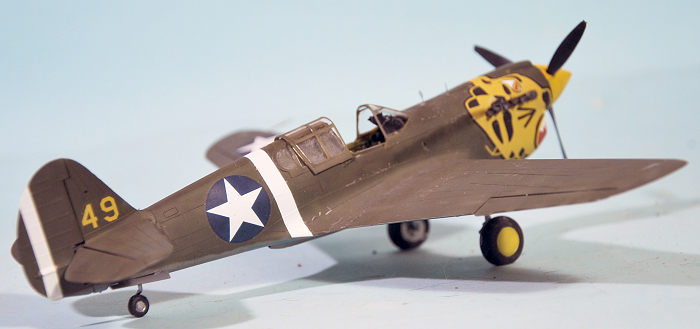 The model was
painted with Tamiya “Air Grey” LP-85, a good match for Neutral Grey, and Tamiya
acrylic XF-81 RAF Dark Green, which is an exact match for US OD 41 green base
Olive Drab (both colors are based on RAF PC 10 from World War I).
The model was
painted with Tamiya “Air Grey” LP-85, a good match for Neutral Grey, and Tamiya
acrylic XF-81 RAF Dark Green, which is an exact match for US OD 41 green base
Olive Drab (both colors are based on RAF PC 10 from World War I).
I used the kit decals, which went down under a few hits of MicroSol without problem. When all was set up, I painted the model with Micro Clear Flat.
I decided to have the airplane look like it would have shortly after the new squadron markings were applied, when the airplanes had still not been “dinged to death” on operations, creating a few dings with a silver pencil.
I unmasked the canopies and glued the sliding portion in the open position, then attached resin wheels with the diamond tread that photographs show the Aleutian Tuigers used. I attached the prop and declared victory.
| CONCLUSIONS |
Another winner from Eduard. This is the best P-40E kit of any scale. It is much less “fiddly” (other than assembling the cockpit which has a lot of small part detail) than previous Eduard kits, but is still appropriate for the more experienced modeler. I’ll be doing more of these, can’t wait for the RAF Kittyhawk release.
7 August 2025
Review kit courtesy of Eduard.
Copyright ModelingMadness.com. All rights reserved. No reproduction in part or in whole without express permission from the editor.
If you would like your product reviewed fairly and fairly quickly, please contact the editor or see other details in the Note to Contributors.