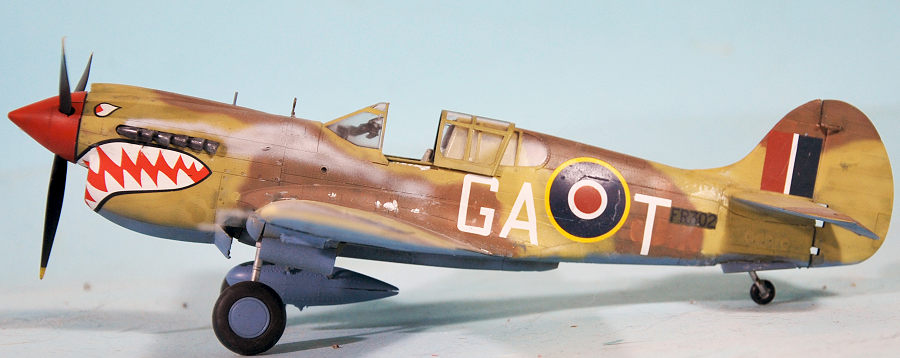
Eduard 1/48 Kittyhawk III
| KIT #: | 82241X |
| PRICE: | $24.95 |
| DECALS: | None (overtrees boxing)options |
| REVIEWER: | Tom Cleaver |
| NOTES: | Tail from AMT kit. Aeromaster decals |
| HISTORY |
The P-40K series marked the introduction of the more powerful Allison V-1710-73 (F4R) engine rated at 1,325 hp for takeoff and 1,150 hp at 11,800 feet. This engine had an automatic boost control.
On October 28, 1941, 600 P-40Ks were ordered for Lend-Lease supply to China. It was envisaged that this would be the last P-40 model to be built in quantity, the P-60 replacing the P-40 on the Curtiss production lines thereafter. However, delays in the P-60 program caused the order for P-40Ks to be increased to a total of 1300 aircraft on June 15, 1942. The first P-40K model rolled off the production line in August 1942. For some odd reason, the company model number used for the P-40K is unknown.
 The P-40K-1-CU and
P-40K-5-CU were generally similar to late-production P-40Es except for the more
powerful Allison engine. The K-5 added rotary valve cooling. The K-1 and K-5
retained the short fuselage of the P-40E, but with the extra power there was a
tendency to swing during takeoff and a dorsal fin was added to correct this
problem. The P-40K-10s and later production blocks had the longer fuselage that
was introduced on the P-40F-5-CU. The P-40K-15-CU was winterized.
The P-40K-1-CU and
P-40K-5-CU were generally similar to late-production P-40Es except for the more
powerful Allison engine. The K-5 added rotary valve cooling. The K-1 and K-5
retained the short fuselage of the P-40E, but with the extra power there was a
tendency to swing during takeoff and a dorsal fin was added to correct this
problem. The P-40K-10s and later production blocks had the longer fuselage that
was introduced on the P-40F-5-CU. The P-40K-15-CU was winterized.
The P-40Ks maximum speed was 320 mph at 5,000 feet and 362 mph at 15,000 feet. A climb to 15,000 feet took 7.5 minutes. Range was 350 miles with a 500-pound bomb attached. Ferry range was 1,600 miles. Weight was 6,400 pounds empty, 8,400 pounds gross, and 10,000 pounds maximum. Most P-40Ks served with the USAAF units the CBI and the Pacific and under Lend-Lease with the Chinese Air Force. 192 P-40K-1-CUs were diverted to Britain under Lend-Lease as Kittyhawk III. RAF serials were FL875/FL905, FR111/FR115, FR210/FR361, and FL710/FL713. The first examples were delivered to the Middle East in late 1942. They served on operations with units of the Desert Air Force in North Africa and Italy until 1944, when they and other Kittyhawk IV aircraft were replaced by the Mustang IV.
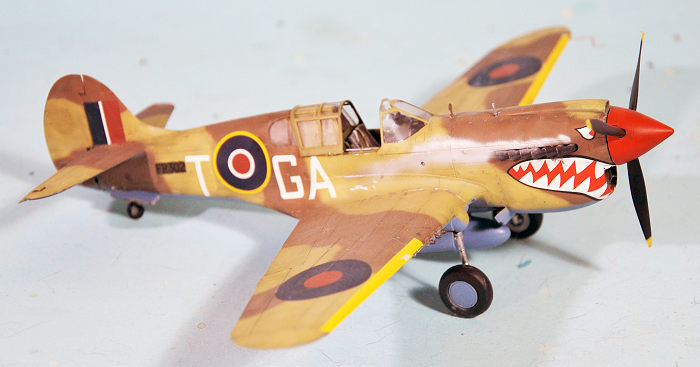
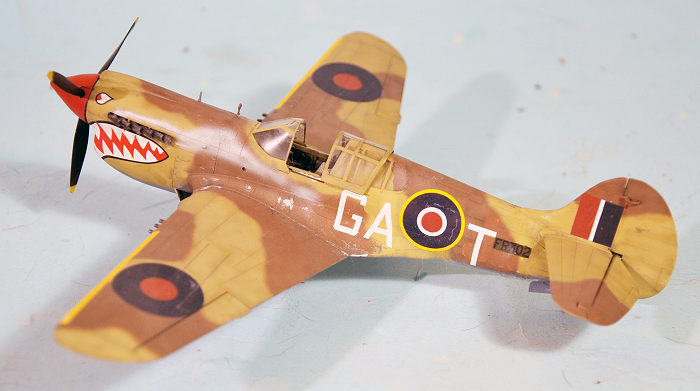
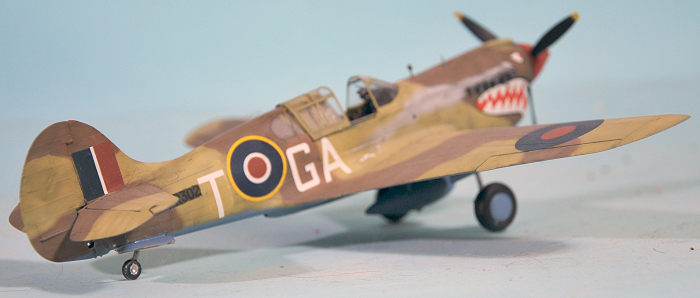
The Kittyhawk III’s last aerial combat of the war took place on August 7, 1944, over Reiti in northern Italy. Flt Lieutenant Neville Ahrens, flying FR474 GA-Jinx and F/Sgt Peters in FR302 GA-T - both from 112 “Shark” Squadron - were on patrol and encountered a formation of FW-190's. F/Sgt Peters blew one of the enemy aircraft to pieces while Flt Lieutenant Ahern inflicted damage to several others. After a spirited engagement Ahern took hurried stock of the damage done to his Kittyhawk and found to his dismay that the airspeed indicator and half the starboard elevator had been shot away. There was a hole clean through the port mainplane 36 inches long by 18 inches wide. There was also a gap in the rudder big enough to allow a pair of fists through, while the left horizontal stabilizer and aileron were also holed. Ahern's achievement in getting his aircraft back to base, a matter of a 100 mile flight, is a striking illustration of just how much punishment a Kittyhawk can take.
| THE KIT |
 I am always interested
when Eduard brings out a new line of kits, to see how they advance the kit
production state of the art. From the merline-60 series Spitfires on, each
release has taken them to new heights of detail and accuracy. The new P-40s do
not disappoint. The surface detail is amazing, even more petite yet accurate
than the P-51Bs that preceded them. For those purists who say you cannot “see”
surface detail in 1/48 and why are they doing all those rivets, I will say from
the experience of having been around five different P-40s out at Planes of Fame
- P-40B, P-40E, P-40F, P-40M and P-40N - the only part of the P-40 airframe that
is flush riveted is the leading edge of the wing back to the mainspar. Raised
rivets predominate everywhere else, and they’re obvious from a distance of 15-20
feet in good light. This Eduard P-40 gets the surface detail right, as will
those that follow. The Overtrees kit only includes the plastic trees, without
decals or instructions.
I am always interested
when Eduard brings out a new line of kits, to see how they advance the kit
production state of the art. From the merline-60 series Spitfires on, each
release has taken them to new heights of detail and accuracy. The new P-40s do
not disappoint. The surface detail is amazing, even more petite yet accurate
than the P-51Bs that preceded them. For those purists who say you cannot “see”
surface detail in 1/48 and why are they doing all those rivets, I will say from
the experience of having been around five different P-40s out at Planes of Fame
- P-40B, P-40E, P-40F, P-40M and P-40N - the only part of the P-40 airframe that
is flush riveted is the leading edge of the wing back to the mainspar. Raised
rivets predominate everywhere else, and they’re obvious from a distance of 15-20
feet in good light. This Eduard P-40 gets the surface detail right, as will
those that follow. The Overtrees kit only includes the plastic trees, without
decals or instructions.
| CONSTRUCTION |
 As is usual with Eduard
kits, MAKE THE REVOLUTIONARY DECISION TO FOLLOW THE DAMN INSTRUCTIONS. They’re
not “somebody’s opinion.”
As is usual with Eduard
kits, MAKE THE REVOLUTIONARY DECISION TO FOLLOW THE DAMN INSTRUCTIONS. They’re
not “somebody’s opinion.”
After the experience of the Aleutian Tiger, I was happy to limit myself to the plastic parts for the cockpit, which were prepainted before assembly and offered no difficulty in assembly. Once the radiator parts were in the nose, it was time to close up the fuselage.
I modified the kit to a P-40K-1 by using the vertical fin from an Italerei release of the AMT P-40E kit with the alernative tail. This was easily done, and the fit between this vertical fin and the area on the Eduard fuselage created no problems. I ecided to do this conversion because there is no word from Eduard if they are going to do another P-40kit once they release the P-40F.
I then assembled the wing, which was the essence of simplicity. After I brought the wing and fuselage together, I attached the horizontal stabilizers and the elevators and rudder. I let the model set up overnight.
| COLORS & MARKINGS |
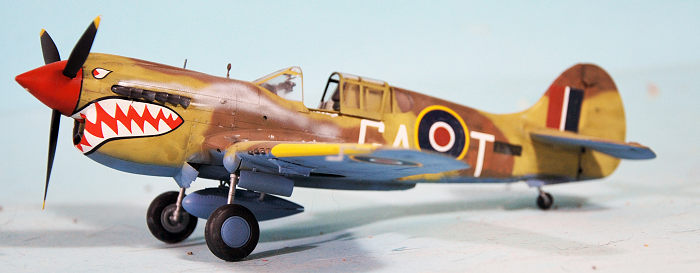 I used Mr. Color C22,
“Dark Earth,” Mr. Color C21 “Middlestone,” and Mr. Color C370 “Azure Blue” for
the RAF desert scheme which was freehanded. I used Tamiya X-4 “Flat Yellow” for
the wing leading edge stripe.
I used Mr. Color C22,
“Dark Earth,” Mr. Color C21 “Middlestone,” and Mr. Color C370 “Azure Blue” for
the RAF desert scheme which was freehanded. I used Tamiya X-4 “Flat Yellow” for
the wing leading edge stripe.
I used decals from the Aeromaster “Sharks Over The Mediterranean” sheet.
I used silver pencils to apply weatherinto to the airframe, painted the exhaust stain grey for a lean mixture, I then attached the landing great and prop, unmasked the cockpit glass and attached the canopy open.
| CONCLUSIONS |
I hope Eduard will release this sub-type, but if they don’t and you have one of the AMT kits with this tail, it is an easy conversion.
Review kit courtesy of you book buyers.
Tom Cleaver
11 September 2025
Copyright ModelingMadness.com. All rights reserved. No reproduction in part or in whole without express permission.
If you would like your product reviewed fairly and fairly quickly, please contact the editor or see other details in the Note to Contributors.