| KIT #: | |
| PRICE: | $ |
| DECALS: | Two options |
| REVIEWER: | Tom Cleaver |
| NOTES: |
| HISTORY |
All of the World War II high performance fighters really needed a two-seat converstion training version, since the “step up” from a Miles Magister or a T-6 was a “big one” for the average wartime-trained pilot, requiring that the first flight be a solo. The accident record in training proves this need, particularly as the war continued and the training cycles were reduced and sped up. The Luftwaffe recognized that the average pilot trainee in 11944-45 desperately needed the opportunity of further instruction in the Bf-109 and Fw-190 before being turned loose solor; the Bf-109G-12 and Fw-190S-8 were converted from already-produced airframes to meet this need.
The Red
Air Force - whose poorly-trained pilots were in even greater need than the
Luftwaffe trainees - created two seat conversion trainers for nearly every
one of their wartime fighters, with 2-seat I-16UTI, Yak-7UTI, La-5UTI
trainers. This was carried forward post war with 2-seat versions of the
MiG-15 and MiG-21.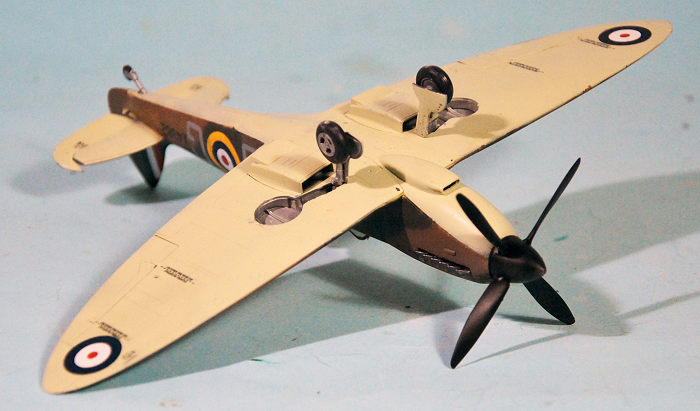
In the USAAF, while the need was recognized, it was never filled during the war. A two-seat conversion of the Thunderbolt - the TP-47G - was developed and flown, but no further action was taken. The P-51D finally saw a two-seat conversion trainer created in the early 1950s for ANG units, which saw use in Latin American air forces that received Mustangs.
Although there were wartime conversions of the Spitfire into a two-seat trainer including the one-off modification of a Mk Vc by 261 Squadron and a Mk IX converted for use as a trainer by the Soviets, the two-seat Spitfire trainer was primarily a postwar development. In 1946, a Mk VIII (MT818) was the first Vickers-built trainer built as a demonstrator; in 1948, ten Spitfire T Mk IXs, were exported to India. In 1951, a further six TR 9 trainers were converted from the standard Mk IX to train pilots for the Irish Air Corps (IAC) Seafire fleet. The Spitfires provided transition training that included gunnery practice since the type was equipped with two .303 Browning machine guns, one in each outer wing bay. Most of the TR 9 aircraft passed to the ground technical training school at Baldonnel where they were used as instructional airframes for the training of aircraft engineers for the Air Corps. Four of the IAC aircraft survived and two went on to join the warbird fleet in the UK during the1970s and later.
T.9s have also been built by British restoration shops, and the two-seat Spitfires are almost ubiquitous in the UK, where they are used to provide flight experiences (for eye-watering prices) to Spitfire enthusiasts, and training for those who become restored Spitfire owners. Most are painted to represent wartime airframes.
| THE KIT |
The T.9 has been available as a resin conversion set in 1/48 made over the years by two different companies whose names I do not recall, for serious Spit Boffins to put in their collections. There have also been a couple 1/72 limited run kits of the Spitfire trainer. This kit by Airfix is both the first of this sub-type by a mainstream model company, and the first to modern mainstream kit standards in 1/48.
 This is
perhaps the most advanced kit Airfix has released, with detail that is fully
up to comtemporary standards. The surface detail is so close to what Eduard
does with their Spitfire kits that a built-up Tr-9 placed next to Eduard
Spitfires could be mistaken for a product of that company. The Airfix kit
simplifies several of the parts that are “fiddly” in the Eduard kits, like
the cockpit interior, the main gear and wells, and the placement of the
exhaust stacks. Modelers who have steered away from Eduard kits for their
alleged “fiddliness” will find none of that here. Also, the clear parts are
hugely superior to previous Airfix Spitfire kits, being as thin as Eduard
clear parts.
This is
perhaps the most advanced kit Airfix has released, with detail that is fully
up to comtemporary standards. The surface detail is so close to what Eduard
does with their Spitfire kits that a built-up Tr-9 placed next to Eduard
Spitfires could be mistaken for a product of that company. The Airfix kit
simplifies several of the parts that are “fiddly” in the Eduard kits, like
the cockpit interior, the main gear and wells, and the placement of the
exhaust stacks. Modelers who have steered away from Eduard kits for their
alleged “fiddliness” will find none of that here. Also, the clear parts are
hugely superior to previous Airfix Spitfire kits, being as thin as Eduard
clear parts.
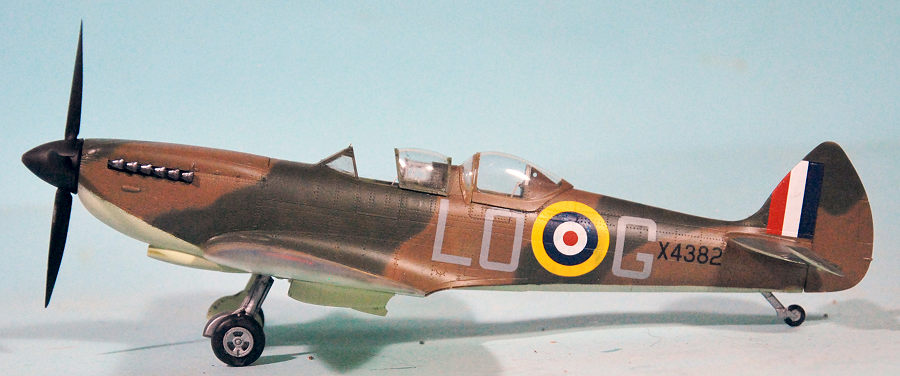
Decals are provided for two postwar restorations of IAC Spitfire trainers - one used in 1967-68 as the aerial photo plane for the making of “The Battle of Britain,” and the other a contemporary restoration as an IAC trainer - the giveaway is that it carries the modern Irish orange/green insignia, rather than the orange/green/white insignia of the 1950s, which was also smaller than that here. Fortunately, Hannant’s has announced they are producing an aftermarket decal sheet for this kit that includes operational markings for the various air forces that used the T.9, which should be available this fall and can be put on pre-order at their website now.
| CONSTRUCTION |
Airfix provides what are probably the best instruction sheets by any model company - they are very modeler-friendly, with each stage of construction clearly identified and illustrated. If you commit the revolutionary “guy act” of following the instructions, you’ll be rewarded with a perfect model.
I particularly liked the new landing gear legs, which are like what is found in the Eduard Spitfires and is both much stronger and less fiddly than what one finds in the box of earlier Airfix Spitfires.
 I painted
all the interior parts and then assembled them to the side pieces while
everything was still on the sprue tree. Then I followed Airfix’s
instructions for assembly. I used Eduard “Q harnesses” since these are
totally-postwar airplanes.
I painted
all the interior parts and then assembled them to the side pieces while
everything was still on the sprue tree. Then I followed Airfix’s
instructions for assembly. I used Eduard “Q harnesses” since these are
totally-postwar airplanes.
The wing and fuselage sub assemblies came together easily, with no putty needed anywhere, and were then joined. I followed that with the horizontal stabilizers, elevators and rudder, which were posed “dynamically.”
The entire process of painting, detailing the interior, and assembly was done over a Saturday I managed to play hookey away from the next book and other writing.
| COLORS & MARKINGS |
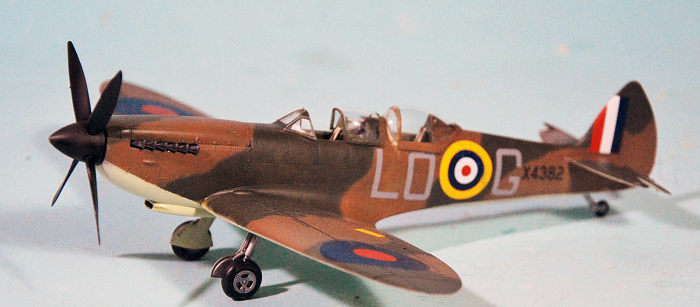 I googled
“photos of Spitfire T.9" and got nice color photos of contemporary warbirds.
I chose this scheme because as I looked at the photo, I realized I had seen
the markings on an Airfix decal sheet that was still in the decal dungeon.
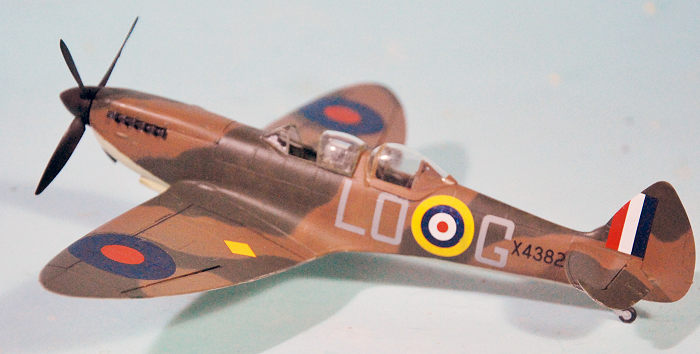
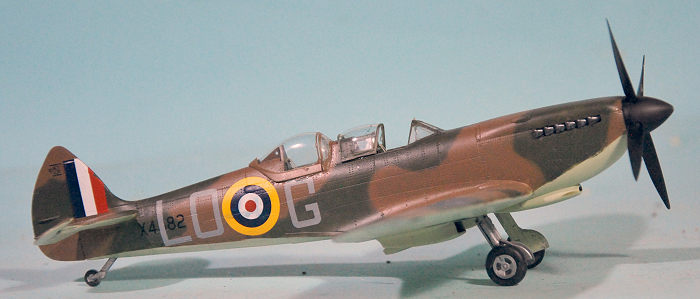
So this is a 1/48 replica of a 1:1 “Airfix Spitfire”. I used Mr. Color
paints for RAF Dark Earth, RAF Dark Green and RAF Duck Egg Blue, with the
pattern applied freehand.
I googled
“photos of Spitfire T.9" and got nice color photos of contemporary warbirds.
I chose this scheme because as I looked at the photo, I realized I had seen
the markings on an Airfix decal sheet that was still in the decal dungeon.
So this is a 1/48 replica of a 1:1 “Airfix Spitfire”. I used Mr. Color
paints for RAF Dark Earth, RAF Dark Green and RAF Duck Egg Blue, with the
pattern applied freehand.
The Airfix decals went down with a minimum of hassle under a coat of Micro-sol.
I attached t he exhausts, landing gear and prop, unmasked the canopies and posed the forward one open, and called it finished.
| CONCLUSIONS |
This is a modeler-friendly kit design that I hope is a sign of things to come with the 1/48 Spitfire IX they have announced for this fall. This kit makes Airfix a contender with manufacturers like Eduard and MiniArt, a situation that brings a smile to my face when I consider the history of this brand, which has been a part of my modeling life since 1958. The kit design makes this one that a modeler of any ability can take up and create a worthy result. Highly recommended for all Spitfire fans.
Review kit courtesy of all you book buyers.
14 A
ugust 2025
Copyright ModelingMadness.com. All rights reserved. No
reproduction in part or in whole without express permission from the editor.
If you would like your product reviewed fairly and fairly quickly, please
contact the editor or see other details in the
Note to
Contributors.