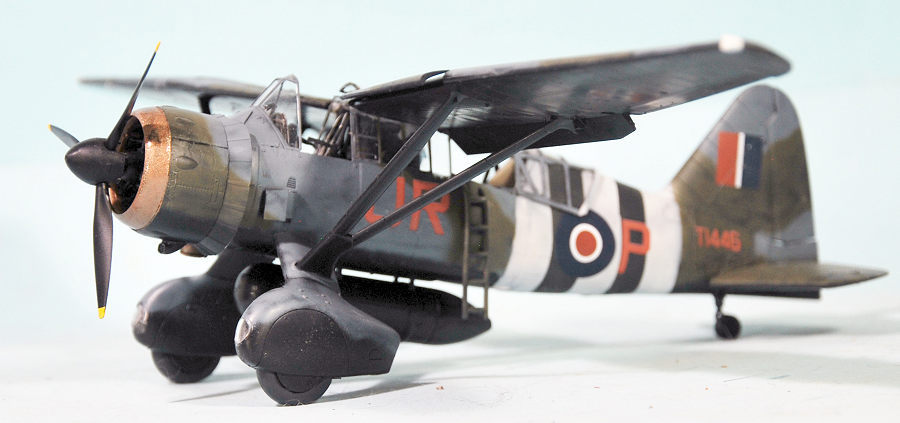
Airfix 1/48 Lysander I/III
| KIT #: | A07116 |
| PRICE: | $65.00 |
| DECALS: | Two options |
| REVIEWER: | Tom Cleaver |
| NOTES: |
| HISTORY |
 In 1934
the Air Ministry issued Specification A.39/34 for an army co-operation aircraft
to replace the Hawker Hector. Initially Hawker Aircraft, Avro and Bristol were
invited to submit designs; after some debate within the ministry, a submission
from Westland was invited as well. The Westland design, internally designated P.
8, was the work of Arthur Davenport under the direction of W.E.W. "Teddy" Petter.
Petter spent considerable time interviewing RAF pilots to find out what they
wanted from such an aircraft. The result suggested field of view, low-speed
handling characteristics and STOL performance were the important requirements.
The Air Ministry requested two prototypes of the P.8 and the competing Bristol
Type 148, quickly selecting the Westland aircraft for production and issuing a
contract in September 1936.
In 1934
the Air Ministry issued Specification A.39/34 for an army co-operation aircraft
to replace the Hawker Hector. Initially Hawker Aircraft, Avro and Bristol were
invited to submit designs; after some debate within the ministry, a submission
from Westland was invited as well. The Westland design, internally designated P.
8, was the work of Arthur Davenport under the direction of W.E.W. "Teddy" Petter.
Petter spent considerable time interviewing RAF pilots to find out what they
wanted from such an aircraft. The result suggested field of view, low-speed
handling characteristics and STOL performance were the important requirements.
The Air Ministry requested two prototypes of the P.8 and the competing Bristol
Type 148, quickly selecting the Westland aircraft for production and issuing a
contract in September 1936.
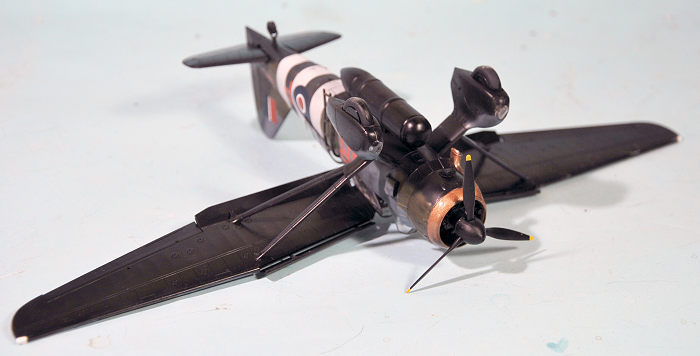
Davenport and Petter designed an aircraft to incorporate these features. The Lysander was powered by a Bristol Mercury air-cooled radial engine, with high wings and a fixed conventional landing gear mounted on an innovative inverted U square-section tube that supported wing struts at the apex, and contained internal springs for the wheels. The large streamlined spats also contained a mounting for a Browning machine gun and fittings for removable stub wings that could carry light bombs or supply canisters. The wings had a reverse taper towards the root, which gave the impression of a bent gull wing from some angles, although the spars were straight. The front spar and lift struts were extrusions. The wing was fabric-covered and its thickness was greatest at the strut anchorage
The fuselage had a girder type construction faired with a light wood stringers to give the aerodynamic shape. The forward fuselage was duralumin tube joined with brackets and plates, and the after part was welded stainless steel tubes. Plates and brackets were cut from channel extrusions rather than being formed from sheet steel. The fixed conventional landing gear was mounted on an innovative inverted U square-section tube that supported wing struts at the apex, and contained internal springs for the faired wheels. The large streamlined spats also contained a mounting for a Browning machine gun and fittings for removable stub wings that could carry light bombs or supply canisters.
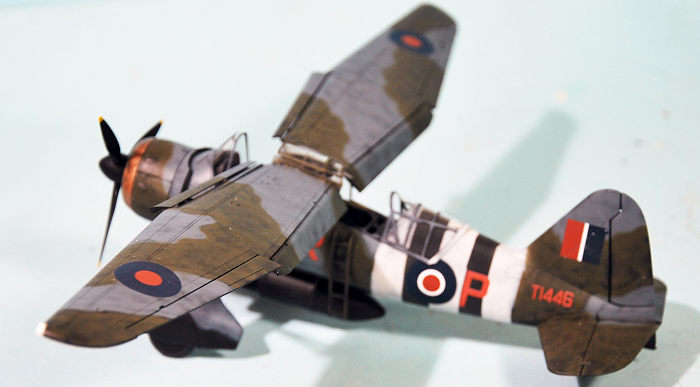
Despite its appearance, the Lysander was aerodynamically advanced, being equipped with fully automatic wing slats and slotted flaps, and a variable incidence tailplane. These refinements gave the Lysander a stalling speed of only 65 mph.
 The
high-lift devices gave the Lysander a short take off and landing (STOL)
performance. The wings were equipped with automatic slats which lifted away from
the leading edge as the airspeed decreased towards stalling speed. These slats
controlled automatic flaps. Slow speed flight was therefore greatly simplified,
"and it was possible to bring a Lysander down to land, if not like a lift, at
least like an escalator" as one pilot said. The inboard slats were connected to
the flaps and to an air damper in the port wing which governed the speed at
which the slats operated. The outboard slats operated independently and were not
connected and each was fitted with an air damper. On a normal approach, the
inboard slats and the flaps would begin to open when the airspeed dropped to
about 85 mph and be half down at 80 mph.
The
high-lift devices gave the Lysander a short take off and landing (STOL)
performance. The wings were equipped with automatic slats which lifted away from
the leading edge as the airspeed decreased towards stalling speed. These slats
controlled automatic flaps. Slow speed flight was therefore greatly simplified,
"and it was possible to bring a Lysander down to land, if not like a lift, at
least like an escalator" as one pilot said. The inboard slats were connected to
the flaps and to an air damper in the port wing which governed the speed at
which the slats operated. The outboard slats operated independently and were not
connected and each was fitted with an air damper. On a normal approach, the
inboard slats and the flaps would begin to open when the airspeed dropped to
about 85 mph and be half down at 80 mph.
Four RAF squadrons equipped with Lysanders accompanied the British Expeditionary Force to France in October 1939; they were joined by a further squadron early in 1940. Following the German invasion of France and the low countries on 10 May 1940, Lysanders were put into action as spotters and light bombers. In spite of occasional victories against German aircraft, they made very easy targets for the Luftwaffe even when escorted by Hurricanes. Withdrawn from France during the Dunkirk evacuation, they continued to fly supply-dropping missions to Allied forces from bases in England; on one mission to drop supplies to troops trapped at Calais, 14 of 16 Lysanders and Hectors that set out were lost. 118 Lysanders were lost in or over France and Belgium in May and June 1940, of a total of 175 deployed.
With the fall of France, it was clear the type was unsuitable for the coastal patrol and army co-operation role, being described by Air Marshal Arthur Barratt, commander-in-chief of the British Air Forces in France as "quite unsuited to the task; a faster, less vulnerable aircraft was required." The view of army AOP pilots was that the Lysander was too fast for artillery spotting purposes, too slow and un-manoeuvrable to avoid fighters, too big to conceal quickly on a landing field, too heavy to use on soft ground and had been developed by the RAF without ever asking the army what was needed. Nevertheless, throughout the remainder of 1940, Lysanders flew dawn and dusk patrols off the coast[12] and in the event of an invasion of Britain, they were tasked with attacking the landing beaches with light bombs and machine guns.[13] They were replaced in the home-based army co-operation role from 1941 by camera-equipped fighters such as the Curtiss Tomahawk and North American Mustang carrying out reconnaissance operations, while light aircraft such as the Taylorcraft Auster were used to direct artillery.
 The
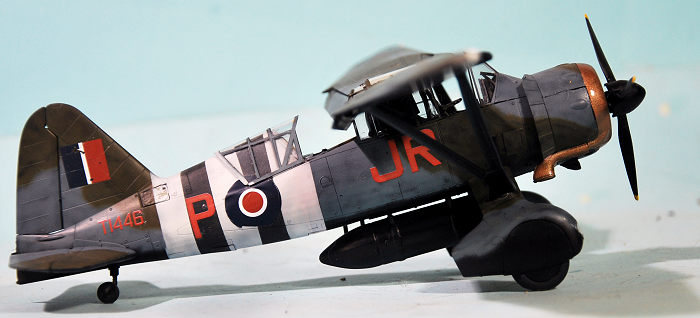
most daring use of Lysanders in WW II was with the Special Operations Executive,
which supported the Resistance in German occupied France and Belgium, by flying
in agents and picking up escapees. It was during these night operations, that
the Lysander came into its own, using its remarkable STOL capabilities to fly
into the small fields marked out by the Resistance.
The
most daring use of Lysanders in WW II was with the Special Operations Executive,
which supported the Resistance in German occupied France and Belgium, by flying
in agents and picking up escapees. It was during these night operations, that
the Lysander came into its own, using its remarkable STOL capabilities to fly
into the small fields marked out by the Resistance.
In August 1941 a new squadron, No. 138 (Special Duties), was formed to undertake missions for the Special Operations Executive to maintain clandestine contact with the French Resistance. Among its aircraft were Lysander Mk.IIIs, which landed in occupied France. While general supply drops could be left to the rest of No. 138's aircraft, the Lysander could insert and remove agents or retrieve Allied aircrew. For this role the Mk.IIIs were fitted with a fixed ladder over the port side to hasten access to the rear cockpit and a large drop tank under the belly. Operations almost always took place within a week of a full moon, as moonlight was essential for navigation. The aircraft undertook such duties until the liberation of France in 1944.
Flying without any navigation equipment other than a map and compass, Lysanders would land on short strips of land, such as fields, marked out by four or five torches or to avoid having to land, the agent, wearing a special padded suit, stepped off the ladder at very low altitude and rolled to a stop on the field. For SOE use, the rear cockpit of the Mk III (SD) version was modified to carry up to three passengers in case of urgent necessity as they were fitted with a rearward facing bench for two passengers (with a locker underneath) and a shelf at the rear of the compartment which could also serve as a seat for a third passenger.
The pilots of 138, and from early 1942 161, Squadrons transported 101 agents to and recovered 128 agents from German-occupied Europe. The Germans knew little about the British aircraft and wished to study one. Soldiers captured an intact Lysander in March 1942 when its pilot was unable to destroy it after a crash, but a train hit the truck carrying the Lysander, destroying the cargo.
In the Far East, from 1944 357 Squadron RAF operated six SD Lysanders as C Flight for dropping agents in support of Fourteenth Army in Burma.
| THE KIT |
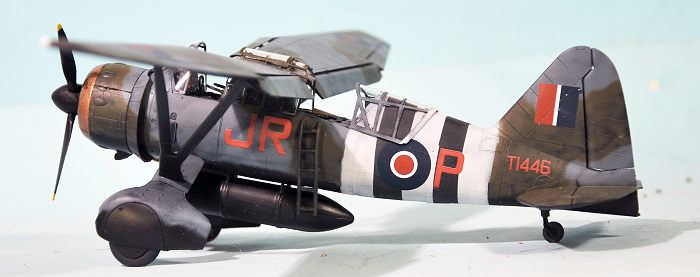 The Lysander
has been produced by British model companies like Airfix and Frog since the
1950s, in 1/72 scale. The first 1/48 kit was produced by Hawk Models USA in the
mid/late 1960s. Eduard released a 1/48 Lysander in the 1990s. In 1/32 scale,
Hobbycraft released a Lysander in the 1990s that was later picked up and is
still produced by Revell. All of these had various faults and inaccuracies.
The Lysander
has been produced by British model companies like Airfix and Frog since the
1950s, in 1/72 scale. The first 1/48 kit was produced by Hawk Models USA in the
mid/late 1960s. Eduard released a 1/48 Lysander in the 1990s. In 1/32 scale,
Hobbycraft released a Lysander in the 1990s that was later picked up and is
still produced by Revell. All of these had various faults and inaccuracies.
This new Airfix 1/48 Lysander I/III solves all the shortcomings of previous kits. The cockpit and engine are well-detailed, the parts fit perfectly, the production design results in a complex airplane not being complicated to assemble. Surface detail is very petite, and the area of the rear fuselage that is fabric covered “gets it right” without any “hills and valleys.” The clear parts are very clear, and can be assembled with the canopies open or closed. Decals are provided for a pre-war Lysander I and an early-war Lysander III in the Dark Earth/Dark Green scheme. Xtradecals have released a sheet of Lysanders and there are both an Aeromaster and Eagle Strike sheet released for the Eduard kit 20-odd years ago. The Aeromaster sheet has a Free French and a Finnish Lysander as markings alternatives.
| CONSTRUCTION |
As I said, the airplane was complex, but the model is not complicated, due to good kit design. The new instruction booklets from Airfix are very useful and should be followed - they’re not “somebody’s opinion.”
I decided to do a Lysander III (SD) when I spotted an old Hawk/Testors
kit at the LHS for “aftermarket parts” price and picked it up. I later got the
Quick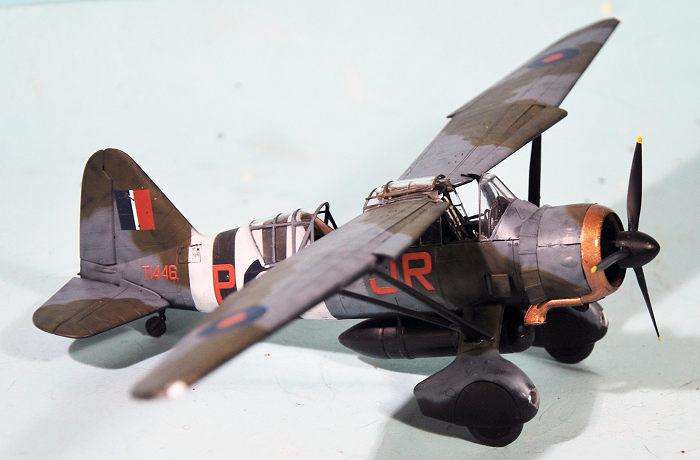 boost
conversion set, but this was largely useless: the fuel tank is very striated
from the 3D printing and the parts don’t fit; the ladder was nice and thin and
quickly went flying off the worktable to disappear on the bare hardwood floor
until magically reappearing to be discovered the hard way (c-r-r-un-ch!) The old
Hawk parts weren’t as detailed but the tank and the ladder worked. The
Quickboost resin additional parts for the cockpit presented no problem to use.
The decals were overall too light,but the ID markings and serial were used,
while the national insignia was robbed from sheets in the decal dungeon.
boost
conversion set, but this was largely useless: the fuel tank is very striated
from the 3D printing and the parts don’t fit; the ladder was nice and thin and
quickly went flying off the worktable to disappear on the bare hardwood floor
until magically reappearing to be discovered the hard way (c-r-r-un-ch!) The old
Hawk parts weren’t as detailed but the tank and the ladder worked. The
Quickboost resin additional parts for the cockpit presented no problem to use.
The decals were overall too light,but the ID markings and serial were used,
while the national insignia was robbed from sheets in the decal dungeon.
As to construction, I assembled the wings and horizontal stabilizers first. Be very careful with installing the flaps and slats, because the attachments are very thin and easily broken (don’t ask how I know - the air was purple over the worktable). I attached the struts to the wings and put these subassemblies in the kit box.I assembled the engine, painting it semigloss black, and assembled the cowling around it, and put it in the box with the wings and tail.
I prepainted the fuselage parts before assembly. There are no wartime photos of Lysander III (SD) cockpits, but a guy at Britmodeller had found an Air Ministry instruction that Special Duties Lysanders were to have their cockpits repainted black over the grey-green, and I went with that. I also used the Eduard photoetch for the insrument panel and seat belts. I followed the instructions and had the fuselage assembled in a few hours on an afternoon. I attached the clear parts and masked them with the Eduard Lysander mask - given the number of glass panels to be masked, the pre-cut mask is a godsend.
No construction difficulties were noted, due to the good parts fit, but as always with modern kits, be sure all sprue nubs are removed from the parts to insure accurate assembly since tolerances are tight.
| COLORS & MARKINGS |
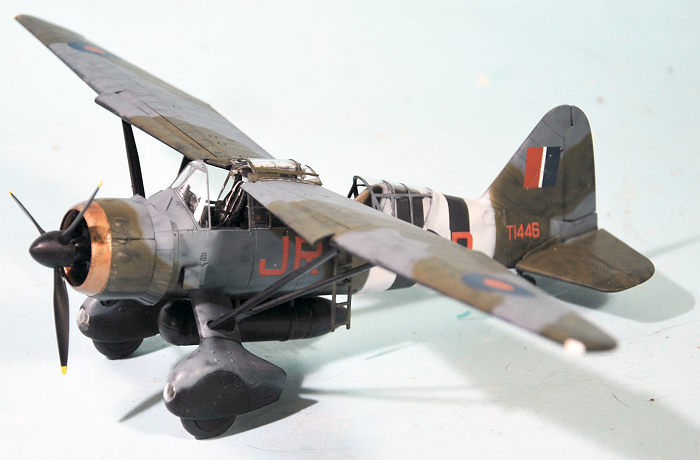 Lysander
III (SD) airplanes came out of the factory painted overall Night. I used
Tamiya semigloss black lacquer LP-5.
Lysander
III (SD) airplanes came out of the factory painted overall Night. I used
Tamiya semigloss black lacquer LP-5.
The squadrons painted their own camouflage over this Night finish. By 1943, standard RAF night fighter colors of Dark Green and Sea Grey Medium were used. However, the Quickboost sheet had an airplane done in “darker grey” as described; I guessed that was Ocean Grey. The fact it also had D-Day stripes on the fuselage was the clincher for an individualistic finish.
I used Tamiya RAF Dark Green XF-81 and Ocean Grey XF-82, thinned with Tamiya lacquer thinner, to paint the camo. I then masked off the rear fuselage and painted the area with Tamiya “Insignia White” LP-35. I masked that for the black stripes, which ware not “symmetrical” (the only D-Day stripes you see in photos that are nice and symmetrical were repainted weeks after the event - the originals were “get it done”). I used Tamya NATO Black LP-60. Both the black and white were applied thin, so there are “holidays” in the paint, as would have been the case with stripes quickly painted.
I then applied the decals, which all went down without problem.
I attached the engine and cowling, then the horizontal stabilizers, then the wings. No problems were encountered. I declared it done and sent it to the model shelves.
| CONCLUSIONS |
If you like the Lysander, this is the kit you want. It is head and shoulders above any other Lysander kit in any scale, with superb detail, logical kit design and excellent parts fit. A modeler with a few kits done can find success with this - but do follow the instructions.
5 September 2025
Review kit courtesy of all you book buyers.
Copyright ModelingMadness.com. All rights reserved. No reproduction in part or in whole without express permission.
If you would like your product reviewed fairly and fairly quickly, please contact the editor or see other details in the Note to Contributors.