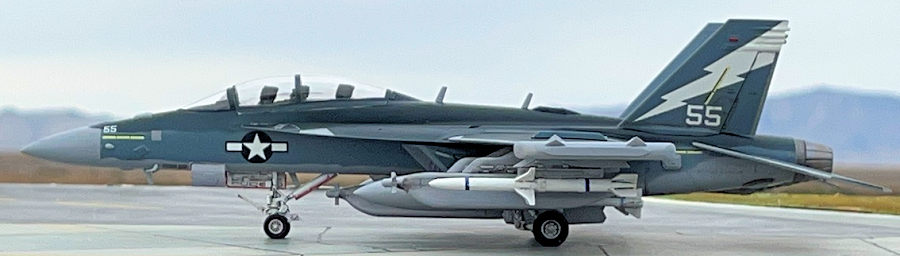
| KIT #: | E 36 |
| PRICE: | $20.00 on sale |
| DECALS: | Two options |
| REVIEWER: | Bob Leonard |
| NOTES: | Two Bobs 72-097 |
| HISTORY |
 I wonder if
the Northrop designers ever dreamed when they rolled out the YF-17 Cobra on
April 4, 1974 that 52 years later, the ancestor of that prototype would
eventually become the carrier based electronic warfare workhorse of the US Navy?
The YF-17 Cobra lost the USAF Lightweight Fighter competition to the F-16
Falcon, but was reworked and enlarged to compete in the Naval Fighter Attack
Experimental program in coordination with McDonnel Douglas. The resulting
McDonnel Douglas F/A-18A/B/C/D Hornets replaced Navy and Marine Corps A-7s and
F-4s, and complimented the larger, more expensive F-14 Tomcat. These original
Hornets also served as land based fighter attack jets of many allied air forces
desiring twin engine performance in lieu of the F-16. Eventually, the Hornet was
scaled up again to the now Boeing (after the merger of the two aerospace giants)
F/A-18E/F Super Hornet. By now it was similar in size and weight to the F-15
Eagle. The EA-18G Growler is based on the twin seat F/A-18F and is the successor
to the Grumman EA-6B Prowler electronic warfare carrier based jet. The Growler
began production in 2007 and entered USN squadron service in 2009. In 2017 the
EA-18G also entered service with the Royal Australian Air Force.
I wonder if
the Northrop designers ever dreamed when they rolled out the YF-17 Cobra on
April 4, 1974 that 52 years later, the ancestor of that prototype would
eventually become the carrier based electronic warfare workhorse of the US Navy?
The YF-17 Cobra lost the USAF Lightweight Fighter competition to the F-16
Falcon, but was reworked and enlarged to compete in the Naval Fighter Attack
Experimental program in coordination with McDonnel Douglas. The resulting
McDonnel Douglas F/A-18A/B/C/D Hornets replaced Navy and Marine Corps A-7s and
F-4s, and complimented the larger, more expensive F-14 Tomcat. These original
Hornets also served as land based fighter attack jets of many allied air forces
desiring twin engine performance in lieu of the F-16. Eventually, the Hornet was
scaled up again to the now Boeing (after the merger of the two aerospace giants)
F/A-18E/F Super Hornet. By now it was similar in size and weight to the F-15
Eagle. The EA-18G Growler is based on the twin seat F/A-18F and is the successor
to the Grumman EA-6B Prowler electronic warfare carrier based jet. The Growler
began production in 2007 and entered USN squadron service in 2009. In 2017 the
EA-18G also entered service with the Royal Australian Air Force.
| THE KIT |
 The Super
Hornet family is well represented in 1/72. Italeri, Revell, Hasegawa and Academy
had all taken a swing at this version in the Gentlemen’s Scale. I read the
Italeri version has airbrake accuracy issues, while the Revell kit has spine
shape issues aft of the cockpit. It was all moot since a sale of the Hasegawa
EA-18G was going for $20.00 USD. The Hasegawa kit has a reputation as accurately
shaped and detailed, but with some tough fit issues.
The Super
Hornet family is well represented in 1/72. Italeri, Revell, Hasegawa and Academy
had all taken a swing at this version in the Gentlemen’s Scale. I read the
Italeri version has airbrake accuracy issues, while the Revell kit has spine
shape issues aft of the cockpit. It was all moot since a sale of the Hasegawa
EA-18G was going for $20.00 USD. The Hasegawa kit has a reputation as accurately
shaped and detailed, but with some tough fit issues.
| CONSTRUCTION |
The Hornet family has a
complicated fuselage with a long skinny front body with twin intake pods on the
sides and rear. This shape necessitates a multipart fuselage and intakes that
often exhibits fit problems. The Hasegawa kit was no exception. I spent
considerable time ensuring the fit and seams were acceptable for parts A1 and A7
and then parts A2 and A8. Once these intakes were firmly cemented and seams
addressed, I test fitted them to part B10, the underside fuselage, which
 revealed some
careful thinning of parts A7 and A8 were needed to make the fit as flush as
possible to minimize the seams. No full length intakes are provided, so to
create that illusion I painted the intake portions of part B10 black to give
depth. No putty was used anywhere on the kit, but every seam needed some
attention from Mr. Surfacer 500 and subsequent sanding. Frankly, every model
company struggles with this fuselage shape and I know of no manufacture who has
successfully made a seamless fit fuselage. Someday, perhaps Tamiya will do a
Hornet family and we can see what sorcery their tool makers can devise.
Obliterated panels lines and rivets were restored with scribing and a steel
sewing needle. Study the instructions carefully and ensure all the holes are
appropriately drilled out for the various antennas, lumps and bumps that
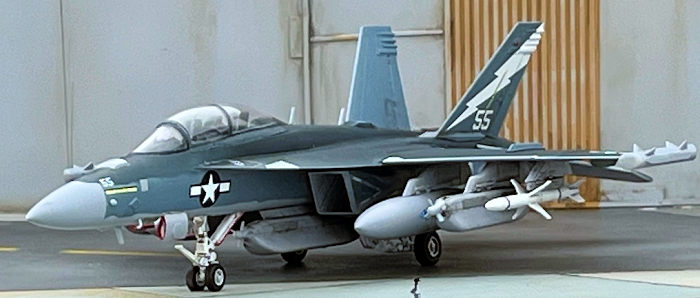
differentiate the Growler from the standard F/A-18F Super Hornet. Hasegawa
provides the stores that make the electronic warfare version, including 480
gallon fuel tanks, two each AIM-120 and AGM-88E missiles (weapons are not always
provided in Hasegawa kits), ALQ-99 low and high band jamming pods as well as
ALQ-218 radar warning receiver pods. This causes the second biggest problem with
the kit, besides the fuselage seams. Once the pods and missiles and antennas are
installed, how to pick up the model and handle it takes careful thought. I had
to reinstall parts more than once due to my ham-fistedness. The wings attach to
the fuselage without drama. The vertical stabilizers fit spectacularly and can
be left off until the end of the build. Likewise, the horizontal stabilizers are
a push fit with polycaps and can be left until the kit its built and painted.
The only aftermarket parts were clear iridescent foil for the Head Up Display on
the cockpit coaming and a 4mm round clear crystal gem to depict the nose landing
gear light.
revealed some
careful thinning of parts A7 and A8 were needed to make the fit as flush as
possible to minimize the seams. No full length intakes are provided, so to
create that illusion I painted the intake portions of part B10 black to give
depth. No putty was used anywhere on the kit, but every seam needed some
attention from Mr. Surfacer 500 and subsequent sanding. Frankly, every model
company struggles with this fuselage shape and I know of no manufacture who has
successfully made a seamless fit fuselage. Someday, perhaps Tamiya will do a
Hornet family and we can see what sorcery their tool makers can devise.
Obliterated panels lines and rivets were restored with scribing and a steel
sewing needle. Study the instructions carefully and ensure all the holes are
appropriately drilled out for the various antennas, lumps and bumps that
differentiate the Growler from the standard F/A-18F Super Hornet. Hasegawa
provides the stores that make the electronic warfare version, including 480
gallon fuel tanks, two each AIM-120 and AGM-88E missiles (weapons are not always
provided in Hasegawa kits), ALQ-99 low and high band jamming pods as well as
ALQ-218 radar warning receiver pods. This causes the second biggest problem with
the kit, besides the fuselage seams. Once the pods and missiles and antennas are
installed, how to pick up the model and handle it takes careful thought. I had
to reinstall parts more than once due to my ham-fistedness. The wings attach to
the fuselage without drama. The vertical stabilizers fit spectacularly and can
be left off until the end of the build. Likewise, the horizontal stabilizers are
a push fit with polycaps and can be left until the kit its built and painted.
The only aftermarket parts were clear iridescent foil for the Head Up Display on
the cockpit coaming and a 4mm round clear crystal gem to depict the nose landing
gear light.
| COLORS & MARKINGS |
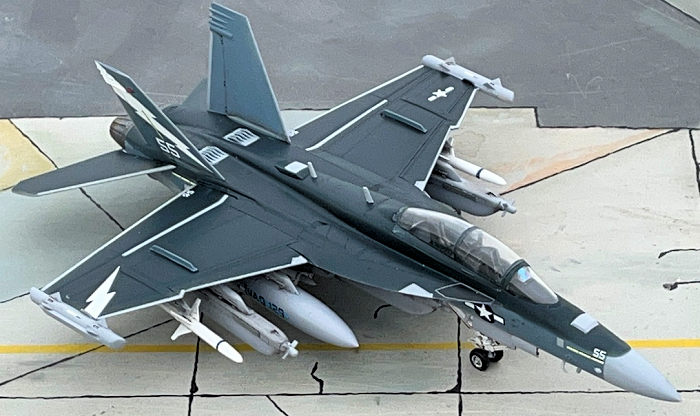
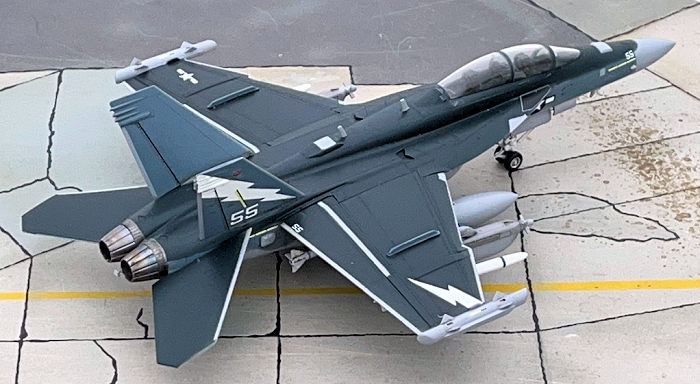
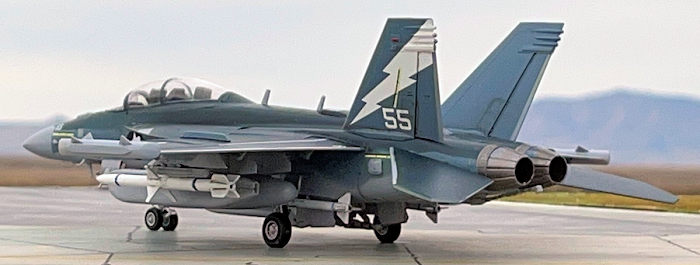 This is the
first Hornet I have ever built, Super or otherwise, despite the fact I have a
1/32 Academy F/A-18C, a Monogram 1/48 prototype, a Hasegawa 1/48 F/A-18C and a
1/72 Hasegawa F/A-18B. The reason I finally pulled the trigger is because of the
Two Bobs decals Centennial of Naval Aviation (CONA) sheet issued in 2011. For
that occasion, VAQ-129 painted BuNo 166899 based at NAS Whidbey, Washington in
the mid-war tricolors of a F4U Corsair from VF-85 in 1944 off the USS Shangri-la
with its distinctive lightning bolt on the vertical stabilizer and starboard
wing tip. The resulting CONA paint job is not 100% accurate and is more of an
homage that a strict WWII historical representation. The bottom of the Growler
remained in Light Ghost Gray, while the sides and top were painted in 2011
interpretations of Intermediate and Dark Sea Blue. I differed from the suggested
shades of the Two Bobs sheet, and used the colors from WWII. The Light Ghost
Gray is Gunze H308, the Intermediate Blue is PolyScale and the Dark Sea Blue is
Model Master enamel. The Two Bobs sheet is 15 years old and printed by
MicroScale. Some decals broke probably due to age, but I was able to piece them
together satisfactorily. I doubt a CONA Growler with this scheme would mount
live AIM-120 and AGM-88E missiles, so I painted them up with blue stripes
indicating inert training rounds.
This is the
first Hornet I have ever built, Super or otherwise, despite the fact I have a
1/32 Academy F/A-18C, a Monogram 1/48 prototype, a Hasegawa 1/48 F/A-18C and a
1/72 Hasegawa F/A-18B. The reason I finally pulled the trigger is because of the
Two Bobs decals Centennial of Naval Aviation (CONA) sheet issued in 2011. For
that occasion, VAQ-129 painted BuNo 166899 based at NAS Whidbey, Washington in
the mid-war tricolors of a F4U Corsair from VF-85 in 1944 off the USS Shangri-la
with its distinctive lightning bolt on the vertical stabilizer and starboard
wing tip. The resulting CONA paint job is not 100% accurate and is more of an
homage that a strict WWII historical representation. The bottom of the Growler
remained in Light Ghost Gray, while the sides and top were painted in 2011
interpretations of Intermediate and Dark Sea Blue. I differed from the suggested
shades of the Two Bobs sheet, and used the colors from WWII. The Light Ghost
Gray is Gunze H308, the Intermediate Blue is PolyScale and the Dark Sea Blue is
Model Master enamel. The Two Bobs sheet is 15 years old and printed by
MicroScale. Some decals broke probably due to age, but I was able to piece them
together satisfactorily. I doubt a CONA Growler with this scheme would mount
live AIM-120 and AGM-88E missiles, so I painted them up with blue stripes
indicating inert training rounds.
| CONCLUSIONS |
When it comes to 1/72 Growlers, you have many options. This Hasegawa kit was a challenge at times, but I got it done. I am not a fan of CAG birds and gaudy one offs most of the time, but this homage to a WWII Corsair won me over and it certainly is more interesting that the 50 Shades of Gray adorning most Growlers.
| REFERENCES |
Airliners.net was a source of BuNo 166899 in CONA colors.
Bob Leonard
26 March 2026
Copyright ModelingMadness.com. All rights reserved. No reproduction in
any form without express permission from the editor.
If you would like your product reviewed fairly and fairly quickly, please
contact
the editor or see other details in the
Note to
Contributors. Back to the Main Page
Back to the Review
Index Page
Back to the Previews Index Page