
Trumpeter 1/48 J-10AY Vigorous Dragon
| KIT #: | 02857 |
| PRICE: | 10 Euros on sale |
| DECALS: | One scheme, 11 serial numbers |
| REVIEWER: | Spiros Pendedekas |
| NOTES: | S8-1 Aerobatic Team boxing |
| HISTORY |
The Chengdu J-10, known as the Vigorous Dragon, is a single-engine, multirole fighter developed by the Chengdu Aircraft Industry Group for the People's Liberation Army Air Force (PLAAF). Designed to provide China with a modern and highly manoeuvrable combat aircraft, the J-10 features a distinctive delta wing, close-coupled canards and a carefully shaped fuselage, giving it an unmistakable appearance among contemporary fighters. Entering operational service in the 2000s, the aircraft has since evolved through several versions incorporating improved avionics, weapons systems and flight capabilities.
Beyond its operational role, the J-10 has also become an important ambassador for the Chinese aviation industry, demonstrating the country's growing aerospace capabilities at airshows and international events. This role is particularly evident through its association with the August 1st Aerobatic Team of the PLAAF, also known as the Bayi Aerobatic Team. Its name commemorates 1 August 1927, a date of particular significance in the history of the Chinese military.
Established in 1962, the team initially operated the Shenyang J-5, the Chinese-built version of the Soviet MiG-17. It subsequently moved to the Chengdu J-7, the Chinese development of the MiG-21 family, before eventually adopting the much more modern J-10. Each transition represented another step in the evolution of Chinese military aviation, as well as the team's ability to demonstrate increasingly sophisticated formation manoeuvres.
The J-10AY, the single-seat aerobatic version, together with the two-seat J-10SY, entered the team's service in 2009. The aircraft made their public debut at Airshow China in Zhuhai in November 2010, where their distinctive canard-delta configuration and colourful presentation attracted considerable attention. Adapted for display duties, the aircraft feature smoke-generation equipment and a special paint scheme, while their armament and certain operational systems are removed or modified as appropriate.
The team's original display aircraft wore a predominantly white, blue and red finish, subsequently giving way to the striking blue scheme that became its visual signature. The August 1st Aerobatic Team has performed at numerous domestic and international events, including appearances at MAKS in Russia, helping introduce the J-10 to audiences around the world. In 2023, the team began transitioning to the newer J-10C-based display aircraft, continuing its role as a showcase for China's indigenous fighter development.
For the modeller, the J-10AY offers an appealing combination of modern fighter design and the colourful world of military aerobatics. Its distinctive shape is interesting enough in its own right, but the special display livery adds a welcome splash of colour to a collection otherwise dominated by conventional operational camouflage.
| THE KIT |
 Trumpeter
introduced its new-tool 1/48 J-10 Vigorous Dragon family in 2009, with the
J-10A, J-10S and aerobatic J-10AY versions appearing almost simultaneously. The
range was subsequently expanded with updated releases featuring additional
parts, including the J-10B in 2011, followed much later by the J-10C in 2022. We
are therefore dealing with a relatively modern tooling, which has served
Trumpeter well in covering several variants of this distinctive Chinese fighter.
The subject of this review is the J-10AY, the aerobatic version flown by China's August 1st Aerobatic Team. I picked up the kit from a hobby shop in Athens around 2022, during a special offer at the absolutely unbeatable price of €10. At that price, it was a deal that was simply too good to pass up!
The kit comes in a large, top-opening box of excellent quality, as we have come to expect from Trumpeter. The attractive box art depicts an aircraft of the August 1st Aerobatic Team flying gracefully in formation with its teammates, providing an appealing introduction to the colourful subject inside.
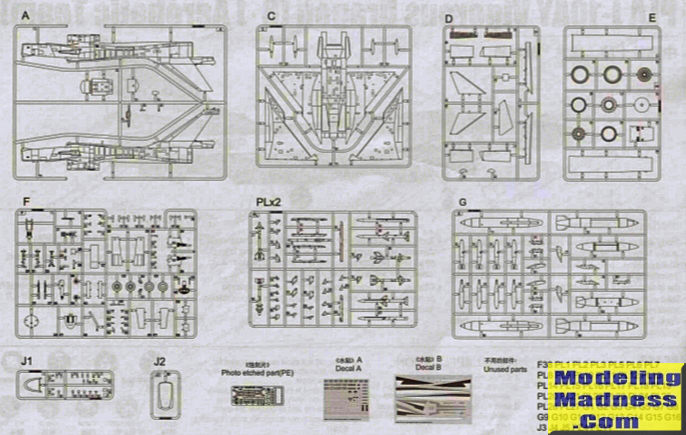
Upon opening the box, I was greeted by more than 232 parts molded in white plastic and neatly arranged on seven sprues. Packaging is excellent, as usual, with the parts well protected and presented. It soon becomes apparent that several sprues are shared with other versions of the J-10, meaning that not all the parts supplied are required for this particular aerobatic variant.
Molding is first-class, with crisp, sharp details and neatly engraved panel lines. I could not spot any flash, and the overall impression is that of a well-produced kit, giving the modeler an encouraging start before construction even begins.
Photo-etched parts are supplied to enhance selected details, including elements of the cockpit and other areas of the aircraft. These additions should prove useful in bringing out the finer features without requiring the modeller to resort to extensive aftermarket additions.
The cockpit is beautifully detailed and looks quite busy straight out of the box. The ejection seat is particularly well done, with photo-etched parts provided to enhance the details, including the seat belts and other small features. The instrument panel and side consoles have molded instrument details, with very nice decals also available to provide additional definition. Overall, the cockpit is impressive for an out-of-the-box build and should respond very well to careful painting and detailing.
The landing gear is equally well represented. The undercarriage legs, wheel bays and doors feature plenty of detail, and the molding is sharp throughout. These areas should look particularly convincing with careful painting and a little judicious weathering, although the clean presentation of an aerobatic aircraft does not call for anything excessive.
The complete air intake is another highlight. It is supplied as an assembly extending back to a compressor face, giving the modeller a convincing representation of the intake duct. The distinctive corrugated area near the intake entrance is also reproduced with PE. Some care will be needed when joining the two halves of the duct, as the resulting seam will run along the interior. With careful alignment, filling and sanding, however, a superb result should be possible.
The exhaust is also nicely executed, with good depth and two alternative configurations, allowing the modeller to choose between an open and a closed nozzle. It is another area where the kit's attention to detail is immediately apparent.
A selection of external stores is included as well. Although the aerobatic version does not require all the equipment supplied in the other releases, Trumpeter has retained a useful assortment of parts on the common sprues. The transparent parts are clear and well molded, providing a good basis for achieving a clean finish around the canopy.
The instructions come in the usual Trumpeter format: a twelve-page printed booklet containing a sprue map, a colour reference chart, a black-and-white side profile and the construction sequence. Assembly is divided into fourteen main steps, some of which contain several sub-steps. The sequence is logically arranged, and the necessary colour references are provided where required. As is the norm with Trumpeter, the instructions deserve a little study before work begins, but I believe the average modeller should have no particular difficulty following them.
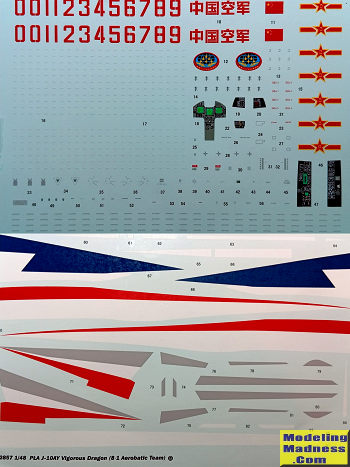 Only one
basic colour scheme is provided, that of the aircraft of the August 1st
Aerobatic Team. All eleven different serial numbers are supplied, offering some
choice within the same overall scheme.
The colorful finish is undoubtedly one of the kit's main attractions. The decals are beautifully printed, with the distinctive colored areas and markings needed to reproduce the team's presentation. It is an elaborate scheme, and applying it will require patience and careful planning. Nevertheless, if the modeller takes the time to work methodically, the result should be a very attractive model indeed.
The instructions begin with the cockpit, followed by the air intake and its compressor face, together with the nose landing gear bay. These assemblies are then trapped between the two fuselage halves.
One point worth considering is the nose weight. The instructions do not specify that any ballast is required, so I would not want to claim that a particular amount is definitely necessary. However, given the arrangement of the forward assemblies and the possibility of a tail-sitting model, I would check the balance carefully with the main model assembled. If ballast proves necessary, I would add it to the nose, which will be then attached.
The next stages involve the wing and fuselage assembly. The main landing gear components are fitted from inside the lower wing section, which is then attached to the fuselage before the upper wing halves are installed. I like this arrangement, as it appears to offer a sound approach to assembly and should help reduce the risk of awkward gaps at the wing roots. Of course, careful dry-fitting is always worthwhile, but the engineering looks sensible and straightforward.
The canards are subsequently attached to the forward fuselage, followed by the transparent parts. Personally, I would leave the canopy until much later in the build to protect it during sanding, filling and painting, but this is simply a matter of personal preference.
The exhaust can be assembled and installed as part of the main construction sequence, with the modeller choosing the desired open or closed configuration. The instructions provide for both options, so the choice is yours.
The landing gear is fitted next, followed by the smoke-generation equipment at the wingtips and the remaining small details, including the pitot probes and refuelling probe. These final components deserve careful handling, as their small size makes them vulnerable to accidental damage during the later stages of the build.
Overall, the construction sequence does not appear overly complicated. The engineering looks logical, and the parts arrangement should make for a reasonably straightforward build. As always, a careful examination of the instructions before starting is recommended, particularly where common parts and variant-specific components are involved. All the necessary information appears to be provided, and a modeller who takes the time to follow the sequence carefully should be rewarded with an excellent-looking J-10AY.
| CONCLUSIONS |
I have to say that I am genuinely impressed with this kit. The J-10 is not among the most familiar subjects in many Western modelling collections, which makes this release all the more interesting. It is a distinctive aircraft, with attractive lines and a substantial presence in 1/48 scale, and Trumpeter has done a very good job of capturing its character.
The tooling is modern, the molding is beautiful, and the engraved panel lines are sharp and consistent. Detail is very good throughout, particularly in the cockpit, landing gear, intake and exhaust areas. The photo-etched additions provide further opportunities to enhance the finer details, while the overall engineering looks sensible and well thought out.
The aerobatic version is especially appealing. Instead of the familiar operational grays and camouflage schemes, we have a colourful aircraft that promises to stand out in any collection. The decal scheme is certainly more demanding than a straightforward operational finish, but this is part of the attraction. With patience, careful preparation and a little planning, the modeller should be able to produce a striking representation of an aircraft from China's famous display team.
Then there is the price! I paid just €10 during a special offer, which was an almost unbeatable deal for what is provided. Even at the more typical prices of around €25–30 that one might encounter for versions in this family, the kit represents a very attractive proposition.
Trumpeter has produced a very appealing package here, combining good molding, useful detail, straightforward-looking engineering and an eye-catching colour scheme. If you are interested in modern Chinese aviation, or simply fancy adding something different and colourful to your collection, this is a kit well worth considering.
For me, the J-10AY is a winner. A very attractive aircraft, a very good kit and a colourful finish that should make the completed model a real eye-catcher. What more could a modeller ask for?
Happy Modeling!
November 2026 Copyright ModelingMadness.com. All rights reserved. No
reproduction in part or in whole without express permission. If you would like your product reviewed fairly and fairly quickly, please
contact
the editor or see other details in the
Note to
Contributors.