Revell 1/48 F-22A Raptor
|
KIT #: |
04559 |
|
PRICE: |
30.00 Euros |
|
DECALS: |
Two options |
|
REVIEWER: |
Spiros Pendedekas |
|
NOTES: |
Reboxed Italeri kit |
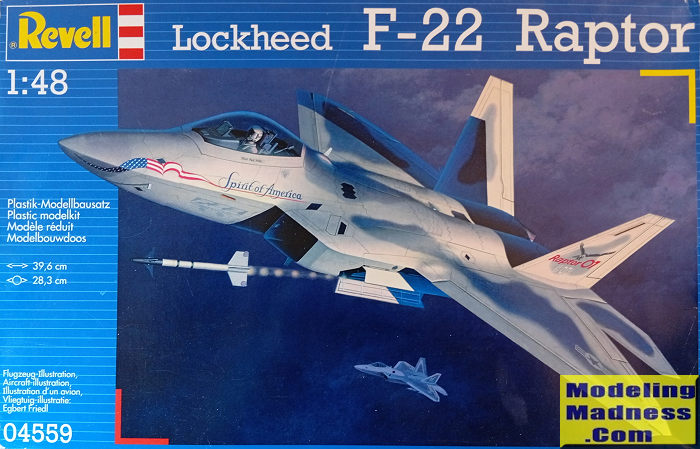
The Lockheed Martin–Boeing F-22 Raptor is an American
twin-engine, jet-powered, all-weather, supersonic stealth fighter aircraft.
As a product of the United States Air Force's Advanced Tactical Fighter
(ATF) program, the aircraft was designed as an air superiority fighter, but
also incorporates ground attack, electronic warfare and signals intelligence
capabilities. The prime contractor, Lockheed Martin, built most of the F-22
airframe and weapons systems and conducted final assembly, while program
partner Boeing provided the wings, aft fuselage, avionics integration and
training systems.
First flown in 1997, the F-22 descended from the Lockheed YF-22 and was
variously designated F-22 and F/A-22 before it formally entered service in
December 2005 as the F-22A. It replaced the F-15 Eagle in most active duty
U.S. Air Force (USAF) squadrons. Although the service had originally planned
to buy a total of 750 ATFs to replace its entire F-15 fleet, it later scaled
down to 381 and the program was ultimately cut to 195 aircraft – 187 of them
operational models – in 2009 due to political opposition from high costs, a
perceived lack of air-to-air threats at the time of production, and the
development of the more affordable and versatile F-35 Lightning II.The last
aircraft was delivered in 2012.
The F-22 is a critical component of the USAF's tactical airpower as its most
advanced air superiority fighter. While it had a protracted development and
initial operational difficulties, the aircraft became the service's leading
counter-air platform. Its deployments include Okinawa, the Middle East, and
NATO's eastern flank. Although designed for air superiority operations, the
F-22 has also carried out and supported airstrikes in Syria, Afghanistan,
Iran and Venezuela. The F-22 is expected to remain a cornerstone of the
USAF's fighter fleet until its successor, the Boeing F-47 enters service
around 2030.
 Italeri
came in 1999 with their F-22 mold, the first Raptor in 1/48, which was
reboxed in 2006 and 2022 (also by Revell in 2001 and Testors in 2009), with
all reboxings differing only in the decal sheet. With little doubt, Italeri
took all measurements from the prototype, which presented a number of
differences from the operational machines that were introduced late in 2005.
Since Yours Truly is by no means an F-22 adept, I will only say that overall
shapes of parts resemble those of the F-22 and I will leave the rest to the
F-22 Experten.
Italeri
came in 1999 with their F-22 mold, the first Raptor in 1/48, which was
reboxed in 2006 and 2022 (also by Revell in 2001 and Testors in 2009), with
all reboxings differing only in the decal sheet. With little doubt, Italeri
took all measurements from the prototype, which presented a number of
differences from the operational machines that were introduced late in 2005.
Since Yours Truly is by no means an F-22 adept, I will only say that overall
shapes of parts resemble those of the F-22 and I will leave the rest to the
F-22 Experten.
The specific kit is the Revell 2001 reboxing, bought in 2005 from one of my
beloved, now sadly closed toy/hobby shops in my equally beloved hometown (Chalkis,
Greece) at what then seemed a fair price. It comes in the classic, big,
good-quality but side-opening Revell blue box, carrying a nice box art by
artist Egbert Friedl of the first two Raptor prototypes flying together,
with the front one firing a Sidewinder.
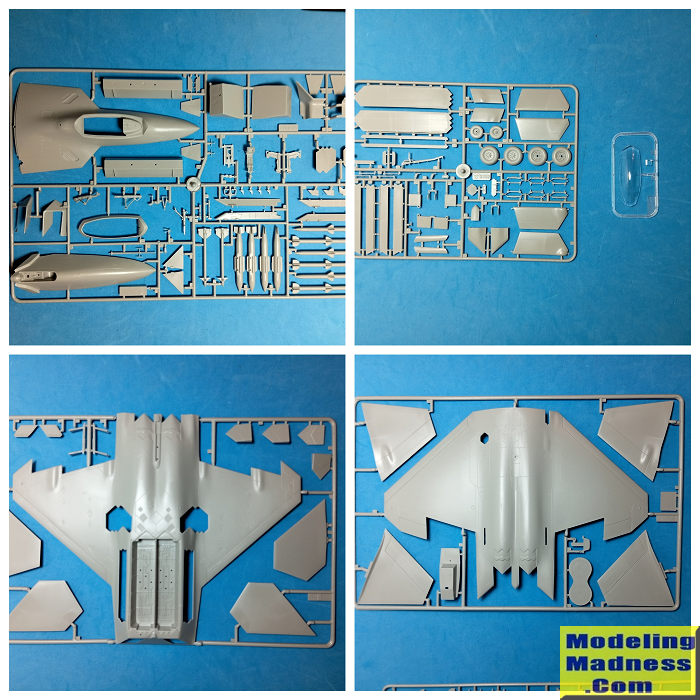
Upon opening the box, I was greeted with 139 light gray styrene parts,
neatly arranged in three big and a fourth smaller sprue. Two of the bigger
sprues contain the main aerodynamic surfaces, while the other two sprues
contain all the rest. The rear fuselage halves nicely contain the wing
halves and are attached vertically. The front fuselage halves are also
attached vertically, so the answer to the obvious question why the complete
fuselage/wing halves are not molded as single pieces might lie to mold size
limitations.
Molding itself is crisp with no flash noted. Panel lines and other surface
details are finely engraved, while the distinctive RAM coatings are nicely
raised and not overdone. There is some slight roughness on the surface
texture, but this might be a plus, since those birds featured totally flat
and somewhat coarse external coating.
Cockpit is not detailed up to modern standards, with some raised
instrumentation for the side consoles and a decal to represent the
instrument panel. The seat itself is quite acceptable, not too departed to
my eye from the real thing. Unless you put a pilot in, if you go for an open
canopy, you should definitely go aftermarket in order to have a detailed
cockpit.
Landing gear is quite fairly represented, with the bays looking relatively
busy. The exhausts are also fairly represented but relatively shallow in
depth, a trend to pre-2000 molds. While the intakes are deep, there is no
intake ducting, so you might consider blanking their end and/or paint the
end area black.
The weapon bays feature molded on internal detailing and can be posed open
or closed. For the open option two Sidewinders and six AMRAAMs are supplied.
The kit also provides options for external underwing stores. These might
have been used in the prototypes but are not often (if ever) seen at
production machines and the same can be said for the distinctive pitot tube.
The flaperons are positionable.
The canopy is nicely molded and crystal clear. It is not tinted as in
reality, so you have to tint it. Maybe a tinted styrene used from the start
wouldn’t be a bad idea. Instructions are the usual excellent Revell from the
past decades, coming in the form of a 14-page b/w booklet, containing a
photo of a built model, a short history of the type, a color chart and a
sprues map, with the construction nicely spread in 46 simple and concise
steps, with color callouts provided where needed.
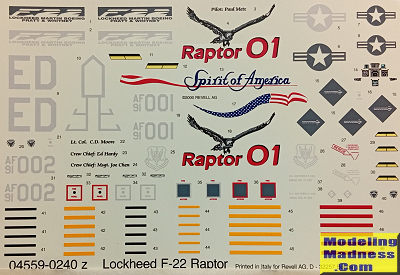 Two
schemes are provided, for the first prototype in its rollout ceremony on 9
April 1997 and for the second prototype as it stood in Edwards AFB more than
one year later during evaluation tests. Decals are superbly printed and,
despite being almost 30 years old, still look usable, but you can only know
upon using them.
Two
schemes are provided, for the first prototype in its rollout ceremony on 9
April 1997 and for the second prototype as it stood in Edwards AFB more than
one year later during evaluation tests. Decals are superbly printed and,
despite being almost 30 years old, still look usable, but you can only know
upon using them.
Instructions want you to first assemble the cockpit and trap it between the
front fuselage halves. You are next instructed to attach various bits
(intakes, exhausts and bays) to the inside of the lower rear fuselage/wing
part and successively attach it to the assembled front fuselage. The
flaperons are then assembled and affixed in their slots. They are
positionable and you can leave them unglued if you wish. Only then the top
rear fuselage/wing part is to be attached.
The weapon bay doors come next, where you can go for open or closed
configuration, followed by the intake fronts, the missiles (if you go for
open bay option), the landing gear (you also have an option for extended or
retracted), the external stores (if you chose to add them) and the arresting
hook (again, select extended or retracted).
The final construction stages deal with assembling and attaching the
elevators, the ruddervators, the addition of some top fuselage access doors,
which can be posed opened, and the canopy, where a nice ladder is provided
as well. There are a few antennas and sensors to be added, which might be
correct for the prototypes, but check your references if you go for a
production machine. This ends a construction that looks straightforward and
relatively uncomplicated.
As of 2026, one has to keep in mind that this almost 30 years old mold comes
closer to the prototypes than the production machines. That said, this is a
decent kit of an early Raptor: molding is crisp, panel lines are finely
engraved, cockpit detail is fair, something also true for the rest of the
details, the canopy is well molded and clear and instructions are superb.
Decals are nicely printed and, despite being almost three decades old, look
usable, but one can only know upon using them. Out of the box, a decent
early Raptor can emerge, while it looks feasible to build a production
Raptor. The construction itself looks quite uncomplex, deeming it suitable
for most modelers but the beginners.
Of course, if you want a modern, detailed and accurate Raptor, you may look
no further than the Hasegawa offering, for which you have to pay roughly
double the price compared to this one. So, in a way, the Revell/italeri kit
comes as a cheaper, simpler, possibly less accurate alternative and as such
it is a kit worth tackling.
Happy Modeling!
Spiros Pendedekas
February 2026
Copyright ModelingMadness.com. All rights
reserved. No reproduction in part or in whole without express permission from
the editor.
If you would like your product reviewed fairly and fairly quickly, please contact the editor or see other details in the
Note to
Contributors.
Back to the Main Page
Back to the Review
Index Page
Back to the Previews Index Page
 Italeri
came in 1999 with their F-22 mold, the first Raptor in 1/48, which was
reboxed in 2006 and 2022 (also by Revell in 2001 and Testors in 2009), with
all reboxings differing only in the decal sheet. With little doubt, Italeri
took all measurements from the prototype, which presented a number of
differences from the operational machines that were introduced late in 2005.
Since Yours Truly is by no means an F-22 adept, I will only say that overall
shapes of parts resemble those of the F-22 and I will leave the rest to the
F-22 Experten.
Italeri
came in 1999 with their F-22 mold, the first Raptor in 1/48, which was
reboxed in 2006 and 2022 (also by Revell in 2001 and Testors in 2009), with
all reboxings differing only in the decal sheet. With little doubt, Italeri
took all measurements from the prototype, which presented a number of
differences from the operational machines that were introduced late in 2005.
Since Yours Truly is by no means an F-22 adept, I will only say that overall
shapes of parts resemble those of the F-22 and I will leave the rest to the
F-22 Experten.