| KIT #: | 1355 |
| PRICE: | 19.00 Euros |
| DECALS: | Eight options |
| REVIEWER: | Spiros Pendedekas |
| NOTES: |
| HISTORY |
The Eurofighter Typhoon is a canard delta wing multirole supersonic fighter jointly developed by Airbus, BAE Systems and Leonardo. Its development began under NATO management in 1983 as a multinational effort (called Future European Fighter Aircraft Programme) involving the UK, Germany, France, Italy and Spain. Disagreements caused France to leave, continuing its effort separately tgat led to the Rafale fighter. The first Eurofighter prototype flew in 1994, and the name Typhoon was adopted in 1998.
Debates on costs and division of work, together with doctrine shifts due to the Cold War's end, not only delayed the plane’s development, but also reduced European demand for the Eurofighter, which finally entered service in 2003. Originally designed for dogfighting, it evolved into a versatile aircraft, excelling in air-to-surface missions with compatibility for various armaments.
The Typhoon first saw combat in 2011 during the Libya intervention, conducting reconnaissance and ground strikes and is now a key asset for air defense in many countries. As of 2026, it is in service with the air forces of Austria, Italy, Germany, United Kingdom, Spain, Saudi Arabia, Oman, Kuwait and Qatar.
| THE KIT |
 Italeri
came in 1993 with its new tool single seater Eurofighter, followed, via addition
of new parts, by the twin seater in 1998. The kit has been regularly reboxed a
good 10 times ever since including once by Tamiya (1996) and twice by Revell
(1994 and 2001 - but note that Revell has come with a new tool Eurofighter in
2004 and an even newer tool in 2016).
Italeri
came in 1993 with its new tool single seater Eurofighter, followed, via addition
of new parts, by the twin seater in 1998. The kit has been regularly reboxed a
good 10 times ever since including once by Tamiya (1996) and twice by Revell
(1994 and 2001 - but note that Revell has come with a new tool Eurofighter in
2004 and an even newer tool in 2016).
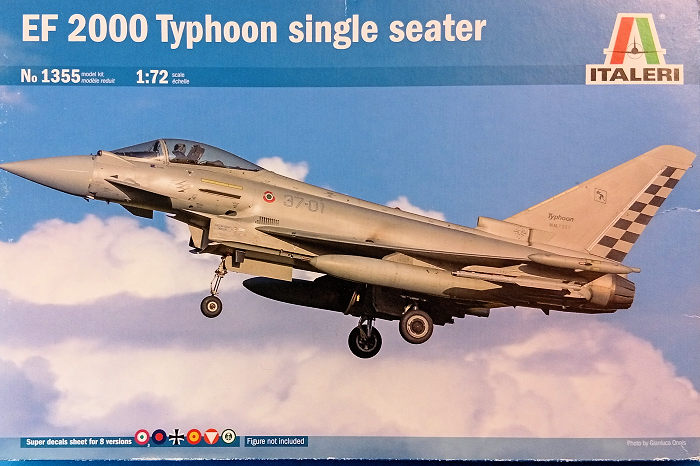
The specific kit is the 2014 single seater reissue and was bought from my petite local hobby shop in 2024. It comes in a small, excellent quality but side opening box, carrying a photo of an Italian machine with a chequered rudder.
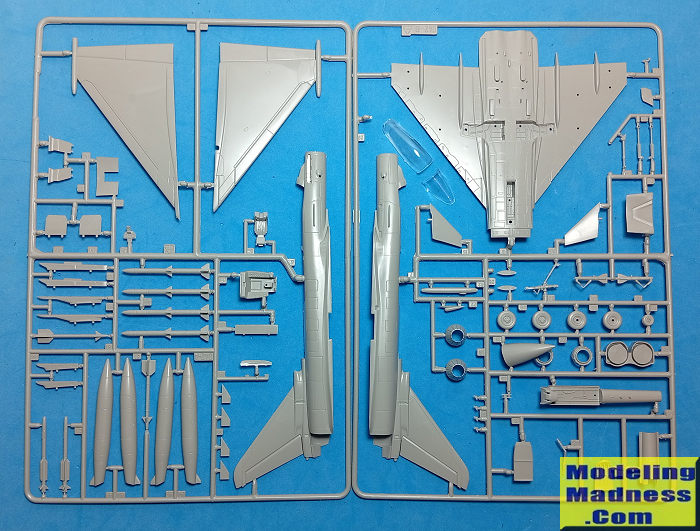
Upon opening the box, I was greeted with 70 light gray styrene parts neatly arranged in two equally sized sprues. Clearly, the kit’s 1993 origins mean that initial measurements were taken by the prototypes, with some extra parts added to the molds later on, to compensate with the production machines. Molding is quite sharp with nothing more than a few mold separation lines here and there. Panel lines are engraved and at the right places, possibly tad on the deep side, but acceptable. The kit engineering is straightforward, especially taking into account the complexity of modern jet shapes.
Cockpit is reasonably detailed for the scale, with the various instruments and switches molded on the instrument panel and side consoles. The seat is equally acceptable with molded-on seat belts. Landing gear is also adequately represented with some interesting molded-on detail within the bays and good looking wheels.
The distinctive air intake is acceptable, while the exhausts lean towards generic looks and are tad on the shallow side. Options are interesting and include open or closed canopy, open or closed exhaust nozzles and deployed or retracted air brake and refueling probe.
Two external tanks are provided. Weapons include two IRIS-T, two Sidewinder and four AMRAAM missiles. Surely there are a lot of aftermarket options here, as the plane can carry a variety of weapons.
 Transparencies
are nicely molded and crystal clear. Instructions are the usual excellent
Italeri, coming in the form of a 16-page b/w booklet, containing a short history
of the type, a sprues map and a color chart. The construction is spread in 10
simple and concise steps, with color callouts noted where needed.
Transparencies
are nicely molded and crystal clear. Instructions are the usual excellent
Italeri, coming in the form of a 16-page b/w booklet, containing a short history
of the type, a sprues map and a color chart. The construction is spread in 10
simple and concise steps, with color callouts noted where needed.
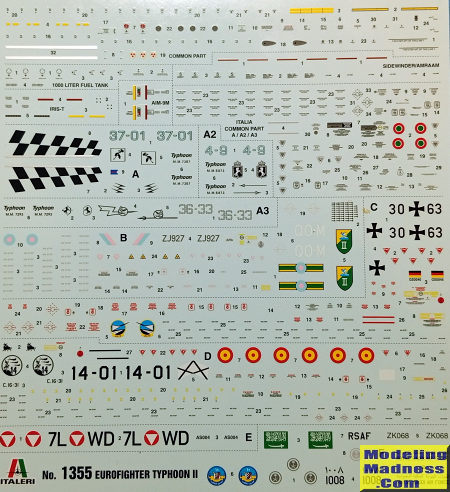
No less than 8 schemes are provided, for a Spanish, a German, an English, a Saudi, an Austrian and three Italian machines. Colors are given in FS numbers, in Italeri codes and in generic form. Decals are wonderfully printed and expected to work well.
Instructions want you to first assemble the cockpit and trap it between the fuselage halves, then attach the 3-piece air intake to the lower wing half, attach the top wing halves and glue the subassembly to the fuselage. Some attention will be needed there, in order to line up everything correctly. The spine is then attached, followed by the air brake (select extended or retracted), the canards (I would attach them at end stages, as they look sensitive) and the nose, where 20 grams of weight have to be secured inside, to avoid tail sitting.
The exhausts are next, followed by the transparencies (I prefer to add them at end stages) and a couple of fillets to the front and rear fuselage. Landing gear is then assembled and attached in position, followed by the external loads and, finally, the refueling probe, ending a build that looks uncomplicated and straightforward.
| CONCLUSIONS |
Superseded by various latest and greatest (and more expensive and complex) releases, this is still a decent kit of the iconic Eurofighter: overall accuracy is good for the scale, as is the molding, with well done recessed panel lines. Detail, though not up to latest standards, is decent, transparencies are well done, and instructions are superb, as are the decals.
Out of the box a good representation of the Eurofighter can emerge. Construction seems straightforward with some extra attention needed to the air intake fitting. Offered at a relatively low price, this can be regarded as a cheaper, simpler but still decent alternative to the latest offerings.
Happy Modeling!
Spiros Pendedekas
March 2026
Copyright ModelingMadness.com. All rights reserved. No reproduction in part or in whole without express permission from the editor.
If you would like your product reviewed fairly and fairly quickly, please contact the editor or see other details in the Note to Contributors.