
Airfix 1/72 F-35B Lightning II
| KIT #: | A50191 |
| PRICE: | $ |
| DECALS: | One option |
| REVIEWER: | Spiros Pendedekas |
| NOTES: | Included in Dambusters 80th Anniversary kit |
| HISTORY |
The F-35B Lightning II is the short takeoff and vertical landing (STOVL) variant of the F-35 family, designed to operate from amphibious assault ships, small aircraft carriers, and forward operating bases where conventional runways may be unavailable. Its most distinctive feature is the innovative propulsion system developed by Rolls-Royce and Pratt & Whitney, combining a shaft-driven lift fan behind the cockpit with a swiveling rear exhaust nozzle. This unique arrangement allows the aircraft to hover, land vertically, or take off from very short runways while retaining the stealth characteristics, advanced sensors, and supersonic performance expected of a fifth generation fighter.
Despite the engineering complexity required to achieve STOVL capability, the F-35B remains a highly capable multirole combat aircraft. It can conduct air superiority, precision strike, close air support, reconnaissance, and electronic warfare missions while sharing real-time battlefield information through its advanced sensor fusion and networked communications. Operated by forces such as the United States Marine Corps, the Royal Air Force, the Royal Navy, and several allied nations, the F-35B has demonstrated that it can bring fifth-generation combat capability to locations and ships that would otherwise be unable to support conventional high-performance fighter aircraft.
| THE KIT |
 Airfix
introduced its new-tool 1/72 F-35B in 2023, marketing it both as a standalone
Starter Set (complete with basic paints, brushes, and glue) and as part of two
sets: "Supermarine Spitfire & F-35B Lightning II" and "617 Sqn. Dambusters 80th
Anniversary – Lancaster and F-35B." The kit previewed here comes from the latter
boxing and was a gift from a friend who only wanted to build the Lancaster.
Airfix
introduced its new-tool 1/72 F-35B in 2023, marketing it both as a standalone
Starter Set (complete with basic paints, brushes, and glue) and as part of two
sets: "Supermarine Spitfire & F-35B Lightning II" and "617 Sqn. Dambusters 80th
Anniversary – Lancaster and F-35B." The kit previewed here comes from the latter
boxing and was a gift from a friend who only wanted to build the Lancaster.
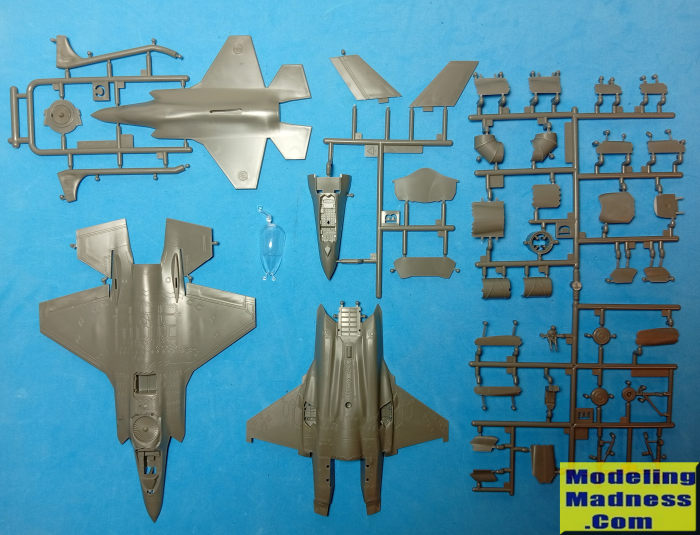
Upon opening the box, I was greeted by 40 dark gray styrene parts. The upper and lower fuselage halves are molded separately, while the remaining parts are neatly arranged on three sprues. Molding is generally crisp, although I noticed a few sink areas such as along the sides of the canopy and the flaperons, possibly indicating premature removal from the molds before sufficient cooling took place. There are also a few minor mold seam lines, but these should be easy to remove during the normal cleanup process.
Surface texture is slightly on the pebbly side rather than perfectly smooth. In this particular case, however, it is not necessarily a drawback, as the F-35's radar absorbent skin has a subtle, non-glossy appearance rather than a highly polished finish. Panel lines are finely engraved and include the aircraft's distinctive sawtooth-shaped low-observable panel joints, which are a characteristic feature of the F-35. They appear restrained and should look convincing once a primer and paint finish have been applied.
A notable aspect of the kit is its balanced approach to detail. It is clearly designed with ease of assembly in mind without appearing overly simplified. The level of detail is sufficient to produce a convincing replica while avoiding high complexity, making the kit suitable for both beginners and experienced modelers looking for an enjoyable build. So, cockpit is fairly basic, with only the essential features represented. The ejection seat is average in both shape and detail, while the instrument panel is intended to be finished with a decal rather than raised detail. An average-looking pilot figure is also included, allowing the model to be displayed in flight if desired.
The same philosophy extends to the landing gear, which is well represented without becoming overly detailed. Once painted and weathered, it should look convincing while remaining easy to assemble. The air intakes are relatively shallow, an understandable compromise given the kit's straightforward engineering. In contrast, the swivelling rear exhaust nozzle is nicely detailed and should look convincing straight from the box. The lift-fan doors may be displayed either open or closed, allowing the aircraft to be built in either its conventional flight or in its distinctive STOVL configuration. The rear exhaust nozzle can likewise be positioned either in its normal forward-flight position or rotated downward for short takeoff and vertical landing.
Neither external tanks nor any other external stores are provided. A well designed display stand is included, providing an attractive way to display the aircraft in flight. To accommodate the stand, a mounting hole is molded into the underside of the fuselage, which has to be filled should the builder wishes to display the aircraft on its landing gear.
Transparencies are well molded and clear. Since the F-35's canopy has its characteristic gold tint, it would have been a welcome touch had Airfix molded the clear parts in a subtle golden shade. Doing so would have spared the modeller the need to reproduce this distinctive feature with tinted clear paints. Instructions are the first part of the combined kit's color booklet. They are nicely done, including a short history of the type, a sprues map, with the construction spread in 26 concise steps where the various options (open or closed lift-fan doors, the alternative positions of the swivelling exhaust nozzle, landing gear extended or retracted) are clearly indicated and with color callouts provided throughout.
 Only one
marking option is provided depicting a Royal Air Force aircraft finished in an
attractive scheme featuring striking lightning bolts on the vertical tails.
Decals are sharply printed, with excellent register and good colour density, and
should perform very well during application.
Only one
marking option is provided depicting a Royal Air Force aircraft finished in an
attractive scheme featuring striking lightning bolts on the vertical tails.
Decals are sharply printed, with excellent register and good colour density, and
should perform very well during application.
Construction begins by joining the upper and lower fuselage halves, trapping the two internal bulkheads, the engine and the exhaust nozzle assembly between them. The fins and the ejection seat are installed next, although the latter can easily be left until the end of the build to simplify painting and detailing.
From this point onward, construction branches according to the configuration the modeller wishes to depict. The appropriate lift-fan doors and exhaust nozzle position are selected depending on whether the aircraft is being built in conventional flight or STOVL configuration. The landing gear may then be installed either extended for a parked aircraft or retracted for an in-flight display. The canopy is designed to snap into place without the need for glue, allowing it to be removed if desired.
The final step is the assembly of the display stand and mounting the aircraft. Alternatively, if the model is to be displayed on its wheels, the stand mounting hole should be filled before painting. This ends a straightforward, uncomplex and seemingly pleasant build.
| CONCLUSIONS |
Overall, this is a very good kit that combines simplicity, accuracy and ease of assembly. The parts breakdown is logical, the clear parts are well done, and the construction process is enjoyable. Molding is sharp, although the presence of some sink marks could easily be avoided with better quality control procedures.
While there are certainly more highly detailed kits available, such as some of the latest offerings from Tamiya or Italeri, this model follows a more beginner-oriented philosophy. It does not aim to compete in terms of extreme detail, but it provides enough detail to achieve a very attractive result. With careful painting and finishing, it can satisfy both newcomers and experienced modelers, looking for an enjoyable and relaxing build.
Happy Modeling!
July 2026
Copyright ModelingMadness.com. All rights
reserved. No reproduction in part or in whole without express permission from
the editor.
Review kit courtesy of my wallet If you would like your product reviewed fairly and fairly quickly, please contact the editor
or see other details in the
Note to
Contributors. Back to the Main Page
Back to the Review
Index Page
Back to the Previews Index Page