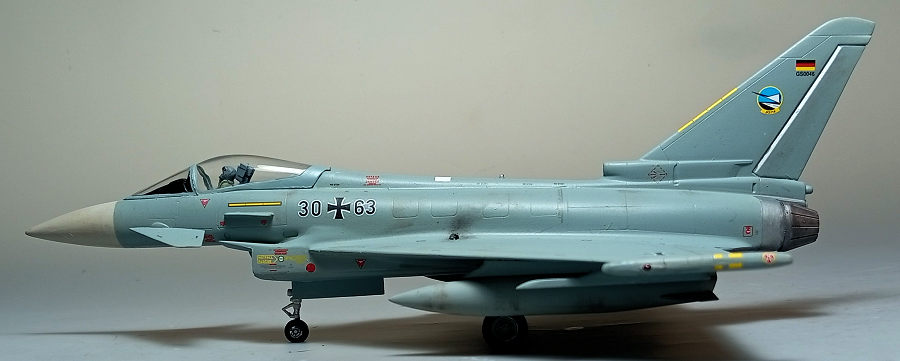
| KIT #: | 1355 |
| PRICE: | 19 Euros |
| DECALS: | Eight options |
| REVIEWER: | Spiros Pendedekas |
| NOTES: | An emotional build commemorating a dream that never came true |
| HISTORY |
THE EUROFIGHTER THAT
NEVER FLEW THAT DAY - A story about a boy, a dream, and a father's love
Loukas's love for Germany began long before he could fully understand where such
feelings came from. In many ways, it was an affection passed down through three
generations, carried from one heart to another like a precious family
inheritance.
His grandfather had loved Germany and often taken Loukas's father there during
his childhood. Those journeys left behind memories that never faded, and
Germany—especially Bavaria—became a place of deep affection for Loukas's father.
Years later, that same love found its way into Loukas's own heart. What had once
been his grandfather's passion, and then his father's cherished memory,
gradually became part of the little boy's own world.
Perhaps some places become part of us not simply because we visit them, but
because of the love with which they are introduced to us. For Loukas, Germany
was more than a country on a map. It was a place filled with happy memories,
familiar images and a special sense of belonging. Its name could bring a sparkle
to his eyes, and the thought of returning there was enough to stir his
imagination.
But there was another
passion growing alongside his affection for Germany: aviation.
Aircraft fascinated him. Their powerful engines, sweeping wings and
extraordinary ability to rise into the vastness of the sky seemed to possess a
magic all their own. To a boy who loved flying
 machines,
every aircraft promised an adventure, every take-off was a small miracle, and
every pilot seemed to belong to a world where courage, skill and freedom met
among the clouds.
Then came the news that a German Eurofighter Typhoon would appear at Athens
Flying Week on 5 September 2026.
For Loukas, this was more than an announcement about an air show. It was the
promise of something he had been longing to experience: a magnificent fighter
representing a country he loved, brought together with the aviation that
captured his imagination. The grey German Typhoon was no longer simply an
aircraft he had seen in photographs. Soon, he hoped, it would be there in front
of him, real and powerful, its engines roaring and its wings cutting through the
September sky.
Yet Loukas dreamed of
something more personal than watching the display.
He wanted to greet the pilot.
He imagined himself standing among the spectators, looking up towards the
cockpit and raising his hand in a wave. Perhaps the pilot would notice him.
Perhaps, just for a second, a hand would rise behind the canopy and return his
greeting. It was such a small wish, almost insignificant in the eyes of an
adult, yet to Loukas it would have meant the world.
For weeks, he carried that hope with him. He pictured the aircraft, its German
markings, the pilot preparing for flight, and the moment when their eyes might
somehow meet across the distance between the cockpit and the crowd.
He could not know whether his dream would come true. That was part of its
beauty. The day had not yet arrived, and anything still seemed possible.
Children have a remarkable ability to fill a single moment with an entire world
of happiness. They do not always dream of grand achievements or extraordinary
rewards. Sometimes, they ask only for one unforgettable experience, one moment
that will belong to them long after the crowds have gone home.
For Loukas, that moment was waiting beneath the September sky.
He had no reason to imagine that the sky he was longing to see would soon become
the setting for a memory so different from the one he had dreamed of.
WHEN THE SKY FELL SILENT
Then came the accident.
An F-4 Phantom crashed, and both pilots lost their lives. The air show came to
an abrupt end. The excitement that had filled the airfield gave way to shock,
grief and silence, and the flying programme was stopped.
The German Eurofighter never took off.
There would be no thunder of its engines across the airfield, no sweeping turns
above the spectators, no grey wings flashing in the sunlight. And there would be
no opportunity for Loukas to greet the pilot he had been waiting so eagerly to
see.
The tragedy was far greater than the disappointment of a child. Two lives had
been lost, and the loss cast a shadow over everything that followed. The sorrow
of that day deserved respect, and no unfulfilled wish could ever be compared
with the lives that had been taken.
Yet, within that much greater tragedy, a young boy carried his own quiet
heartbreak.
Loukas had looked forward to that afternoon with all the anticipation his young
heart could hold. He had imagined the aircraft so vividly that, in his mind, the
experience had almost become real. Now, in a single devastating turn of events,
the moment he had waited for had disappeared.
There was no one to blame. The pilot had not failed him, and the aircraft had
not disappointed him. Life had simply taken a course nobody could have foreseen.
In the days that followed, the memory of the air show remained with Loukas.
Perhaps he wondered what the Eurofighter would have looked like in flight, how
its engines would have sounded, or whether its pilot might really have returned
his wave. The questions could have no answer. The aircraft remained unseen, and
the greeting existed only in the world he had imagined.
 A father
cannot undo such a moment. He cannot turn back time, reverse a tragedy or
promise his child that every dream will come true. There are disappointments
that cannot be repaired with words, however lovingly they are spoken.
But a father can remain beside his child. He can listen, share the things that
matter to him and help him discover that an interrupted dream does not always
have to disappear.
Sometimes, the way forward begins with something very small.
For Loukas, it began with a model aircraft.
A DREAM TAKES SHAPE
A Eurofighter Typhoon kit had been waiting in the family's stash for several
years. Loukas had noticed it long before the air show and had often asked when
it would finally be built. Now, after the September afternoon that had ended so
differently from what he had imagined, he asked whether the model could be
finished as a German aircraft.
It was a simple request, but it carried a world of feeling.
The little fighter could never replace the real aircraft he had hoped to see. It
could not reproduce the thunder of its engines, the vibration of the air beneath
its wings or the extraordinary sight of a modern fighter climbing into the sky.
Nor could it change what had happened at the air show.
But it could bring the aircraft into Loukas's own world.
It could wear the markings of Germany, the country he loved. It could become the
fighter he had been waiting for. And, most importantly, it could give him and
his father something meaningful to do with a dream that had been left
unfinished.
The box was opened, and the familiar grey plastic parts were laid out on the
workbench. Some work had already been done, some parts were glued together. To
someone else, they might have seemed like nothing more than pieces waiting to be
assembled. To Loukas, they represented the beginning of a new journey.
The cockpit took shape first, followed by the fuselage, wings and canards.
Gradually, the distinctive silhouette of the Eurofighter emerged from the
scattered parts. Each stage brought the little aircraft closer to life:
components fitted together, seams were smoothed, surfaces prepared and details
carefully painted.
There were small challenges along the way, as there always are in scale
modelling. But with every completed stage, the fighter became more recognisable,
more tangible, and more closely connected to the aircraft Loukas had imagined
standing on the airfield.
The German markings were especially important. They gave the model its identity,
transforming it from a generic miniature fighter into the aircraft he had wanted
to see. When the decals were finally in place, the little Typhoon stood before
him in the colours of the German Luftwaffe.
It was a small achievement, perhaps, but one filled with a special kind of
satisfaction.
The model had become more than a project. It was a shared experience, a
collection of hours spent at the workbench, and a reminder that happiness could
still be found in something connected to the dream that had been interrupted.
That is one of the quiet wonders of scale modelling. We begin with plastic
parts, paint and decals, intending to recreate a machine. Yet sometimes, without
even realizing it, we begin to build something else: a connection, a memory, a
story that will remain long after the glue has dried and the airbrush has been
cleaned.
For Loukas, the German Eurofighter was becoming a little piece of the world he
loved. The aircraft he had never seen fly now had a place in his home, where he
could admire it, imagine its flight and keep his fascination with aviation
alive.
His father had helped him bring it into existence.
The real aircraft had never crossed the sky above the air show, but another
journey had begun—one that would unfold not on a runway, but in the imagination
of a boy who was not yet ready to let his dream go.
THE FLIGHT BENEATH THE SEPTEMBER SKY
A year had passed.
Loukas was a little older now, but his fascination with Germany and aviation
remained as strong as ever. The German Eurofighter rested on the shelf, its grey
wings stretched out and its national markings catching the light. The model had
become a familiar presence in his room, yet it had never lost the special
meaning it had acquired during its construction.
Sometimes, he would stop and look at it, remembering the air show, the aircraft
he had hoped to see, and the afternoon that had ended in tragedy. The memory had
become part of his childhood, but it no longer belonged only to disappointment.
There were other memories attached to the little fighter now: the workbench, the
assembly of its parts, the application of its markings, and the satisfaction of
seeing it finally completed.
One afternoon, Loukas stood looking at the model for a little longer than usual.
He studied the pointed nose, the swept wings and the small German insignia. He
imagined the pilot beneath the canopy, the engines beginning to roar, and the
aircraft accelerating towards the end of the runway.
Then, almost without noticing, he began to imagine the flight itself.
The room faded from his thoughts. The quietness around him gave way to the
distant rumble of engines. The shelf became an airfield, the still model became
a living machine, and the blue of the sky stretched endlessly beyond the runway.
This time, the flying programme would not be stopped.
This time, the aircraft would take off.
The airfield lay beneath a brilliant September sky. A grey German Eurofighter
Typhoon stood on the runway, its markings glistening in the sunlight. Ground
crew moved away from the aircraft as the pilot completed his preparations.
Inside the cockpit, the canopy reflected the blue above, concealing the face of
the man who was about to take the fighter into the air.
Then the engines came alive.
Their roar rolled across the airfield, growing louder until it seemed to fill
every corner of the world. Loukas stood among the spectators, his eyes fixed on
the aircraft. His father was beside him, but for a moment the boy scarcely
noticed anything else.
The Eurofighter began to move.
It accelerated along the runway, gathering speed with breathtaking
determination. Its nose lifted, the wheels left the ground, and the grey fighter
climbed into the open sky.
There it was.
The German aircraft Loukas had wanted so desperately to see was finally flying
before him. Sunlight flashed across its wings as it climbed higher, then banked
gracefully above the airfield. Its engines filled the sky with their powerful
roar, and the fighter swept through the blue as though it had always belonged
there.
Loukas followed every movement, afraid to miss even a second. The aircraft
turned, levelled out and returned for another pass. He watched its wings tilt
against the sunlight, its nose pointing towards the horizon before it curved
back over the spectators.
His face shone with excitement.
The aircraft was real to him now, not merely a collection of photographs or a
miniature resting on a shelf. He could almost feel the power of its engines,
almost sense the rush of air beneath its wings. Everything he had imagined
during the long wait before the air show was unfolding before his eyes.
Then the Eurofighter approached once more.
Loukas raised his hand.
 He waved
towards the cockpit, offering his greeting with all the enthusiasm and sincerity
of a boy whose dream had finally come true. He could not know whether the pilot
could distinguish him among the spectators, but that did not matter. The
greeting came from the heart, and for one brief moment he felt connected to the
aircraft and the world of aviation he admired so much.
Sunlight glimmered across the canopy.
The pilot looked towards the crowd.
Then, in the world Loukas had created in his imagination, the pilot raised his
hand in return.
Loukas saw it.
The salute lasted only a moment. It was no more than a small gesture from a
cockpit high above the ground, a movement that almost anyone else might have
missed. But for Loukas, the world seemed to stand still.
The pilot had seen him.
His greeting had been returned.
A smile spread across the boy's face, the kind of smile that needs no
explanation and asks for nothing more. For that one precious instant, the
distance between the cockpit and the crowd had disappeared. The boy who had
waited so patiently had become part of the world he had admired from afar.
Beside him, his father watched the happiness on his son's face.
The Eurofighter banked gently and continued across the sky, its grey wings
catching the sunlight as it headed towards the horizon. Loukas watched it grow
smaller, wishing the moment could last just a little longer. He followed the
aircraft until it was almost lost against the endless blue.
He had seen the flight.
He had greeted the pilot.
The pilot had waved back.
For a moment, the dream had become everything he had hoped it would be.
Then the aircraft disappeared into the distance, and the sky grew quiet again.
WHAT A MODEL CAN REMEMBER
The room returned.
The airfield vanished, the roar of the engines faded, and the spectators
dissolved into the stillness of an ordinary afternoon. Loukas was standing
before his model once more. The little German Eurofighter rested exactly where
it had always been, motionless on its landing gear, its grey surfaces and
national markings illuminated by the light.
The flight had taken place only in his imagination.
The real Eurofighter had never flown at Athens Flying Week that September, and
its pilot had never had the opportunity to return a little boy's greeting. The
two Phantom pilots had lost their lives, and the tragedy that ended the air show
remained an unchangeable part of the story.
Nothing about the model could alter those facts.
Yet something important had survived.
The aircraft on the shelf carried Loukas's fascination with aviation, his
affection for Germany and the memory of a dream that had once seemed so close.
It also carried the hours he and his father had spent bringing it to life,
turning an ordinary kit into something that belonged to them both.
Perhaps years from now, when Loukas is older and the details of his childhood
have begun to blur, he will come across this little fighter among the models
that have become part of his life. He may not remember every step of its
construction or every conversation at the workbench. But hopefully, he will
remember how much he wanted to see the German Eurofighter, how eagerly he
anticipated that September afternoon, and how deeply disappointed he was when
the aircraft never took off.
Perhaps he will remember something even more important.
He will remember that he did not have to carry that disappointment alone.
His father could not bring the real aircraft back to the airfield. He could not
change the tragic events of that day or give Loukas the experience he had hoped
for. But he could share his son's passion, help him bring the little fighter to
life, and give him something that would preserve the dream without pretending
that the tragedy had never happened.
Sometimes, that is all love can do. It cannot erase every sadness, but it can
stand beside us when sadness arrives. It cannot guarantee that our dreams will
come true, but it can help us discover another way to keep them alive.
Sometimes, that other way begins with a simple box of plastic parts.
The Eurofighter on the shelf was more than a model of a modern fighter. It was a
reminder of the bond between father and son, of the happiness found in creating
something together, and of the way imagination can help a young heart find its
way back to joy.
The aircraft had never flown that day.
But the story it inspired had travelled much further than either of them could
have imagined.
THE SALUTE THAT REMAINED
There is a reason the imagined flight matters so much.
It does not change the past. It does not erase the loss of the two Phantom
pilots or pretend that the air show continued as planned. It does not turn an
imagined greeting into a real event.
Instead, it gives Loukas a different way to remember.
The boy who once stood waiting for a German Eurofighter can now look at the
model and picture the aircraft rising into the September sky. He can imagine the
roar of the engines, the sunlight across the grey wings, and the moment when the
pilot notices him among the spectators.
He can raise his hand and wave.
In his imagination, the pilot will always have time to wave back.
Perhaps that is what makes the little fighter so precious. It allows the dream
to continue without denying reality. The sadness of that September day remains
part of the story, but it is no longer the only thing the story contains.
Alongside it are the pleasure of building the model, the excitement of aviation,
the affection for Germany passed down through generations, and the love that
brought father and son together at the workbench.
A father cannot promise his child that every dream will come true. He cannot
protect him from every disappointment or give back every moment that life takes
away. But he can help him discover that a dream is not always destroyed when the
moment we hoped for never arrives.
Sometimes, it changes its shape.
Sometimes, it finds a home in a memory, a photograph, a story or a little
aircraft resting on a shelf. And sometimes, it continues to fly in the
imagination of a boy who has not forgotten what he wished for, and in the heart
of a father who wanted to help him find his smile again.
The real German Eurofighter never crossed the September sky above the Tanagra
airfield. Its engines never roared over the spectators, and its pilot never saw
Loukas waving below.
But the little model has given that unfinished dream a place to live.
Whenever Loukas looks at it, the flight can begin again. The engines come alive,
the grey fighter accelerates along the runway, and its wings lift it towards the
endless blue. It sweeps above the airfield, turns towards the spectators and
passes once more beneath the sunlight.
A small boy raises his hand.
High above him, the pilot returns the salute.
Loukas waves back, his father beside him.
The Eurofighter flies on.
| THE KIT |
This is the 2014 reissue
of Italeri's original 1993 tooling. A decent kit by all means, although it has
undoubtedly been superseded by newer offerings. Nevertheless, it can still
produce a respectable representation of the Eurofighter Typhoon. The kit is not
particularly elaborate by modern standards, but it remains an enjoyable project,
with Italeri's excellent decals being the icing on the cake.
I purchased this particular kit around 2020–2021 at my local club's annual
contest. It subsequently found its place in my stash, where it remained for
several years. My younger son, Loukas, had always been particularly fond of this
kit and would often ask me when we were going to build it, and, in fact, I had
started the kit a year or so ago.
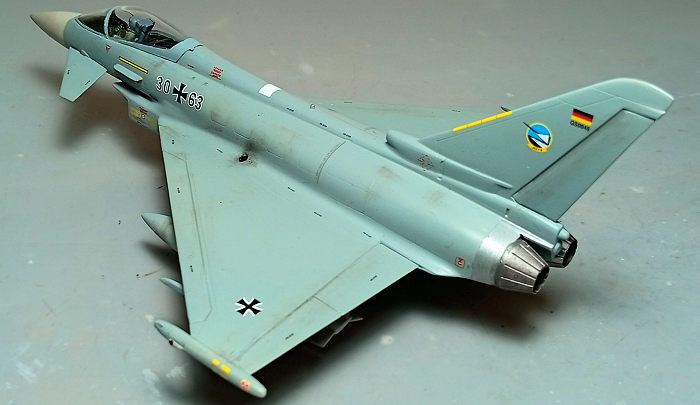 As mentioned
above, last summer, on 5 September, we attended one of the air shows we
regularly visited near our home base. Loukas had developed a special affection
for Germany during our family holiday the previous summer, and he was especially
excited about seeing the German Eurofighter Typhoon at the show. He was eagerly
looking forward to greeting its pilot, hoping that the pilot might notice him
and return his wave.
Unfortunately, the tragic crash of an F-4 Phantom brought the flying programme
to an abrupt end. The Eurofighter never took off, and Loukas never had the
opportunity to see it fly or greet its pilot.
The accident was a sobering experience, and the disappointment of the day stayed
with him. Afterwards, he asked me if we could build the German Eurofighter,
preserving the markings of the aircraft he had been so eager to see. It was his
way of maintaining a connection with a dream that had never come true.
For me, this became a very special project. What had been sitting in my stash as
just another kit became something much more personal: an opportunity to share my
son's passion for aviation, to help him keep a cherished dream alive, and to
turn a disappointing memory into something positive that we could build
together.
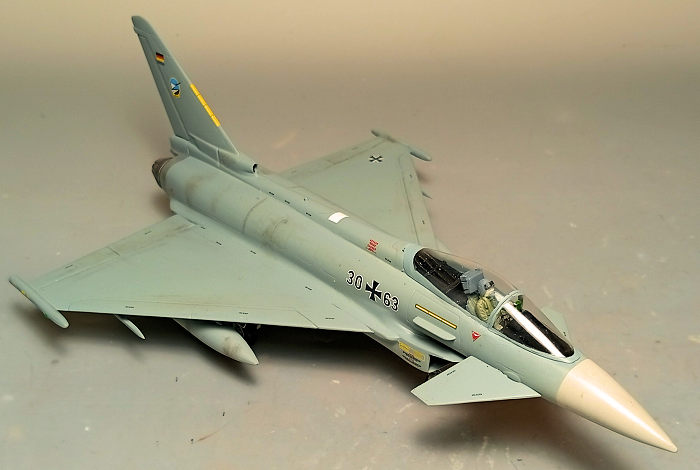
So, the Italeri Typhoon finally got prioritised to the workbench. This is our
German Eurofighter, a model with a story that goes far beyond the plastic from
which it was made.
| CONSTRUCTION |
I began construction
with the cockpit, which is neither overly simplistic nor particularly elaborate.
It is adequately detailed for the scale and provides a satisfactory basis for an
out-of-the-box build.
The main cockpit colour was medium grey, while the instrument panel and the
control stick were painted black. The raised instrument details were picked out
with a silver dry-brushing technique. The prominent multifunction displays were
simulated by applying a small spot of silver paint to each screen, followed by a
coat of clear green.The ejection seat received the same basic grey colour, while
the upper cockpit coaming and the glare shield behind the instrument panel were
painted black. The protruding head-up display was also treated with clear green
paint to simulate its glass.
I decided to include the pilot for two reasons. First, a figure adds life to the
not overly elaborated cockpit and makes the finished aircraft more convincing.
More importantly, this particular Eurofighter was meant to represent the
aircraft whose pilot Loukas had hoped to greet at the air show. Including a
pilot was therefore an important part of the story behind the model.
The pilot was painted in a green flight suit, with a grey helmet and black
goggles. The seat belts were picked out in a lighter, pale green shade to
provide some contrast against the seat.
Once everything was assembled and painted, the cockpit looked sufficiently busy,
especially with the pilot in place. Considering that I was building the kit
straight from the box, I was perfectly happy with the result.
The cockpit was then trapped between the fuselage halves. Next, I assembled the
wing subassembly, which incorporates the air intakes.Careful alignment was
required when fitting the central intake section to the main wing assembly, but
everything came together satisfactorily. The completed assembly was subsequently
attached to the fuselage.
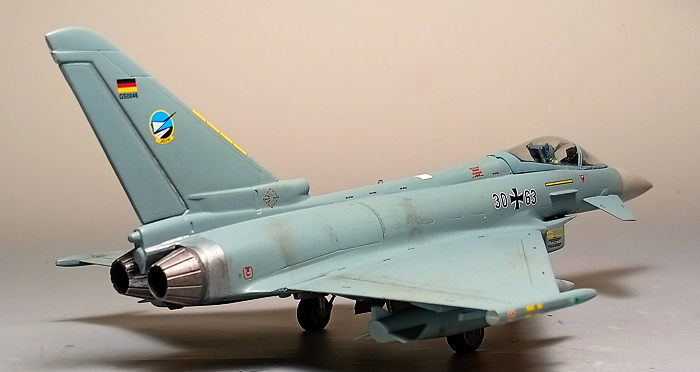 The upper
fuselage spine is made up of two pieces. It is apparent that Italeri designed
the tooling to accommodate both single-seat and two-seat Eurofighter versions,
using inserts to cater for the differences between the two configurations. The
rear fuselage section, which forms the basis for the exhaust nozzles, was also
attached at this stage.
I did not glue the canards permanently in place during the main assembly.
Instead, I test-fitted them and left them removable.
Before closing
everything up, I considered how much nose weight would be required to prevent
the completed model from sitting on its tail. Approximately 30 grams of lead
proved sufficient, and I secured the weight in the nose. This ensured that the
finished aircraft would sit correctly on its landing gear.
There are a few additional parts that can be attached to various areas of the
fuselage, but these are not appropriate for every version of the Eurofighter. I
left them off because they were not present on the particular aircraft I was
modelling. As always, some research into the specific version being built is
advisable before adding these details.
With the main airframe assembled, I was ready to proceed with filling and
sanding. However, I discovered that a small part on the right side of the intake
was missing. Despite searching for it, I could not locate it anywhere. It had
apparently disappeared into hyperspace!
Rather than let this small mishap delay the project, I fabricated a replacement
from a piece of styrene sheet and carefully blended it into position. Once the
repair was completed, the missing detail was restored and the assembly looked as
it should.
Overall, the fit was relatively good. The assembly process was quite pleasant,
and only modest amounts of filler and sanding were required to tidy up the
joints. There were no major problems, and the airframe soon reached the stage
where it was ready for the paint shop.
| COLORS & MARKINGS |
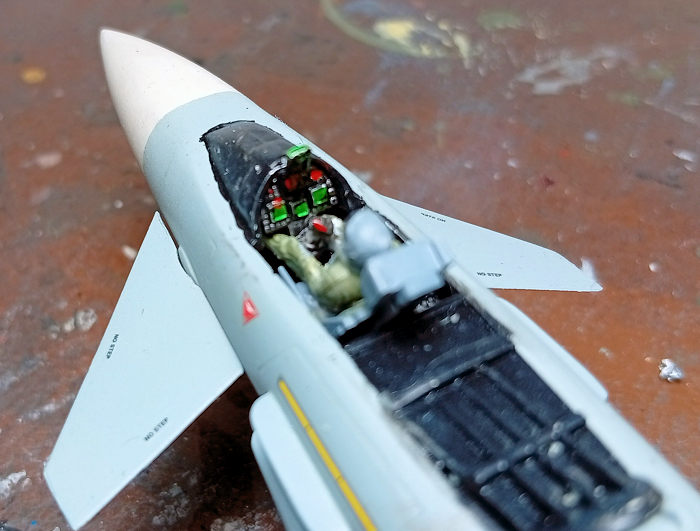 I gave the
completed airframe an overall coat of Humbrol 128 gray. To my eye, this provides
a reasonable match for the general grey appearance of the operational
Eurofighter.
The nose radome was then masked and painted with Humbrol 129, a lighter,
slightly tan-toned grey, to reproduce the difference in shade between the radome
and the surrounding fuselage. The interiors of the air intakes were painted
white, while the distinctive APU exhaust area was painted black, reproducing the
characteristic darkened patch associated with this part of the aircraft.
Once the paint had dried thoroughly, I applied a coat of Future to prepare the
surface for the decals. This provided a smooth, glossy finish and helped ensure
that the decals would settle properly onto the model.
I used the kit decals to represent the German Eurofighter. Italeri's decals
behaved beautifully throughout the application process. They detached cleanly
from their backing paper, were easy to position and adhered well to the model,
settling nicely over the surface details.
The German markings were an essential part of this particular build. They gave
the aircraft the identity Loukas had been looking forward to seeing at the air
show and helped preserve the connection with the country he had grown so fond
of.
As usual, Italeri's decals proved to be a real asset to the kit. Their quality
and ease of application add considerably to the overall value of the model.
After the decals had dried, I applied another coat of Future to seal them and
protect the markings before proceeding with the final stages.
| FINAL CONSTRUCTION |
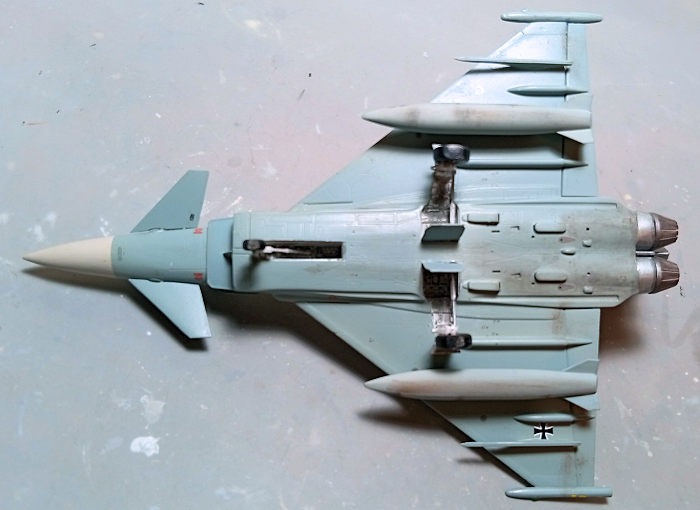
The landing gear was
assembled and attached in position. The lgear legs, struts, wheel bays and the
door innards were all painted white. The oleo sections were picked out in
silver, while the wheel rims were also painted white and the tires black. With
the landing gear in place, the Eurofighter was finally standing proudly on its
own feet.
The exhaust nozzles were painted with Testors Burnt Metal, while the fore
fuselage section received a steel finish. The kit's exhaust nozzles are molded
in the closed position, representing an aircraft with its engines running at a
relatively low thrust setting. This is appropriate for the operational
appearance I wanted to portray, with the pilot seated in the cockpit.
The external fuel tanks received the same basic grey colour as the airframe and
were subsequently attached in position.
I adecided to apply some weathering to break up the otherwise rather uniform
grey finish. I kept it relatively restrained, using dark brown and black patches
in selected areas where dirt, exhaust deposits and grime would naturally
accumulate. Particular attention was given to the APU exhaust, where the
distinctive blackened area was reproduced with a diffused finish.
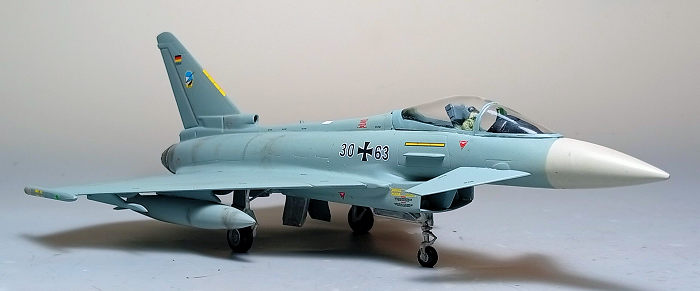 A black wash
was applied around the landing gear and associated details to accentuate the
moulded features and give these areas a slightly used, oily appearance. I
deliberately avoided excessive weathering, as I wanted to retain the overall
clean appearance of an operational modern fighter without leaving the model
looking too pristine.
A final satin coat brought everything together and provided the finish I wanted
for the completed aircraft.
The transparencies have reasonably well-defined frames, which I hand-painted
before attaching them to the model. Their fit was quite good, and they settled
into position without any major difficulties.
The canards were finally press-fitted into place. The wingtip navigation lights
were represented with small spots of clear red and clear green paint, while a
tiny spot of silver simulated the upper anti-collision light.
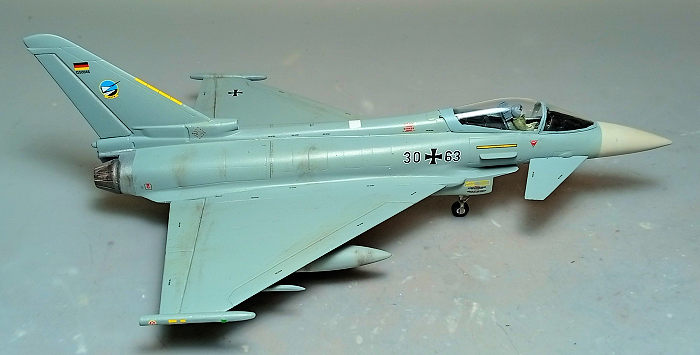
With these final details completed, the German Eurofighter Typhoon was finished
and ready for the display shelf.
| CONCLUSIONS |
The Italeri 1/72
Eurofighter Typhoon may no longer be the latest or most sophisticated kit of
this aircraft, but that does not mean it should be overlooked. Despite its age,
the kit remains a very good proposition for anyone wishing to build a model of
this impressive modern fighter.
Its greatest strength lies in its straightforward nature. The kit is not
overloaded with complicated assemblies or an overwhelming number of tiny
details, yet neither is it so simplistic that the finished model lacks
character. It strikes a very reasonable balance between ease of construction and
the level of detail needed to produce an attractive representation of the real
aircraft.
The overall shape looks convincing, the engraved panel lines are nicely done,
and the fit is generally good. Although some careful alignment is required in
places, particularly around the intake assembly, the construction is pleasant
and does not demand excessive amounts of filling and sanding. The transparent
parts are satisfactory, and the decals are particularly impressive. They are
easy to handle, adhere well and settle beautifully over the surface details.
Built straight from the box, the Italeri Typhoon can produce a very attractive
model. With some careful painting, a little attention to the details and
restrained weathering, the result is more than satisfactory. It is a kit I would
happily recommend to beginners who want to try their hand at a modern jet
aircraft without being overwhelmed by complexity. It offers an enjoyable
introduction to the subject and provides plenty of scope for a rewarding result.
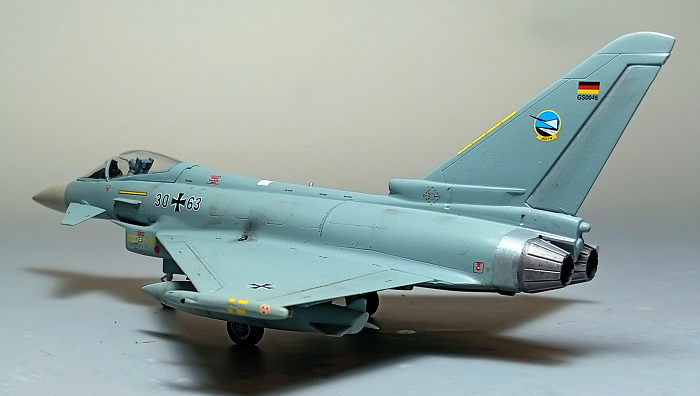 But, as you
may have gathered from the story accompanying this review, this particular model
means much more to me than its technical qualities.
For me, this Eurofighter
will always hold a special place in my heart. It represents a dream my son,
Loukas, had cherished: to see the German fighter fly and, above all, to greet
its pilot. The tragic accident involving the F-4 Phantom brought the air show to
an end, and that little dream remained unfulfilled.
As a father, I wished I could somehow give him back that moment. But we cannot
change what life takes away from us. Sometimes, all we can do is stand beside
our children and help them find another way to hold on to what they love.
A kit that had waited for years in my stash became something far more
meaningful. As we assembled the parts, painted the aircraft and applied its
German markings, we were doing more than building a model. We were preserving a
dream and creating a memory of our own.
The finished Eurofighter cannot replace the flight Loukas never saw, but it
gives that dream a home. Whenever I look at it, I see not just a little gray
fighter, but my son's excitement, our time together at the workbench, and a
moment in his childhood that we have made our own.
Perhaps this is what makes our hobby so special. Beyond the plastic, paint and
decals lie the memories we create and the people with whom we share them.
The Eurofighter never flew that day, and the greeting Loukas had hoped for never
happened. But in our imagination, the grey fighter rises into the September sky,
its pilot turns towards the boy below and raises his hand in salute.
Loukas waves back, his father beside him.
This model is more than a tribute to an aircraft or a dream interrupted. It is a small, lasting expression of a father's love for his son.
So the Eurofighter flies on.
Happy Modeling!
Spiros Pendedekas
16 November 2026 Copyright ModelingMadness.com. All rights reserved. No
reproduction in part or in whole without express permission. If you would like your product reviewed fairly and fairly quickly, please
contact
the editor or see other details in the
Note to
Contributors.