Italeri 1/72 Rafale M
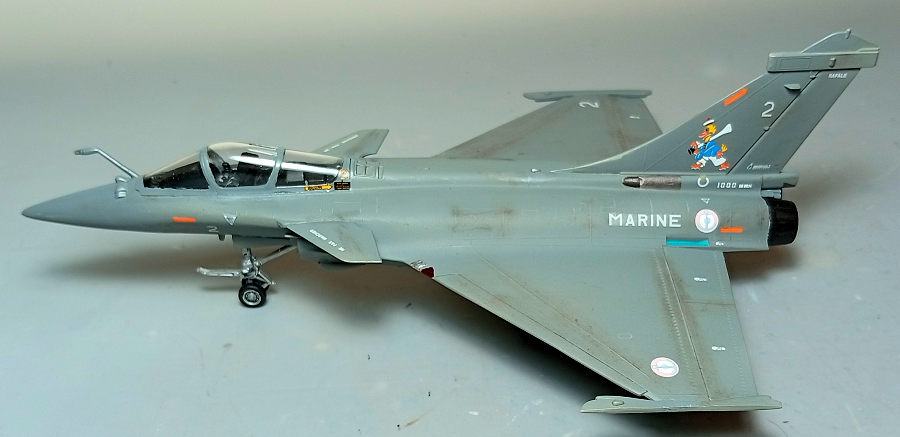
The Dassault Rafale M is the naval version (Marine) of the beautiful French
4.5 generation twin-engine fighter, designed for carrier-based operations
(CATOBAR). It features a reinforced airframe, a detent hook, a "jump strut"
nose wheel, and carries multiple weapons, including Meteor, MICA, SCALP and
Exocet.
Aéronavale received its first Rafale M fighters in December 2000. Flottille
12F, previously operating F-8 Crusaders, became the first squadron to
operate the Rafale in May 2001. They participated in Trident d'Or aboard
carrier Charles de Gaulle, testing avionics and engaging in maritime
exercises. The plane was declared operational with the French Navy in June
2004.
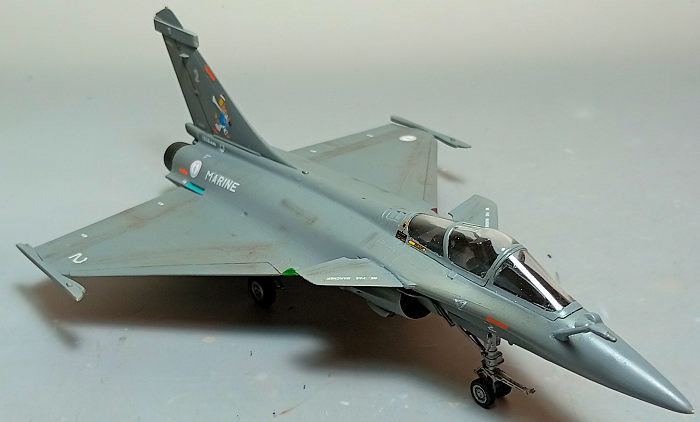 In
2002, Rafale Ms were first deployed in combat during "Mission Héraclès"
aboard the French Navy's Charles de Gaulle. They operated near Afghanistan
but did not engage due to the limitations of the F1 standard. The carrier
later conducted training in the Gulf of Oman and patrols near the
India-Pakistan border. In 2016, Rafales from the same carrier targeted
Islamic State positions in Iraq and the Levant.
In
2002, Rafale Ms were first deployed in combat during "Mission Héraclès"
aboard the French Navy's Charles de Gaulle. They operated near Afghanistan
but did not engage due to the limitations of the F1 standard. The carrier
later conducted training in the Gulf of Oman and patrols near the
India-Pakistan border. In 2016, Rafales from the same carrier targeted
Islamic State positions in Iraq and the Levant.
The type is designed to be fully compatible with United States Navy aircraft
carriers and several French Navy pilots have received qualifications to
operate the aircraft from US Navy flight decks. A significant event occurred
on 4 June 2010, when a French Rafale became the inaugural foreign navy jet
fighter to have its engine replaced on board the USS Harry S. Truman during
a military exercise.
In December 2015, American and French military officials considered
deploying French naval Rafale Ms on a US Navy Nimitz-class aircraft carrier
starting January 2017, allowing continued operations during Charles de
Gaulle's major refit. Although Rafales had demonstrated interoperability by
landing on U.S. carriers, this would mark their first combat missions from
one. Up to 18 Rafale Ms could be stationed on the carrier, with space needed
for support crews and supplies. In May 2018, Operation Chesapeake tested
this interoperability, with 12 Rafales and approximately 350 personnel
training on USS George H.W. Bush.
On January 9, 2025, the Rafale participated in joint anti-aircraft exercises
alongside the Indian Air Force's Su-30MKI and Jaguar aircraft. This event
took place while the French Carrier Strike Group (CSG), led by the aircraft
carrier Charles de Gaulle, was visiting India from January 4 to January 9,
2025, as part of Mission Clemenceau 25. During this timeframe, the INS
Mormugao was also engaged in joint navigational drills and a Maritime
Partnership Exercise with the escort ships accompanying the French CSG.
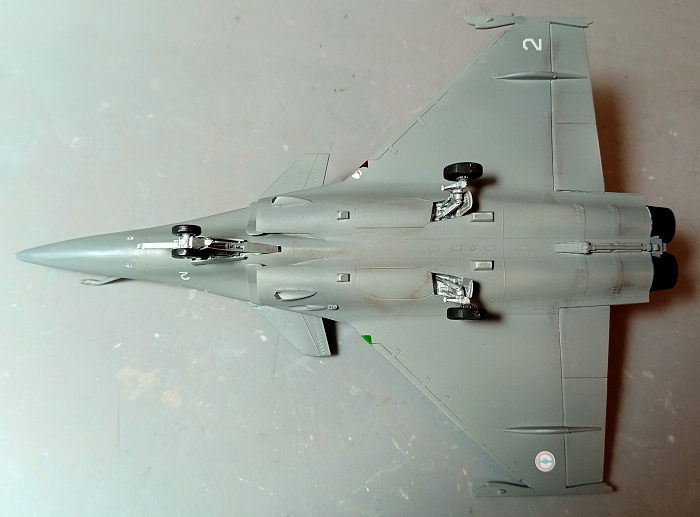 Italeri
came in 1993 with its new tool Rafale C, followed, via addition of new
parts, by the navalized Rafale M and the dual seater Rafale B in 1995 and
1998 respectively. Versions of these kits have been reboxed quite a few
times by Tamiya, Heller, Hasegawa, Revell and Platz (in two cases as “model
sets”, featuring basic color paints, glue and a paintbrush). In 2012 the
“M” version was again reissued, this time with upgraded molds, featuring new
parts.
Italeri
came in 1993 with its new tool Rafale C, followed, via addition of new
parts, by the navalized Rafale M and the dual seater Rafale B in 1995 and
1998 respectively. Versions of these kits have been reboxed quite a few
times by Tamiya, Heller, Hasegawa, Revell and Platz (in two cases as “model
sets”, featuring basic color paints, glue and a paintbrush). In 2012 the
“M” version was again reissued, this time with upgraded molds, featuring new
parts.
The specific kit is the 2012 version, which was a gift from my small but
beloved local club (Paneuboean Miniature Club) for my nameday in 2023.
Superseded by the very good Hobby Boss offering, this is a decent kit and
for a more in depth look at its contents you may read its preview,
found in the ever growing MM archives.
The cockpit was assembled and, together with the interconnected canards,
trapped between the top and bottom fuselage halves, which nicely contain the
wings. Basic cockpit color was black, with the same shade used for the side
stick and the inner front and rear antiglare areas. All raised instruments
were dry brushed with silver, to bring out their details and a few knobs
were replicated by “pinning” red and yellow paint. The seat received the
same black color, including all cushions, with the seat belts painted medium
gray. While not overly detailed, the practically all-black cockpit looks
acceptable under my “de rigeur” closed canopy.
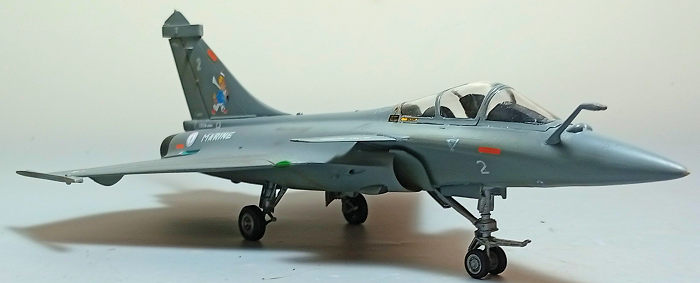 I next
successively attached to the main model the nicely done nose gear bay, the
Intakes (2-piece each) with the SPECTRA countermeasure antennas on them, the
two small ventrally located air inlets, the two wingtip pylons, the 2-piece
fin and the nose cone, where I secured around 20 grams of fishing weights.
As a note, a pitot tube is supplied, instructed to be attached to the nose
cone tip. This is not correct for production Rafales, as they didn’t feature
such a pitot so the best thing to do is only attach its base, to cover the
existing hole, then cut off the tube and blend the remaining with the nose
cone.
I next
successively attached to the main model the nicely done nose gear bay, the
Intakes (2-piece each) with the SPECTRA countermeasure antennas on them, the
two small ventrally located air inlets, the two wingtip pylons, the 2-piece
fin and the nose cone, where I secured around 20 grams of fishing weights.
As a note, a pitot tube is supplied, instructed to be attached to the nose
cone tip. This is not correct for production Rafales, as they didn’t feature
such a pitot so the best thing to do is only attach its base, to cover the
existing hole, then cut off the tube and blend the remaining with the nose
cone.
After the above steps, basic assembly was completed, which was neither
complex nor complicated. Fit was quite good, with some attention needed to
the intakes to fuselage joints. Since the model was destined to be posted
to a friend in France, I decided not to attach any stores, to facilitate
packing and reduce the risk of something breaking during transportation.
After all, the Rafale looks gorgeous naked! Upon some filling and sanding,
it was time to take the bird to the paint shop!
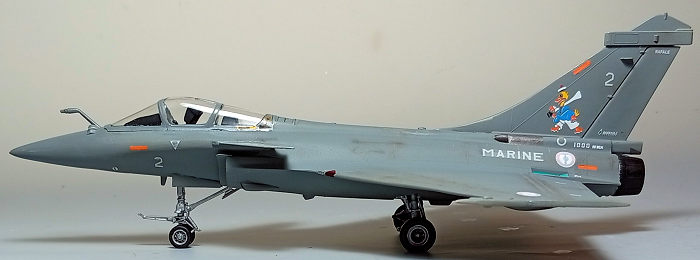 I gave
the complete model, including the gear doors, a coat of Hu165 Medium Gray,
which I had darkened a bit with around 2% black to achieve (to my eye) the
distinctive Rafale gray shade. The various ECM antenna radomes were painted
a darker gray, the spine located APU exhaust and the small protective filet
between the two engines were painted steel, the aft located flare dispenser
areas were painted turquoise and the nose cone tip was painted linen. A
coat of Future prepared the bird for decaling.
I gave
the complete model, including the gear doors, a coat of Hu165 Medium Gray,
which I had darkened a bit with around 2% black to achieve (to my eye) the
distinctive Rafale gray shade. The various ECM antenna radomes were painted
a darker gray, the spine located APU exhaust and the small protective filet
between the two engines were painted steel, the aft located flare dispenser
areas were painted turquoise and the nose cone tip was painted linen. A
coat of Future prepared the bird for decaling.
I used the kit decals to represent Flottille 12F’s #28 machine, as it stood
in Charles de Gaulle Aircraft Carrier during the 2011 Libya Operation.
Typically for Italeri, the decals behaved beautifully, easily detaching from
the backing paper and nicely adhering to all areas. A coat of Future sealed
them.
The good looking landing gear was assembled and attached in position. Main
color, including that of bay walls, inner doors and rims, was silver and
tires were painted black. The wheels were tad filed to look weighted.
The two exhausts were assembled and attached in position. The afterburner
can innards were painted Testors Burned metal, while their nozzle flaps were
painted matt black, to simulate that carbon look. The front located IR and
SPECTRA sensors were attached and painted the same basic
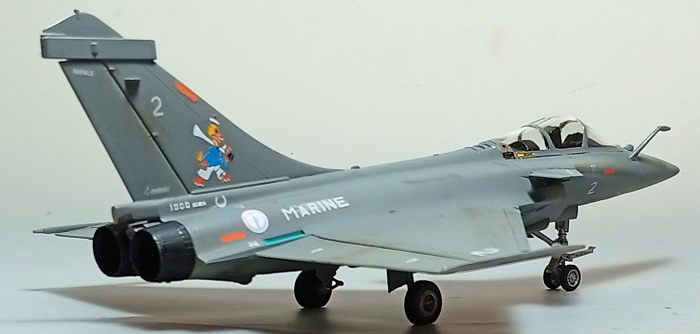 model
color. In retrospect, I should have attached them at earlier stages, to be
painted together with the basic model. Oh well! The refueling probe was
attached at this time, as well.
model
color. In retrospect, I should have attached them at earlier stages, to be
painted together with the basic model. Oh well! The refueling probe was
attached at this time, as well.
Not too much weathering was applied, apart from some black wash at
the landing gear area and some brown and black dry pastels, to cut the
boring overall gray. A satin coat gave the bird its final hue.
The transparencies had their well defined frames hand painted and attached
in position, fitting quite well, with white glue used to blend them to the
fuselage. The port leading edge landing light and the anticollision lights
were replicated using my fine tip silver pen, while the navigation lights
were represented by blobs of red and green clear paint, before calling the
Marine Rafale done!
Superseded by the latest and greatest Hobby Boss offering, this is an
acceptable kit of the navalized Rafale. Molding is crisp, detail is
sufficient, transparencies are clear and instructions are good, as are the
decals. Panel lines are raised, but this might not be a problem for a number
of us. Regarding accuracy, it is true that the Italeri kit is based on the
earlier prototypes, with an “update” sprue used to add some later fittings.
If you add those bits and delete the nose pitot, the final result comes
quite close to the production Rafales. The construction itself is uncomplex
and pleasant, with fit being quite good, deeming it suitable for less
experienced modelers.
If you want the latest, greatest and most accurate Rafale, go for the Hobby
Boss offering, but if you want a cheaper, simpler and less complex kit, the
Italeri will not disappoint.
Happy Modeling!
10 March 2026Copyright ModelingMadness.com. All rights reserved. No
reproduction in part or in whole without express permission.
If you would like your product reviewed fairly and
fairly quickly, please
contact
the editor or see other details in the
Note to
Contributors.
Back to the Main Page
Back to the Review
Index Page
Back to the Previews Index Page