| PRICE: | 72-136 |
| PRICE: | $35 shipped from Ukraine |
| REVIEWER: | Joe Essid |
| UNITS: | 2 aircraft options |
| PRICE: | 72-136 |
| PRICE: | $35 shipped from Ukraine |
| REVIEWER: | Joe Essid |
| UNITS: | 2 aircraft options |
The Grumman Albatross was developed for search-and-rescue operations and had a long service life during the Cold War, starting in 1949. It served in the US Air Force, Navy, Coast Guard, and in the services of several other nations. It was Grumman’s final Amphibian aircraft.
For modelers who fancy 1/72 scale, the venerable Monogram kit remains a viable option if one can live with or remove the rivets and scratch-build an interior. Hasegawa issued the Monogram kit in Japan with Japanese markings, as well. SOVA-M produced a limited-edition kit in 1/72, with PE parts and a more modern molding, but it’s going to be tough to find and, like most limited-edition kits, fiddly to build.
Our editor previewed the Monogram boxing I have, reissued by Revell in the original Monogram box and artwork, at https://modelingmadness.com/scott/korean/sa16preview.htm
I am fond the kit because I love seaplanes of all sorts. And this kit includes a life raft and downed aviators; not sure how I missed this model back in the 1960s, but here it is now. A diorama with a water base came to mind for my IPMS chapters upcoming “Red White and Blue” group build. I figured that Coast Guard Albatross in white with red details and floating on blue water would fit the bill.
I wanted a Coast Guard bird with orange contrasts, not a USAF plane with red (though easier to fit the IPMS theme) because I’ve had friends picked up at sea by the Coast Guard and thought it would be fitting to model one of their aircraft.
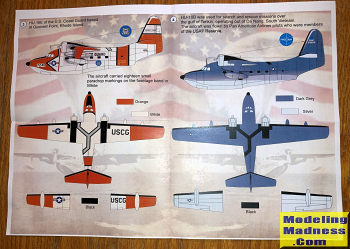
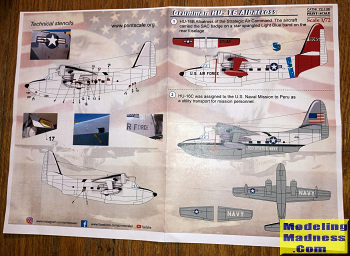
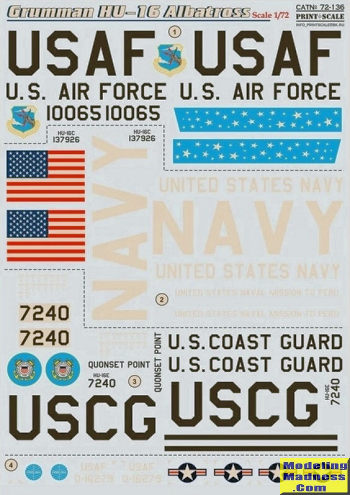 A Web search
turned up this sheet, from Print Scale of Ukraine, featuring a Coast-Guard
scheme close to what I imagined, depicting an aircraft from Quonset Point, RI.
Other options include a very attractive USAF Albatross in Dark Gray and Silver,
from the Vietnam War, sporting a Pam-Am marking. Pam Am pilots in the USAF
reserve crewed these planes. An Albatross with the SAC logo and a Navy bird
assigned to the Naval Mission in Peru round out the set. All should work with
the Monogram kit. You’d have to source more national insignias, but this set
should then let you make all four aircraft.
A Web search
turned up this sheet, from Print Scale of Ukraine, featuring a Coast-Guard
scheme close to what I imagined, depicting an aircraft from Quonset Point, RI.
Other options include a very attractive USAF Albatross in Dark Gray and Silver,
from the Vietnam War, sporting a Pam-Am marking. Pam Am pilots in the USAF
reserve crewed these planes. An Albatross with the SAC logo and a Navy bird
assigned to the Naval Mission in Peru round out the set. All should work with
the Monogram kit. You’d have to source more national insignias, but this set
should then let you make all four aircraft.
You need to know the subjects, however, when choosing paints as Print Scale provides no paint callouts for any of the planes beyond a few basic colors. You do, however, get a full set of stencils.
I’ve read that these decals are finicky and tear easily. I don’t recall that issue with an earlier Print-Scale set, but if you use this brand, check their Facebook and Web pages for advice: basically, apply one decal at a time. Then don’t let the decals stay in water longer than 5-10 seconds before removing them to a clean surface. After a minute, they should come from the backing paper with a brush. Avoid tweezers.
I plan to wet the decals in warm, soapy water and float them from the backing into a puddle of Future brushed on the kit. This method requires careful work with cotton swabs to remove excess liquids. We’ll see how well they conform to the Monogram kit without a solvent, which I fear would weaken the thin carrier film. In any case, I’m going to make a scan of the decals for backup and begin with a common marking that I can easily replace from my spares.
Prices for these decals vary, but my set cost far more than my reissued Monogram kit. Still, for just the right result, I felt it worth the expense.
Print Scale operates in the midst of a war; it’s amazing that they can keep production going and like other Ukrainian firms, when you support them, you support their nation in a time of existential crisis. I’d wager that is worth more than a torn decal for a subject hard to source, otherwise.
July 2026
If you would like your product reviewed fairly and quickly, please contact me or see other details in the Note to Contributors.