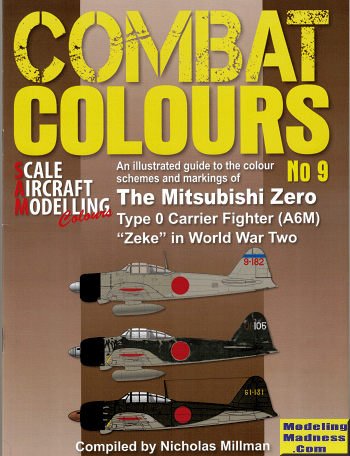
 Nick Millman is considered an expert on WW2
aircraft colors. This 2017 monograph may be his first on the subject of
Japanese aircraft colors as solo author. It relies heavily on Jim Lansdale’s
research and judgments, including Mr. Lansdale’s study of colors on relics.
Nick Millman is considered an expert on WW2
aircraft colors. This 2017 monograph may be his first on the subject of
Japanese aircraft colors as solo author. It relies heavily on Jim Lansdale’s
research and judgments, including Mr. Lansdale’s study of colors on relics.
Minuses
There is no guidance about what model paints to use.
A number of the printed color chips are not good
representations. In Colour Chart 1, the renderings of B3, E3, M1 and N0 are
not very close to the vintage chips. In addition, the cockpit colors are too
gray. The depiction of J3 Gray is a reasonable representation of J3 as
basically colorless, but for some reason has been limited to “fabric dope”.
In Colour Chart 3, the chips of J3 Gray are misleadingly on the brown side.
(A f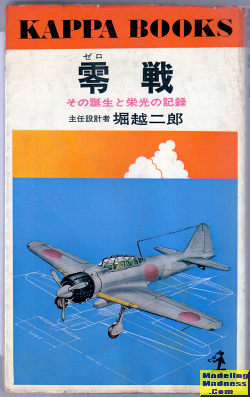 airly good representation of J3 Gray appeared on the dust jacket of Jirō
Horikoshi’s 1970 book about the Zero, attached here.)
airly good representation of J3 Gray appeared on the dust jacket of Jirō
Horikoshi’s 1970 book about the Zero, attached here.)
There are not many citations to support the color choices for the printed color chips, and the vague concept of “amber-grey” is based largely on relics. Some photo credits don’t tell us the Japanese publications that published the same photos before Mr. Millman. Japanese publishers deserve credit. Incidentally, credit “LRA” is the James Lansdale collection.
Mr. Millman mentions the intentional exaggeration “genyō ameiro” (the ameiro currently in use) in the IJN report known as KūGiHō 0266 (which he calls YoKo 0266). Shigeru Nohara used the word “ameiro” in the 1980s and 1990s as a shorthand to describe the color of the early Zero variants. This book doesn’t mention that he was criticized for it in Japan because the word is not used in the IJN’s color standards, and it overemphasizes the minimal amount of ameiro that the authors of KūGiHō 0266 saw in what was otherwise J3 Gray.
Unlike the word ameiro, “amber-grey” is Mr. Millman’s coinage. So is “SP”, which he attaches to three variations of J3 Gray. This invites confusion. “Amber-grey” and “SP” live in an alternate universe where we never need to reconcile them to an IJN manufacturing specification dated February 1941 that did not include any such colors or color names. (That specification was published in Japan the year after Mr. Millman’s monograph.1)
This monograph perpetuates the belief that Nakajima applied a noticeably different shade of gray compared to what Mitsubishi applied. However, no distinction is stated in KūGiHō 0266. (That report was issued in February 1942, when Nakajima completed its 35th Model 21.)
(I could go on, but you get the idea.)
Plusses
There are a number of photos that you probably haven’t seen before;
There are footnotes to support some assertions;
The basic distinguishing features of most Zero variants are discussed;
There is coverage of the colors and markings of trainers, and the C2 Yellow (an orange) is represented well. The floatplane fighter “Rufe” is also covered;
There is an interesting story about applying camouflage in the field;
The discussion of the colors of engine parts is exceptional;
There is a list of tail markings;
The shapes and locations of markings have been rendered with great care.
Conclusions
This is the book that Jim Lansdale would have written if he had gotten to it before his passing in 2018, and it contains some of his misunderstandings.
Put simply, the darker and grayer representations of J3 Gray in this book should have been explained as depicting fresher J3 Gray. There is little guidance about depicting the more strongly olive or brown variations, which are likely the result of severe yellowing of the paint.
Parts of this monograph are not aging well. I give the coverage of the grays a “C-”, and the coverage of the other colors a “B”.
A table
from the February 1941 manufacturing specification “Hikōki Kitai Kōsaku
Hyōjun” (“Aircraft Airframe Manufacturing Standards”) (1) was photographed
and published in an article by Sunao Katabuchi, “Reisen no ‘Haiiro’ ha
Shiro to Kuro Dake de Dekite Ita” (“The “Gray” of the Reisen Was Made
With Only White and Black”), Rekishi Gunzō No. 147, Feb. 2018. That
specification notified manufacturers that they might be called on to
apply colors C2, D1, J3, M2 and P1 to exteriors of aircraft. None of
those colors is a gray-olive, olive, ochre, “amber-grey”, beige or
brown.
Editor's Note: This is a subject that has interested me for
many years so let me add in some additional insight. In a recent
LifeLike A6M decal review, the maker of the decals, who is meticulous
regarding research and is Japanese, includes a rather substantial look at early A6M
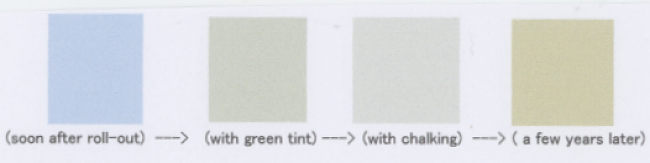
colors. He states that the aircraft were painted in a light bluish-grey
from the factory, but this shade quickly degraded over time to the
brownish-grey shade that has become popular with modelers and paint
makers. Allow me to reproduce the printed color representation included
in the set and you can then make up your own mind on the situation:
" Most interesting is that on early Zero colors. Lifelike provides a representation of early A6M grey that flies in the face of what has been considered the latest info for the last 25 years. I've reproduced that below." Quote from decal review.
July 2025