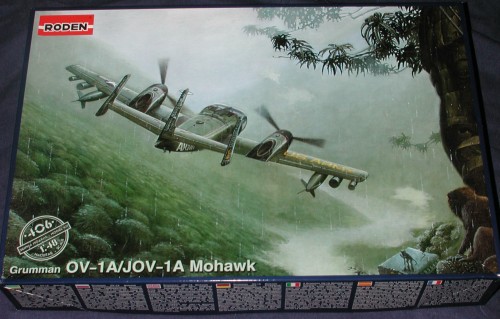
During WWII, multipurpose aircraft such as the American Piper Cub, the British Westland Lysander and the German Fiesler Storch, were used for performing multiple tasks (reconnaissance, communication, artillery spotting, etc.) with considerable success. But it seemed that the jet age that commenced at the end of the 1940s would radically change the nature of aircraft and the tasks that aviation would undertake. However, the general military doctrine of that time was based on the premise of conducting military actions using all types of existing resources, and the necessity of introducing new multi-purpose aircraft was obvious.
In 1954 the U.S. Department of Defense put out for tender a requirement for a new aircraft, which could be used, for performing the tasks mentioned above. According to the tender, this had to be a lightweight two-seater aircraft with twin turbo-prop engines. One of the principal requirements was the ability to take-off from small airfields, unsuitable for regular aircraft. Among several proposals, the winner was the G-134 aircraft designed by Grumman.
According to the requirements of naval aviation, these aircraft should also be suitable for operation from escort class aircraft carriers. However, the Navy later refused to participate in the G-134 project since it was impractical to combine the functions of two different aircraft within one project. The Army continued to finance the promising project and in the spring of 1959 the first test flights took place of the aircraft now classified as the YAO-1AF.
The aircraft had a rather strange appearance - a wide front fuselage in the cockpit area where the pilots were seated side-by-side resembled an insect's bug eyes. Unlike the original design's T-shaped tail unit, the pre-series aircraft featured a regular one, but with three vertical stabilizers. The test flights of the nine pre-serial aircraft lasted until 1961. Shortcomings were eliminated and the aircraft was recommended for series production, its code changed to OV-1A. Initially the aircraft was given the name Montauk - after one of the smaller Native American tribes; later this was changed to that of the well-known Mohawk tribe.
The first production OV-1A arrived with the US 7th Army in Germany in February 1961. The main task of early version aircraft was photoreconnaissance. A KA-60 high-resolution camera, with night photography capability, was installed inside the fuselage. Some design changes were made in response to the requests of pilots and service staff - now the front part of the fuselage could be opened, the undercarriage was reinforced and the electronics were improved. The Mohawk was the first turbo-prop aircraft received into service by the Army.
Later, new requirements were formulated for this aircraft - the ability to mark specific targets with the help of smoke pots, as well as the ability to withstand ground fire. At first the aircraft had only two pylons underneath its wings, intended for use with additional fuel tanks; shortly afterwards 54 aircraft were returned to service stations for additional pylon installation.
As a result, the modified wing design provided six pylons, able to carry containers for 2.75-inch missiles, 500-pound bombs, or 5-inch Zuni missiles. Six modified aircraft, known as the JOV-1A, were sent to Vietnam where they underwent tests with the 23rd Special Aviation Group.
This short experience persuaded the Army commands that an air force is a more efficient operator of aviation than the Army, and a decision was reached that the JOV-1A experiment should be stopped. The aircraft was renamed the OV-1A and it no longer performed the duties of army air support, although it was decided not to remove the pylons. The OV-1A Mohawk was still conducting photoreconnaissance missions, and it was frequently fitted with armament for self defense purposes. This was not the end of the OV-1 as specialized battlefield intelligence variants of the aircraft were operated until the planes were finally removed from service in the mid-1990s.
Thanks to Roden for the historical background. Now for a bit of added info from reader Mike Stevens, 225 Avn Co 1966-68: "The 225th got together a Ft. Lewis Wa. in 1966 and went to RVN end of April and 1st of May in sevaral C-141 flights 1967. I think official in country date is May 1. Originally name was Black Hawks the first year and as we finished our year and new people took over they changedto Phantom Hawks. I was with the initial group from Ft. Lewis. I did not know Mike Langer and figure he was a Phantom Hawk, so his date in country (at least with the 225th) had to be 1968 or later. It is possible he flew OV-1's earlier in VN, but not with the 225th as you can see. I worked on 3736 as a 41G20 (aerial camera repair tech.). Flew 2nd seat for tests and gp when I could. Great plane to fly in and aerobatic too. Grumman test pilot could make it sing."
When I saw that this kit was coming last year, I was pretty psyched up about it. The Mohawk isn't a glamour plane by any stretch of the imagination, but it was unusual (which always strikes a chord in my kit desires), it was in service a long time and it was a design that I happened to like. Oddly, I've not built the old Hasegawa 1/72 version, but know that this larger one will not remain unbuilt!
If you have bought any of the Roden kits over the last year or so, then you know that they are well molded and generally go together well if one is a careful constructor. Like Dragon kits, one cannot just toss together a Roden model. You have also noted a steady improvement with each new kit being that much better engineered and more builder-friendly.
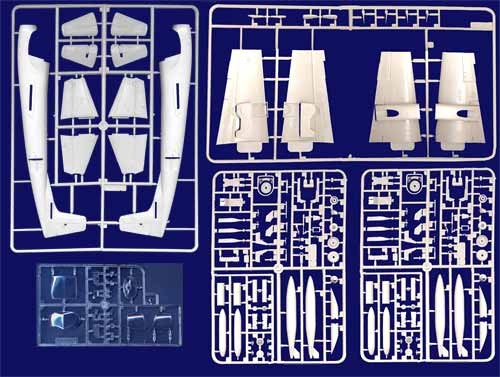
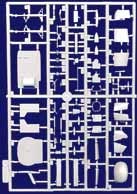
After opening the rather large box, I started going over the kit with a critical eye. Much to my delight, I found no sink areas, no flash and no problems with ejector pin marks. The clear parts are individually packaged so there is no problem with scratches or stress marks and the parts are commendably transparent and thin. Not all pieces are used in this variant, so you can be sure that there are at least one or two more boxings of this kit to come, including, I'm pretty sure, a modern version with the SLAR pod, as several of the unused clear bits are a more modern instrument panel and several CRT boxes.
The cockpit is very well appointed with individual rudder pedals and nicely done 9 piece seats. You have the option to leave off the wing pylons should you desire, but I've rarely seen an OV-1 without them in place. In addition to large fuel tanks, you have what appears to be a gun pod and two different rocket pods to help put something under the wings. You also have two different noses for the plane, one a more modern one with a landing light in it and molded in clear. Speed brakes can be positioned open or closed as you wish. Wheel wells are nice and deep and well detailed.
Instructions are excellent with very clearly done construction drawings and any color information required for the different decal options clearly marked. You can have your OV-1 in any color you want as long as it is OD with black-grey wing walk areas. These wing walk areas will have to be painted in as the decals only provide the black outlines. The black engine anti-glare panels and wing/tail leading edges will have to be painted on as well. I don't recall seeing any indication of nose weight needed but with its short coupled landing gear, it will definitely need all you can supply.
Decal options are as follows:
- Grumman JOV-1A Mohawk, s/n 60-3736, 225th Aviation Company, "Phantom Hawks", flown by Capt. Mike Langer, Vietnam, December 1964.
- Grumman OV-1A Mohawk, s/n 59-2617, 23rd Special Warfare Aviation Detachment, Vietnam, 1963.
- Grumman OV-1A Mohawk, s/n 63-13125, 73 Avn Co (AS), An Xugen Province, flown by Lt. Johnson, Vietnam, September 1964.
- Grumman JOV-1A Mohawk, s/n 60-3729, 23rd Special Warfare Aviation Detachment, Vietnam, 1964.
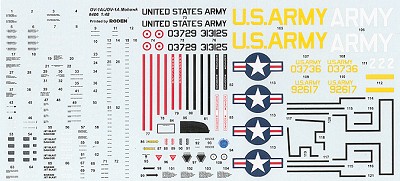 The first two are in FS 14064 "Gloss Olive Green" and not OD as stated in the instructions, with full color national insignia and highly visible 'ARMY' markings. (Thanks to R.Jackson for setting me straight on this) The others are in the variants with no national insignia and just the black 'United States Army' markings and small serial numbers. These later aircraft are undoubtedly in the matte OD. Those of you with some Army National Guard markings could easily do one of the many Guard planes as they were relatively non-descript as well. I know that at least one OV-1 was in an overall white scheme with red-orange wing and tail tips, but you'd have to dig up some references to do that one. Decals are quite extensive, including all the little data decals and there is a separate instruction sheet for applying those.
A really nice touch is a copy of the box top artwork included with the kit. This has none of the logos on it and would be suitable for framing.
This one looks like the best Roden kit yet. I'd have to say that they are getting closer and closer to the 'big boys' with every new kit they produce, and this one seems on the verge of reaching its goal. It is highly detailed and seems to be well engineered. I Know I'm looking forward to starting on mine and you should seek it out when you get the opportunity.