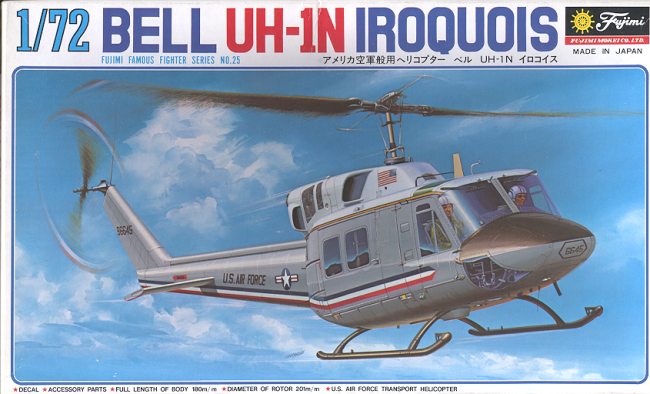
| KIT: | Fujimi 1/72 UH-1N Huey |
| KIT # | 7A25 |
| PRICE: | $ |
| DECALS: | One aircraft |
| REVIEW & | |
| NOTES: | ` |
| HISTORY |
'Huey' is practically synonymous with helicopter to millions ofpeople throughout the world and especially to those who fought in Vietnam. Itwas the probably the most successful line of turbine-engined helicopters to haveever been built and the AH-1Z Cobra gunship is still being produced for theUSMC, who prefer the smaller, more nimble Huey Cobra over the hulking AH-64Apache preferred by the Army, though thousands of AH-1 variants were built forthe Army in the late 60's/early 70's.
Probably the first real improvement over the early UH-1B/C/DHueys was the addition of a second engine. This really improved survivability ofthe type and made it something that the Navy could really buy into. The Navy hasan almost standing requirement for a second engine in case one fails while overwater. This would allow the aircraft to safely reach it home ship or station onthe remaining engine. Though the 'N' in UH-1N could stand for Navy, it doesn't.
Widely used by the USMC as part of the scouting/attack comboalong with the AH-1 in HMLA units, the UH-1N is also used for SAR units andstation flights. The USAF has used the UH-1N for quite a while as part of itsVIP short range airlift capabilities. Variants of the UH-1N are flown by thearmed forces around the world and has been license built in large numbers byAgusta in Italy.
| THE KIT |
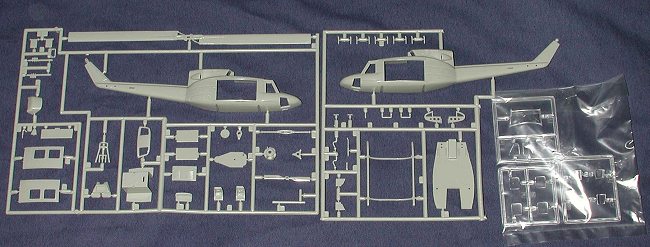
The Fujimi kit is not a new one by any means, but does have engraved panel linesas well as rivets on the tail boom. The panel lines are, for the most part, welldone and the rivets are quite petite and near-scale. What you get with this kitis the basic UH-1N. As you can see from the right sprue, there is a largesection missing. This has the ASW equipment for the AB.212 ASW kit that isn'tneeded on this version.
There is a pretty complete interior consisting of seats, sticks and rudderpedals. As with many helo kits, the control that makes the helo go up and down(the collective, I believe) is missing and will have to be added by the builder.Why this is so often missed is beyond me as it is an integral part of theaircraft. The rotor hub is sufficiently detailed for this scale. There areblanking plates for the intakes and the exhaust is a single, rather shallow,piece that fits on the back. The cabin door can be displayed open if you wish todo some minor surgery and cut it from the forward attaching piece. The clearbits are thick so should fit well into the recesses. You'll need to tint theupper ones with a clear green. No indication of nose weight is given, but I'dpack as much as I could in the nose as it will surely need some.
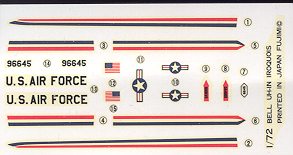
Adifficult kit to build it does not appear to be. When finished, it will lookvery nice in amongst your other 1/72 aircraft.
Review kit courtesy of me and my wallet!
If you would like your product reviewed fairly and fairly quickly by asite that averages over 2,700 visits a day, please contactme or see other details in the