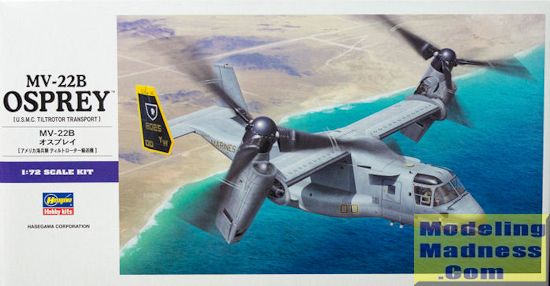
| KIT #: | 01571 (E41) |
| PRICE: | 3,060 yen (a bit under $25) direct |
| DECALS: | Three options |
| REVIEWER: | Scott Van Aken |
| NOTES: | 2013 basic boxing |
| HISTORY |
The Bell Boeing V-22 Osprey is an American multi-mission, tiltrotor military aircraft with both a vertical takeoff and landing (VTOL), and short takeoff and landing (STOL) capability. It is designed to combine the functionality of a conventional helicopter with the long-range, high-speed cruise performance of a turboprop aircraft.
The V-22 originated from the United States Department of Defense Joint-service Vertical take-off/landing Experimental (JVX) aircraft program started in 1981. The team of Bell Helicopter and Boeing Helicopters was awarded a development contract in 1983 for the tiltrotor aircraft. The Bell Boeing team jointly produce the aircraft. The V-22 first flew in 1989, and began flight testing and design alterations; the complexity and difficulties of being the first tiltrotor intended for military service in the world led to many years of development.
The United States Marine Corps began crew training for the Osprey in 2000, and fielded it in 2007; it supplemented and then replaced their Boeing Vertol CH-46 Sea Knights. The Osprey's other operator, the U.S. Air Force, fielded their version of the tiltrotor in 2009. Since entering service with the U.S. Marine Corps and Air Force, the Osprey has been deployed in transportation and medivac operations over Iraq, Afghanistan, Libya and Kuwait.
Fourteen USMC and five USAF squadrons operate the Osprey. For those of us who like anime, Osprey-like aircraft are featured extensively in those series' that depict either modern or near future themes.
| THE KIT |
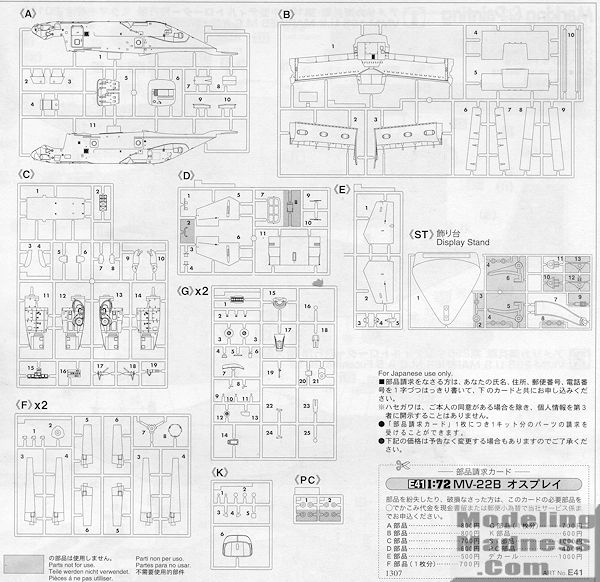 It
used to be that as soon as a prototype of an aircraft was produced, Hasegawa
and others would rush out and mold a kit. However, having been bitten by
airframe changes between the prototype and production planes, most companies
will now wait for the definitive production aircraft before expending the
funds. Back in the very early 1990s, Italeri jumped on the Osprey by
producing kits in both 1/72 and 1/48 of the prototypes. Your editor built
the Italeri version in 1/48 and it was quite a struggle! Now, Hasegawa has
provided us with what looks to be a very nice kit of this plane in 1/72
scale, the scale in which I prefer to build (as much due to diminishing
shelf space as anything else).
It
used to be that as soon as a prototype of an aircraft was produced, Hasegawa
and others would rush out and mold a kit. However, having been bitten by
airframe changes between the prototype and production planes, most companies
will now wait for the definitive production aircraft before expending the
funds. Back in the very early 1990s, Italeri jumped on the Osprey by
producing kits in both 1/72 and 1/48 of the prototypes. Your editor built
the Italeri version in 1/48 and it was quite a struggle! Now, Hasegawa has
provided us with what looks to be a very nice kit of this plane in 1/72
scale, the scale in which I prefer to build (as much due to diminishing
shelf space as anything else).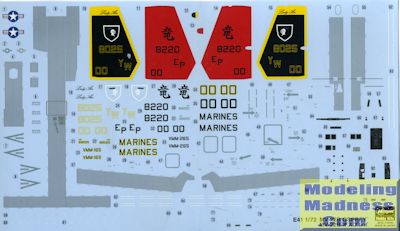 Instructions
use Gunze paint references and while the instructions look complex at first
glance, studying them shows that they are quite logically arranged and
should be quite helpful. Typical of Marine helos, this one is in three
shades of grey. Both markings options are commander's aircraft with colorful
tail markings. The box art plane is from VMM-165 based at MCAS Miramar in
2011 while the other is with VMM-265 at MCAS Futenma in Japan. Hasegawa
provides the option of painting the background of the tail markings and
using separate decals for the unit and serial markings, a nice touch. The
decals are very nicely done and provide all the standard markings including
the rather extensive wing and fuselage walk areas. For those who wish a
standard 'line bird', these can be found on some aftermarket sheets.
Instructions
use Gunze paint references and while the instructions look complex at first
glance, studying them shows that they are quite logically arranged and
should be quite helpful. Typical of Marine helos, this one is in three
shades of grey. Both markings options are commander's aircraft with colorful
tail markings. The box art plane is from VMM-165 based at MCAS Miramar in
2011 while the other is with VMM-265 at MCAS Futenma in Japan. Hasegawa
provides the option of painting the background of the tail markings and
using separate decals for the unit and serial markings, a nice touch. The
decals are very nicely done and provide all the standard markings including
the rather extensive wing and fuselage walk areas. For those who wish a
standard 'line bird', these can be found on some aftermarket sheets.
| CONCLUSIONS |
One expects a nice kit from Hasegawa and in this case, you do get it. If you have the Italeri version, you might want to raffle it off or something as it is based on the prototype. Already there has been a JASDF limited edition and I'm sure there will be more to come, including a dedicated USAF variant. Well worth picking up if you are a fan of modern aircraft. As a note, for those who don't mind waiting a bit for your kits, it is well worth picking up from Japanese retailers as even with the shipping, especially if buying more than one kit, it is far less expensive than US retail and even most discount places.
| REFERENCES |
https://en.wikipedia.org/wiki/Bell_Boeing_V-22_Osprey
November 2015
Copyright ModelingMadness.com
Thanks to me for picking this one up.
If you would like your product reviewed fairly and quickly, please contact the editor or see other details in the Note to Contributors.