
| KIT: | Hasegawa 1/72 F-4J Phantom II |
| KIT # | Ka 1 |
| PRICE: | $25.95 in 1990 |
| DECALS: | See review |
| REVIEW & | |
| NOTES: |
| HISTORY |
Rather than a long historical treatise on the Phantom II, let mejust give some info on the J model. The Navy was very pleased with the initialproduction aircraft, the F-4A and F-4B. The USAF also liked their Phantoms, andwhile the F-4C was very much like the Navy's F-4B, the F-4D was a much improvedaircraft in both engines and avionics. The Navy adopted several of themodifications that were made in the F-4D when it came time for an improvedPhantom. This aircraft would eventually become the F-4J
Differences between it and the F-4B were not so obvious whenlooking at the aircraft. Major clues were the lack of an IR seeker head underthe radome and larger afterburner petals on the engine. The outside of theintakes on later F-4Js had sprouted short, skinny ECM antenna bulges. Inaddition, it had the thicker wings and wheels of the USAF F-4C/D and a slottedstabilizer to help improve slow speed handling.
The main differences were, as in most aircraft modifications,internal. This included uprated engines, a more powerful electrical generator,new radar system as well as a lot of newer radios and navigational aids. An ASW-25 Automatic Carrier Landing System was also part of the upgrade. Nearly600 F-4Js were built between December 1966 and January 1972. Many of theseaircraft saw service in Vietnam and those that survived were later modified toF-4S standard.
| THE KIT |
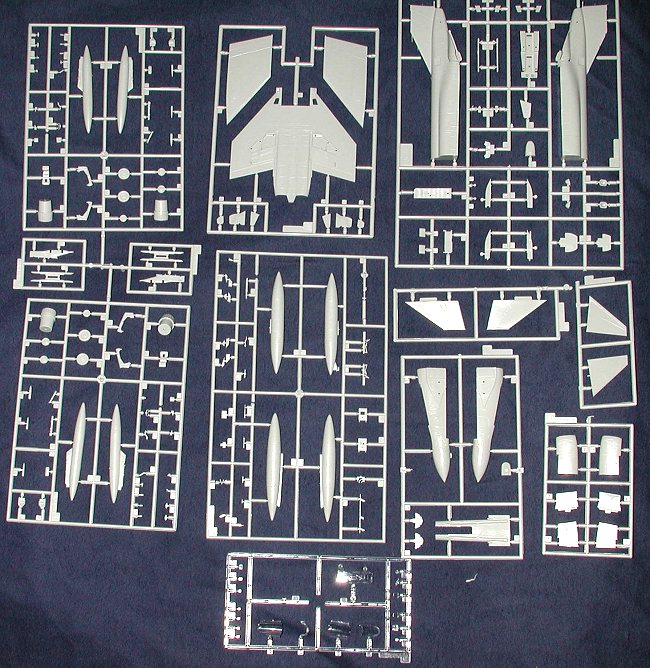
It is hard to believe that thisparticular kit is now over ten years old, however, it is still considered bymany to be the finest US F-4 kit around. Hasegawa went whole hog into current tendencyto offer as many common sprues for a basic airframe and then adding additionalsprues for the type being kitted. This means several things. One is that thereare usually a number of spare parts left over from the kit and secondly, thereare a lot of smaller sprues which makes for a really full box.
Thekit was state of the art in 1990 and still holds up very well. All the partshave engraved panel lines, which is the expected norm, and there are lots ofthem. In fact, many think that these multi-version kits are a bit too intricatewith too many parts. In several ways, I must agree. The greater the number ofparts, the greater the chances of messing something up! However, it is the mostcost effective way for Hasegawa to produce multiple versions of an aircraft,otherwise the additional tooling cost would have to be passed along to theconsumer.
Hasegawa cockpits are usually devoid of sidewalland instrument panel detail in 1/72 and this one is no exception. Theinstruments and side console detail is provided by a decal and that is adequatefor this scale. Also typical of Hasagawa kits is that there are no externalstores beyond the wing and centerline drop tanks. For these items, you need tobuy the Hasegawa weapons sets, an additional expense.
All of thesprues, including the clear bits are packed together in a single clear bag.Drawback of this is that by the time the modeler gets the kit, the parts are allwell scratched by rubbing against each other during shipment. Other kit makersuse multiple bags to prevent this damage. Why Hasegawa still does not do this isbeyond me.
The only real option on the kit is for open or closedcanopies. Missing are the canopy actuating arms that hold the canopies open. Thekit also has no provisions for lowered slats, speedbrakes or flaps. Phantoms onthe deck are often seen with drooped flaps or speedbrakes.
Now in spiteof all the nitpicking, this is still a superb kit and one that you shouldactively seek if interested in modeling US Phantoms in this scale. Carefulconstruction and attention to the building steps will provide you with asuperior kit that will look great on your model shelf. If there isn't enoughdetail in the kit, then there are a number of aftermarket detail sets and decalsheets to customize your F-4. A final note on this kit.This was later released as an F-4J/S with the same box art. Not sure if thedecals are the same, but it would definitely have had the updated leading edgemaneuvering slats that were fitted to all but the first F-4S aircraft. REFERENCES McDonnell Douglas Aircraft since 1920: Volume 2, by ReneJ Francillon, 1990, Naval Institute Press Review kit courtesy of me and my wallet! If you would like your product reviewed fairly and quickly by asite that has over 1,500 visits a day, please contactme or see other details in the