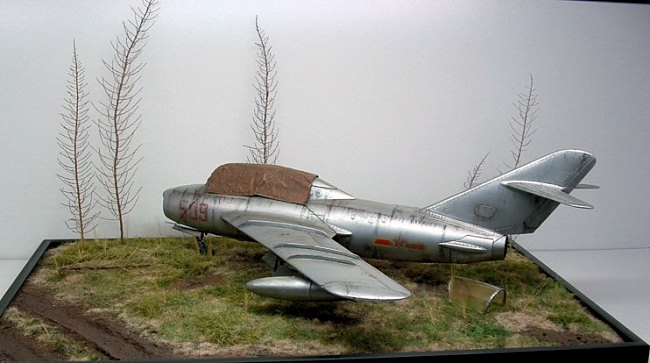
| KIT: | Trumpeter 1/32 FT-5 |
| KIT #: | 2203 |
| PRICE: | $7.09 |
| DECALS: | One Option |
| REVIEWER: | Jason Moores |
| NOTES: |
| HISTORY |
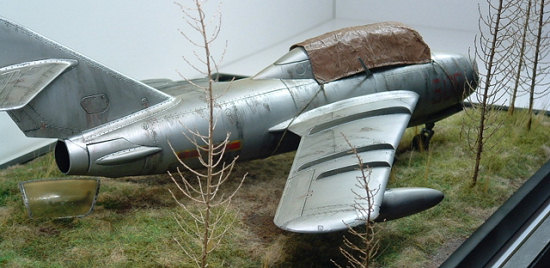 The Chinese foray into jet fighter aircraft is
a lesson in reverse engineering. Namely Soviet designs of the likes of the
Mig 15, 17. While we may never know the goings on between these two secretive
countries, the Shenyang
JJ-5 is an all Chinese product as the Soviet Union never produced a duel seat
Mig-17. The JJ-5 or Ft-5 for export versions, is a combination of
locally built Mig-17 Fresco with the cockpit of the Mig-15uti, also locally
built. The Chinese never built the Mig 15 fighter named J-2, with the first
Chinese built aircraft type to go into service being the J-5 or copied
Mig-17. Interestingly The JJ-5 trainer production started ten years after the
J-5 with exports going to Sudan, Pakistan,
Bangladesh, Albania, and Tanzania. Powered by a WP-5D turbojet rated at
24.68kN with a top speed 1,048km/h (Mach 0.932) and
service ceiling of 14,300m, 974 aircraft were built from 1966 to 1983. The
JJ-5 is still used for basic jet training today before going onto the JJ-6 or
JJ-7 fighter-trainer. Weapons include an under-nose Type 23-I 23mm cannon
and two stations under the wings for 400 litre drop tanks or other ordinance.
The Chinese foray into jet fighter aircraft is
a lesson in reverse engineering. Namely Soviet designs of the likes of the
Mig 15, 17. While we may never know the goings on between these two secretive
countries, the Shenyang
JJ-5 is an all Chinese product as the Soviet Union never produced a duel seat
Mig-17. The JJ-5 or Ft-5 for export versions, is a combination of
locally built Mig-17 Fresco with the cockpit of the Mig-15uti, also locally
built. The Chinese never built the Mig 15 fighter named J-2, with the first
Chinese built aircraft type to go into service being the J-5 or copied
Mig-17. Interestingly The JJ-5 trainer production started ten years after the
J-5 with exports going to Sudan, Pakistan,
Bangladesh, Albania, and Tanzania. Powered by a WP-5D turbojet rated at
24.68kN with a top speed 1,048km/h (Mach 0.932) and
service ceiling of 14,300m, 974 aircraft were built from 1966 to 1983. The
JJ-5 is still used for basic jet training today before going onto the JJ-6 or
JJ-7 fighter-trainer. Weapons include an under-nose Type 23-I 23mm cannon
and two stations under the wings for 400 litre drop tanks or other ordinance.
| THE KIT |
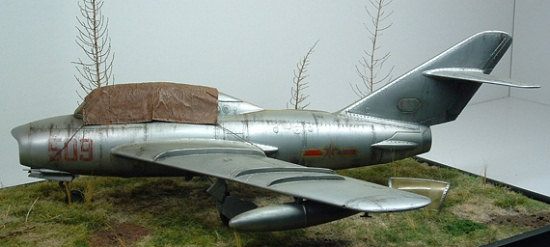 One of Trumpeters early 1/32 releases before the
learning curve kicked in. Packaged in the usual plastic bags in a largish
box, there was no evidence of flash on my kit. Rubber tyres and decals for
one aircraft are included, that being of the "August 1st" Aerobatic team of
China with no stencils or marking other than national insignia and ac numbers.
The cockpit and seats are basic in detail with moulded on dials, landing
gear is adequate but the gear doors are very thick and some what confusing
with no real indication of position on main gear legs. The cockpit tub can be
seen from both the intake and exhaust openings. But on the good side the
panel line positions look close to what images I could conjure up on the net.
The three part canopy is rather thick but clear although the profile seems a
bit high in cross section. An engine is included and can be displayed
mounted in the aircraft with the tail section siting on its own trolley The
fit is quite good, but the panel trenches and rivet holes are on the 1/16
scale side. With ordinance you get two drop tanks for the wing stations. All
up a kit that probably wouldn't see the light of day, but I couldn't just
throw away hard earned money so I thought I would use it as a test bed for
some Alclad.
One of Trumpeters early 1/32 releases before the
learning curve kicked in. Packaged in the usual plastic bags in a largish
box, there was no evidence of flash on my kit. Rubber tyres and decals for
one aircraft are included, that being of the "August 1st" Aerobatic team of
China with no stencils or marking other than national insignia and ac numbers.
The cockpit and seats are basic in detail with moulded on dials, landing
gear is adequate but the gear doors are very thick and some what confusing
with no real indication of position on main gear legs. The cockpit tub can be
seen from both the intake and exhaust openings. But on the good side the
panel line positions look close to what images I could conjure up on the net.
The three part canopy is rather thick but clear although the profile seems a
bit high in cross section. An engine is included and can be displayed
mounted in the aircraft with the tail section siting on its own trolley The
fit is quite good, but the panel trenches and rivet holes are on the 1/16
scale side. With ordinance you get two drop tanks for the wing stations. All
up a kit that probably wouldn't see the light of day, but I couldn't just
throw away hard earned money so I thought I would use it as a test bed for
some Alclad.
| CONSTRUCTION |
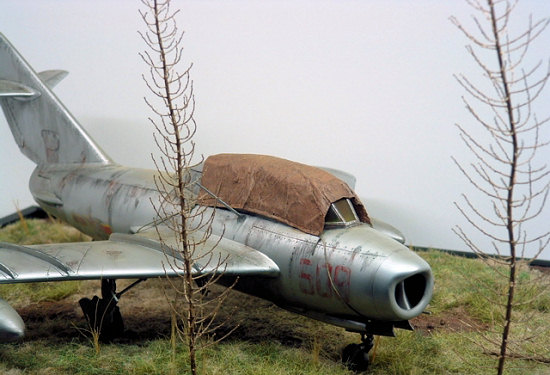 internals were added and
only the front and back of the three part canopy. Some intake trunking using
plastic card was placed inside each fuselage half to try to hide the cockpit
tub with only minimal results so I didn't bother improving the tail end only
including the tail pipe in construction. Some lead weight was added either
side of the cockpit tub just in case although this wasn't specified in the
instructions until step 13 when it would be all to late. All control surfaces
were glued in the neutral position for ease of construction and painting
although I have seen photos of parked aircraft where the tail surfaces are
slightly in the nose up attitude with airbrakes slightly open.
internals were added and
only the front and back of the three part canopy. Some intake trunking using
plastic card was placed inside each fuselage half to try to hide the cockpit
tub with only minimal results so I didn't bother improving the tail end only
including the tail pipe in construction. Some lead weight was added either
side of the cockpit tub just in case although this wasn't specified in the
instructions until step 13 when it would be all to late. All control surfaces
were glued in the neutral position for ease of construction and painting
although I have seen photos of parked aircraft where the tail surfaces are
slightly in the nose up attitude with airbrakes slightly open.
| COLORS & MARKINGS |
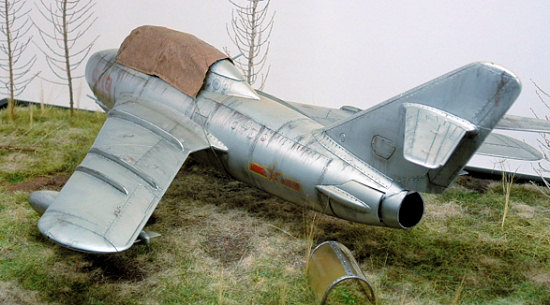 I used Alclad Grey primer / micro filler first
and then Aluminium over the entire model. Panel shading was done with Dark
Aluminium. As weathering is my favourite part I wanted to do an "in the back
paddock " look. The heavy panel lines and rivet holes lend them selves
well to this. I used a semi permanent black marker to highlight, dragging my
finger down over the fresh marker to simulate a vertical weather beaten look.
Concentrating and repeating on the mid fuselage lines rather than the top or
wing surfaces. Once completed I use my preferred wash of Hobby Color H
12 flat black acrylic, thinned with a few drops of whitespirit/methylated
spirits and a couple of drops of water. Applied with a thin brush and wiped
vertically down with my finger or a Q-tip. Also using Hobby Color H 77
Tire black for the same process. Then on to the decals which were Tiger
Wings # 32-119 Chinese Insignia. The a/c number Is fictitious and drybrushed
with aluminium for a worn off look. The trick I found for a really decrepit
finish Is not to finish off with a lacquer or Future coat. The variation
between the semi gloss Alclad and flat wash Is quite noticeable to the eye,
If not the camera. What you could see of the canopy was brushed with a mixture
of gloss laquer and clear orange to simulate the yellowing of Soviet
canopy acrylic, or this may just be a coating they give to stored aircraft?
The tarp was airbrushed with MM 1701 Military brown then washed with
method above, then drybrushed with a tan color and flat coated. Finally a
light misting of sand over the top surfaces to simulate dust.
I used Alclad Grey primer / micro filler first
and then Aluminium over the entire model. Panel shading was done with Dark
Aluminium. As weathering is my favourite part I wanted to do an "in the back
paddock " look. The heavy panel lines and rivet holes lend them selves
well to this. I used a semi permanent black marker to highlight, dragging my
finger down over the fresh marker to simulate a vertical weather beaten look.
Concentrating and repeating on the mid fuselage lines rather than the top or
wing surfaces. Once completed I use my preferred wash of Hobby Color H
12 flat black acrylic, thinned with a few drops of whitespirit/methylated
spirits and a couple of drops of water. Applied with a thin brush and wiped
vertically down with my finger or a Q-tip. Also using Hobby Color H 77
Tire black for the same process. Then on to the decals which were Tiger
Wings # 32-119 Chinese Insignia. The a/c number Is fictitious and drybrushed
with aluminium for a worn off look. The trick I found for a really decrepit
finish Is not to finish off with a lacquer or Future coat. The variation
between the semi gloss Alclad and flat wash Is quite noticeable to the eye,
If not the camera. What you could see of the canopy was brushed with a mixture
of gloss laquer and clear orange to simulate the yellowing of Soviet
canopy acrylic, or this may just be a coating they give to stored aircraft?
The tarp was airbrushed with MM 1701 Military brown then washed with
method above, then drybrushed with a tan color and flat coated. Finally a
light misting of sand over the top surfaces to simulate dust.
| CONCLUSIONS |
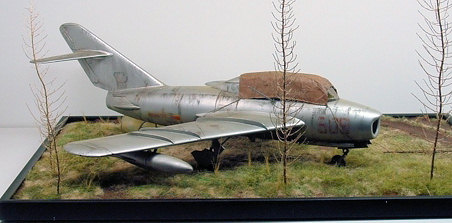 With the look of " in the back paddock " coming up so
well I thought I would have a go at modelling the paddock as well, and using
that as a base for the Ft-5. This is just plaster of Paris poured over a
craft wood base with tyre tracks pressed in it before it set. Then painted
with acrylics and various scenic grasses of the train modelling variety. I am
super pleased with the end result and a useful method for an otherwise
ordinary kit.
With the look of " in the back paddock " coming up so
well I thought I would have a go at modelling the paddock as well, and using
that as a base for the Ft-5. This is just plaster of Paris poured over a
craft wood base with tyre tracks pressed in it before it set. Then painted
with acrylics and various scenic grasses of the train modelling variety. I am
super pleased with the end result and a useful method for an otherwise
ordinary kit.
| REFERENCES |
July 2007
Jason Moores If you would like your product reviewed fairly and quickly by a
site that has nearly 400,000 visitors a month, please
contact
me or see other details in the
Note to
Contributors.