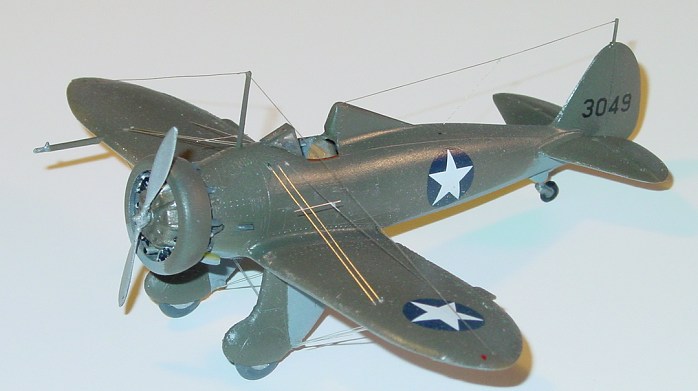
Revell 1/72 P-26A
|
KIT # |
H-656 (1971) |
|
PRICE: |
Less than a buck in 71 |
|
DECALS: |
One option, 34 PS |
|
REVIEWER: |
Brian Baker |
|
NOTES: |
Also issued as kit # H-667 (1967) Issued in 3-pack with Macchi C.200 and Curtiss P-36A . |
|
HISTORY |
 engines, and 23 P-26C's,
which featured minor changes. All were later equipped with flaps,
which lowered the landing touchdown speed from 82 mph. to 73 mph, a
significant improvement. An improved tail wheel was also retrofitted to
all aircraft,
and some aircraft appear in photographs without the telescopic gun sight
commonly associated with the type.The Boeing P-26's bridged the gap
between the World War I style biplane, with fixed landing gear, bracing
wires, and an open cockpit, and the modern all-metal high speed
monoplane, with a cantilever wing, enclosed cockpit, constant speed
propeller, supercharger, and increased armament.
engines, and 23 P-26C's,
which featured minor changes. All were later equipped with flaps,
which lowered the landing touchdown speed from 82 mph. to 73 mph, a
significant improvement. An improved tail wheel was also retrofitted to
all aircraft,
and some aircraft appear in photographs without the telescopic gun sight
commonly associated with the type.The Boeing P-26's bridged the gap
between the World War I style biplane, with fixed landing gear, bracing
wires, and an open cockpit, and the modern all-metal high speed
monoplane, with a cantilever wing, enclosed cockpit, constant speed
propeller, supercharger, and increased armament. |
THE KIT |
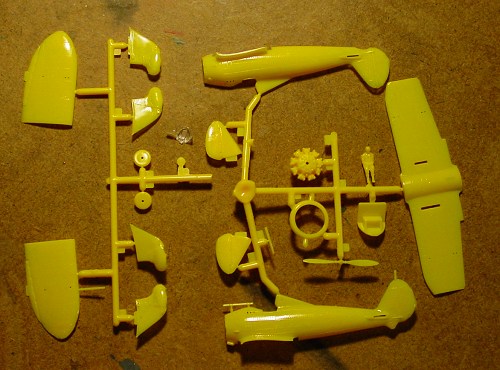 The Revell P-26A kit in 1/72 scale has been around since at least 1967,
and I have a number of them in stock. They are very basic, with
surface detailing consistent with the time they were produced, so
building a modern, state-of-the-art model requires some work. Cast in
bright yellow plastic, the kit consists of about 22 parts, including a
pilot figure. There is no interior detail except for a very crude
seat, and the radial engine does not include any of the exhaust
system. The decals are extensive, and strangely enough, the old "U.S.
Army" letters were sufficiently well preserved to be used on my model.
The Revell P-26A kit in 1/72 scale has been around since at least 1967,
and I have a number of them in stock. They are very basic, with
surface detailing consistent with the time they were produced, so
building a modern, state-of-the-art model requires some work. Cast in
bright yellow plastic, the kit consists of about 22 parts, including a
pilot figure. There is no interior detail except for a very crude
seat, and the radial engine does not include any of the exhaust
system. The decals are extensive, and strangely enough, the old "U.S.
Army" letters were sufficiently well preserved to be used on my model.|
CONSTRUCTION |
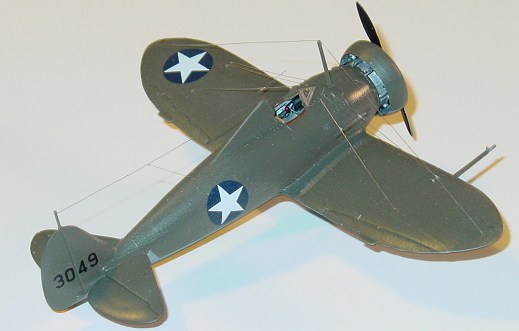
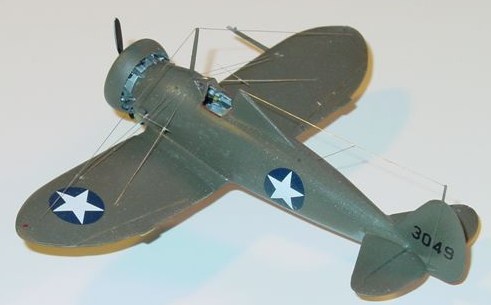
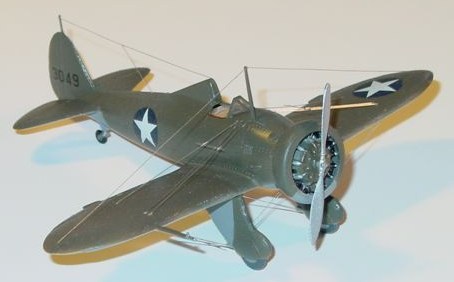 Guatemala City on
11 May 1943, before the aircraft left Army service. It is a faded OD
over neutral gray, with black tail numbers (3049) and blue and white
insignias. the aircraft has the late type tail wheel but no
telescopic gun sight. Decals were no problem on this one.
Guatemala City on
11 May 1943, before the aircraft left Army service. It is a faded OD
over neutral gray, with black tail numbers (3049) and blue and white
insignias. the aircraft has the late type tail wheel but no
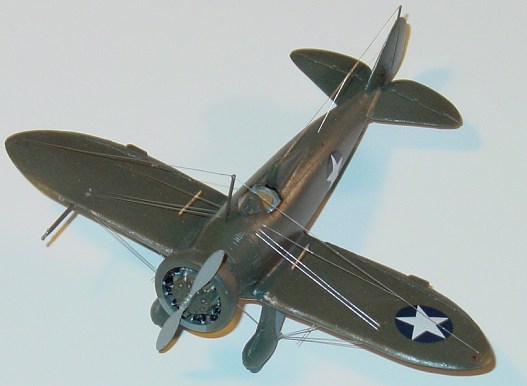
telescopic gun sight. Decals were no problem on this one.I first sanded off nearly all of the rivet detail, as the airplane WAS flush riveted. I used the seat as a pattern and rebuilt the entire interior, using photos in the Bowers book as a reference. Kit instructions say to paint the interior "light green" but Army aircraft interiors from this time period were bare aluminum, and they were rarely repainted. A new seat, side details, instrument panel, and other "goodies" were scratch-built. The cockpit opening is very small on this aircraft, but at least I know that it looks like the real thing. There are no wheel wells on a fixed gear airplane, so that makes things easier.
 smoothed out to the proper
aerodynamic contours, and most parts need careful trimming. The makers
have attempted to help the builder rig the airplane with flying wires,
but all of the holes in the wing and landing gear aren't there, so
they will have to be drilled out. The engine is fairly well detailed,
but needs a lot of trimming. These engines require careful detailing,
and not as well done as the contemporary Monogram F11C-2 and F4B-4
kits. The propeller is useful, but I would rather have replaced it
with a better unit, but I didn't have one in the spares box, so I had
to make do with the one included in the kit.
smoothed out to the proper
aerodynamic contours, and most parts need careful trimming. The makers
have attempted to help the builder rig the airplane with flying wires,
but all of the holes in the wing and landing gear aren't there, so
they will have to be drilled out. The engine is fairly well detailed,
but needs a lot of trimming. These engines require careful detailing,
and not as well done as the contemporary Monogram F11C-2 and F4B-4
kits. The propeller is useful, but I would rather have replaced it
with a better unit, but I didn't have one in the spares box, so I had
to make do with the one included in the kit.|
COLORS AND MARKINGS |
|
CONCLUSIONS |
If you have the time, this model is cheap entertainment. I probably spent about 6 hours total time in assembly and painting, as the airplane is VERY small in 1/72 scale. from the tone of the instructions, it is obvious that the kit was intended for kids, but to make a really good model, some serious adult level skills are required. Although decal trim is provided, if I were doing one of the highly decorated versions, I would mask and paint the trim rather than use kit decals.
|
REFERENCES |
 Many publications provide useful information on the P-26 series,
but the best I have found are the Aerofax Minigraph 8 publication on
the Boeing P-26 Variants by the late great aviation historian Peter
Bowers, a former Boeing engineer who had access to as much information
on Boeing aircraft as anyone. This was published in 1964. Another
more recent publication is the Squadron In-Action Mini Series Number 2
on the P-26, by Larry Davis, published in 1994. The Bowers Book has
extensive information, including detailed interior photos, while the
Squadron book has more color information. Both are worth having. Dan
Hagedorn's book, Wings Over The Canal, a history or the 6th Air Force
defending the Panama Canal, has some interesting information on P-26's,
and this is well worth getting.
Many publications provide useful information on the P-26 series,
but the best I have found are the Aerofax Minigraph 8 publication on
the Boeing P-26 Variants by the late great aviation historian Peter
Bowers, a former Boeing engineer who had access to as much information
on Boeing aircraft as anyone. This was published in 1964. Another
more recent publication is the Squadron In-Action Mini Series Number 2
on the P-26, by Larry Davis, published in 1994. The Bowers Book has
extensive information, including detailed interior photos, while the
Squadron book has more color information. Both are worth having. Dan
Hagedorn's book, Wings Over The Canal, a history or the 6th Air Force
defending the Panama Canal, has some interesting information on P-26's,
and this is well worth getting.
April 2004
Copyright ModelingMadness.com. All rights reserved. No reproduction in part or in whole without express permission from the editor.
If you would like your product reviewed fairly and quickly, please contact the editor or see other details in the Note to Contributors.