| KIT #: | ? |
| PRICE: | $5. |
| DECALS: | One option |
| REVIEWER: | Carmel J. Attard |
| NOTES: | Short run kit with metal parts |
| HISTORY |
The Balliol was developed to meet Air Ministry Specification T.7/45Specification
T.7/45 for a three-seat advanced trainer powered by a turboprop engine,
competing against the
Avro Athena. It was a conventional
low-wing monoplane with a retractable main undercarriage and a fixed tailwheel.
Pilot and instructor sat side by side ahead of the observer. The first prototype
first flew on 30 May 1947, being temporarily powered by an 820 hp (611 kW)
Bristol Mercury 30 radial engine.
The second prototype, powered by the intended Armstrong Siddeley Mamba
turboprop, first flew on 17 May 1948, the world's first single-engined
turboprop aircraft to fly. The Air Ministry had second thoughts about its
training requirements, and issued a new specification, T.14/47, requiring a
two-seat trainer, powered by a Rolls-Royce Merlin
piston engine.
 The Merlin powered Balliol, designated Balliol T.2, first flew on 10 July 1948,
and after extensive evaluation, it was chosen over the Athena, with large orders
being placed to replace some of the Harvards in RAF service. The observer's seat
of the Mk 1 was removed, the side-by-side seats remaining.
The Merlin powered Balliol, designated Balliol T.2, first flew on 10 July 1948,
and after extensive evaluation, it was chosen over the Athena, with large orders
being placed to replace some of the Harvards in RAF service. The observer's seat
of the Mk 1 was removed, the side-by-side seats remaining.
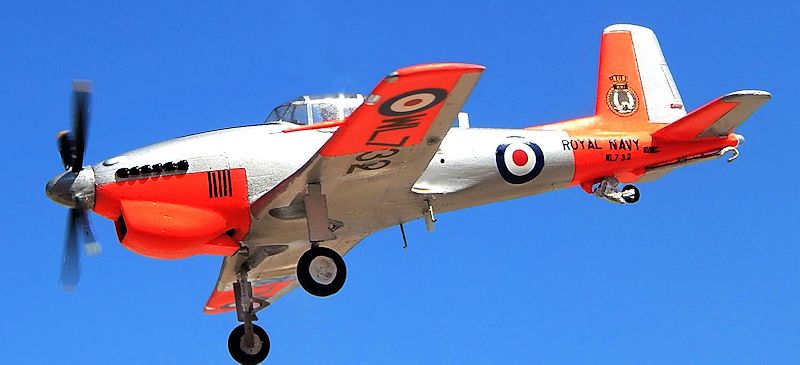
The Sea Balliol T.21 had folding wings and arrestor hook
for deck landings. By 1951, however, the Air Ministry changed its mind
about its training requirements yet again and decided to introduce a jet-powered
advanced trainer, the de Havilland Vampire T.Mk11. A total of 30 Sea Balliols
T.21 were built by Boulton Paul.
The Sea Balliols served with 781 squadron at Lee-on-Solent and 1843 Squadron
RNVR at Abbotsinch. The last one was delivered in December 1954. Some remained
active at Abbotsinch until September 1963.
Two Balliols were used for the testing of radar absorbing coatings.The only
Balliols exported were 12 Mk.2s to the Royal Ceylon Air Force, 7 from RAF
cancelled contracts and five from RAF stocks, which were replaced by a further
five production aircraft.
| THE KIT |
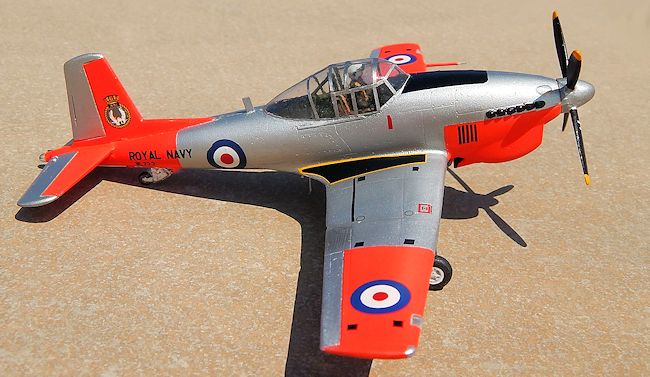
 Kit is molded in soft gray plastic. A canopy is provided but looked under size
and I preferred to use it to mold one slightly bigger. Careful separation of
parts is imperative as plastic can easily drag part of the component unless cut
through from its gates. Parts have engraved panel lines including engraved
detail inside wheel wells. The kit has a spacious cockpit office but evidently
lacks detail as only a pair of seats were provided.
Kit is molded in soft gray plastic. A canopy is provided but looked under size
and I preferred to use it to mold one slightly bigger. Careful separation of
parts is imperative as plastic can easily drag part of the component unless cut
through from its gates. Parts have engraved panel lines including engraved
detail inside wheel wells. The kit has a spacious cockpit office but evidently
lacks detail as only a pair of seats were provided.| CONSTRUCTION |
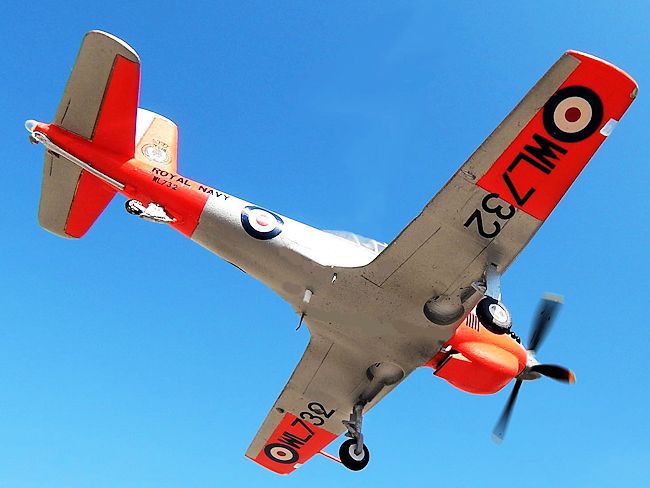 these could be folded upwards at the joint at a slightly acute angle
just past the vertical in the event a Sea Balliol is built.
these could be folded upwards at the joint at a slightly acute angle
just past the vertical in the event a Sea Balliol is built.| COLORS & MARKINGS |
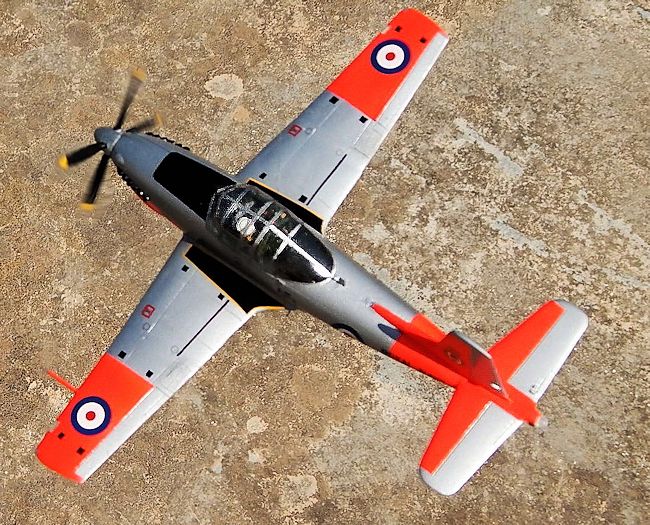 The kit was airbrushed in base coat of white followed by Revell dayglow orange.
These areas were then masked and an overall coat of silver mix
was applied to the kit. This was followed by two coats of Future. Model
Decals were used for lettering and roundels. Tail unit crest was partly hand
painted of a printed decal from spares. Kit was completed as WL732, a sole
surviving Sea Balliol now accommodated at the RAF Museum in UK.
The kit was airbrushed in base coat of white followed by Revell dayglow orange.
These areas were then masked and an overall coat of silver mix
was applied to the kit. This was followed by two coats of Future. Model
Decals were used for lettering and roundels. Tail unit crest was partly hand
painted of a printed decal from spares. Kit was completed as WL732, a sole
surviving Sea Balliol now accommodated at the RAF Museum in UK. | CONCLUSIONS |
June 2015
If you would like your product reviewed fairly and fairly quickly, please contact the editor or see other details in the Note to Contributors.