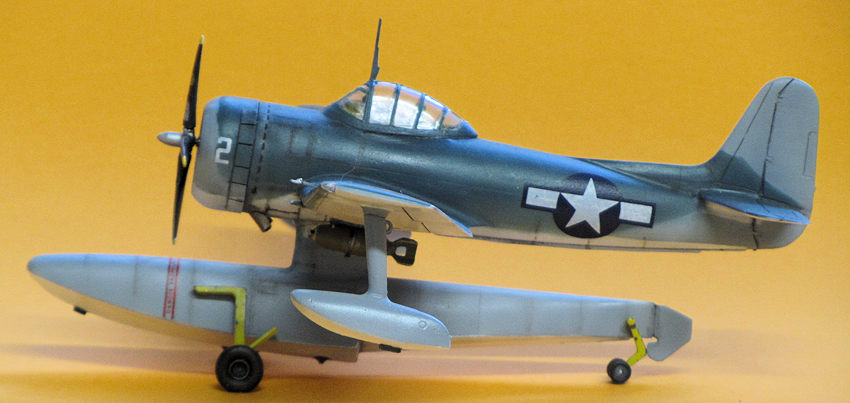
| KIT #: | 001 |
| PRICE: | $15.00 |
| DECALS: | Two options |
| REVIEWER: | Ryan Grosswiler |
| NOTES: | Manufacturer apparently went tango-uniform after this product, but its currently available under the Smer label |
| HISTORY |
Let's see, how does the song go? "I am the eye in the sky, looking at you--oo--oo--I can read your mind. I am the maker of rules. Dealing with fools. I can cheat you blind..." (Sound byte from my elementary-school years--now it's going to be stuck in my head the rest of the day!).
 Knowledge is
power, and the potential power of aircraft scouting ahead of a surface fleet
to detect the enemy's presence, strength, composition, and predict his
movements was recognized very quickly by the US Navy, who strove to put this
capability on all its capital ships from the nine-teens onward. The Curtiss
SC-1 depicted here was the final aircraft in a long line that started in
1910 with Eugene Ely's pioneering flights on and off makeshift platforms in
the Curtiss Model D.
Knowledge is
power, and the potential power of aircraft scouting ahead of a surface fleet
to detect the enemy's presence, strength, composition, and predict his
movements was recognized very quickly by the US Navy, who strove to put this
capability on all its capital ships from the nine-teens onward. The Curtiss
SC-1 depicted here was the final aircraft in a long line that started in
1910 with Eugene Ely's pioneering flights on and off makeshift platforms in
the Curtiss Model D.
Three decades later, under the pressures of world war and reeling from the tragicomic failure of their own SO3C Seamew, Curtiss engineers went swiftly to work in 1942 on a new design that would also replace it plus the far more trusty Vought Kingfisher, not to mention that earlier SOC Seagull--a fabric-covered biplane embarrassingly pulled back into service to compensate for the shortcomings of the "Sea Cow". The seaplane that emerged had a much higher performance--close to floatplane fighters of the period--as well as a reasonable offensive capability which included weapons racks on the wings, twin .50s firing forward, and even a waterproof internal bomb bay in the main float (this last being deleted in favor of additional fuel capacity).
Development was
fast and smooth. Flight testing was complete in the spring of 1944, and
deployment rosters show twenty SC-1s embarked in the fleet on eight ships by
December of that year, all except four in the Atlantic Fleet. Such was the
pace of war, however, that the aircraft would not see its first
 action until eight
months later, in the Pacific with the invasion of Borneo.
However, photographs taken of seaplane bases around the end of the conflict
show them crowding the ramps. So once it arrived, it did so in force.
Rosters at the end of 1945 show the type rapidly supplanting the two others
representing over 50% total strength, with total succession complete by
December 1946. 577 rolled off the lines in Columbus, including a few of an
advanced version, the SC-2, distinguished by a circular cowl and clear
bubble canopy.
action until eight
months later, in the Pacific with the invasion of Borneo.
However, photographs taken of seaplane bases around the end of the conflict
show them crowding the ramps. So once it arrived, it did so in force.
Rosters at the end of 1945 show the type rapidly supplanting the two others
representing over 50% total strength, with total succession complete by
December 1946. 577 rolled off the lines in Columbus, including a few of an
advanced version, the SC-2, distinguished by a circular cowl and clear
bubble canopy.
However, the inherent hazards of seaplane operations on the open water ensured that all were out of service by 1950, replaced by Igor Ivanovich Sikorsky's wondrous and far more adaptable creation.
The SC-1 in 1/72: Prior to this, there was a good vac-formed kit produced by Formaplane in the late 70s, plus a short-run injection-molded product by Aviation Usk in the mid-90s, also reviewed on this site. While representing different molding technologies, as finished replicas, I don't know that any have a decisive advantage over the other two. More on this below.
| THE KIT |
 The big, airy box with some attractive art
of the subject in flight spills out the usual Two Grey Sprues and One Clear
totaling 55 parts. Long run styrene, with very fine engraved lines on the
fuselage and heavy ones on the wings. A nice, clear set of instructions
which also include photos of the real aircraft and helpful line drawings of
some details. A clean sheet of decals by Propagteam cover three options, one
on landing gear and two on floats. Overall impression is favorable, except
for a closer look at the uninspiring detail parts, and impression that will
only worsen as the project commences.
The big, airy box with some attractive art
of the subject in flight spills out the usual Two Grey Sprues and One Clear
totaling 55 parts. Long run styrene, with very fine engraved lines on the
fuselage and heavy ones on the wings. A nice, clear set of instructions
which also include photos of the real aircraft and helpful line drawings of
some details. A clean sheet of decals by Propagteam cover three options, one
on landing gear and two on floats. Overall impression is favorable, except
for a closer look at the uninspiring detail parts, and impression that will
only worsen as the project commences.| CONSTRUCTION |
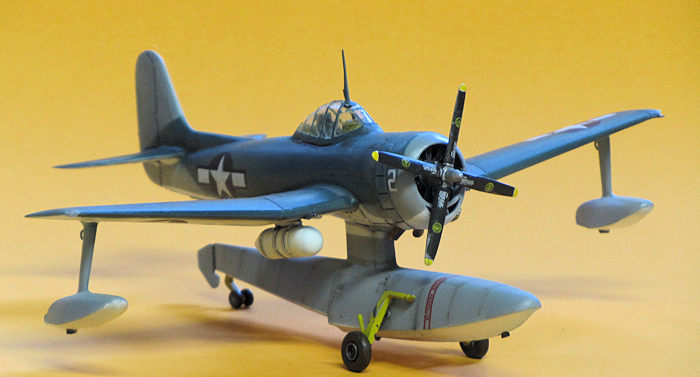
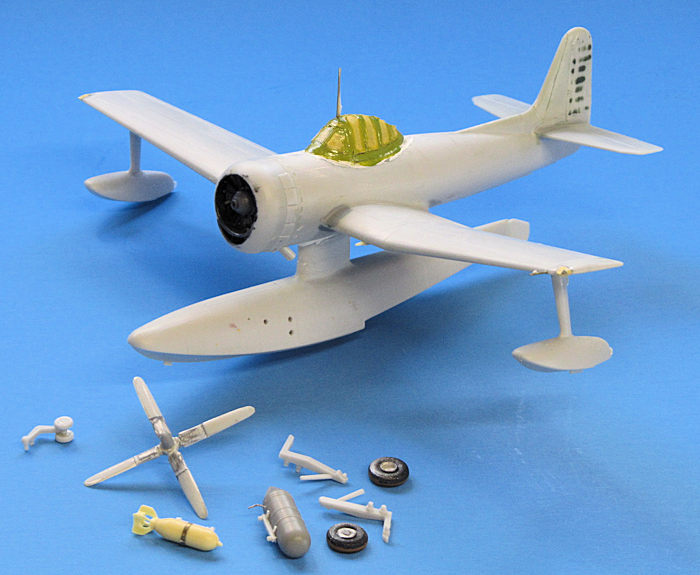 to-fuselage seam on the bottom that required a few rounds
of putty-sand-primer. The floats followed. The landing light beneath the
wing does not come flush with the surface, but does provide a perfect
platform for the MV Products lens which went in after finishing. Overall up
to this point enjoyable stuff.
to-fuselage seam on the bottom that required a few rounds
of putty-sand-primer. The floats followed. The landing light beneath the
wing does not come flush with the surface, but does provide a perfect
platform for the MV Products lens which went in after finishing. Overall up
to this point enjoyable stuff.| COLORS & MARKINGS |
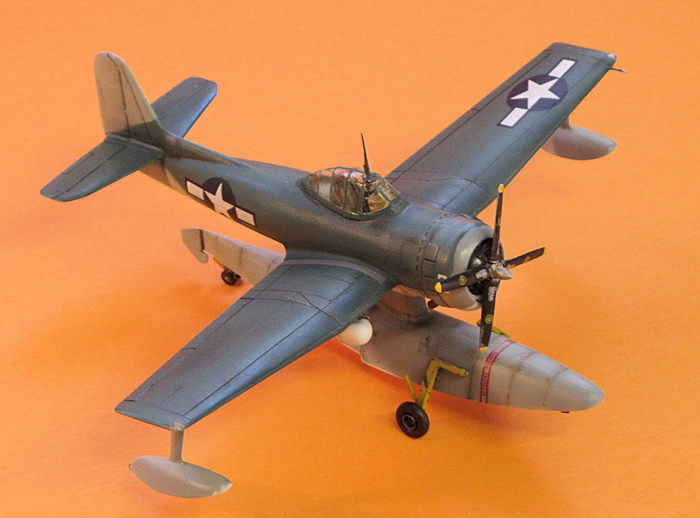
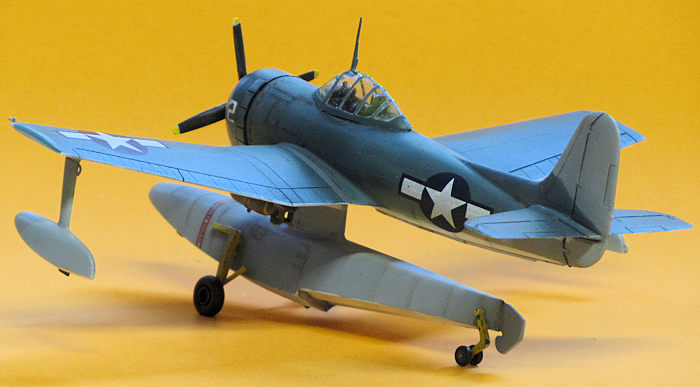
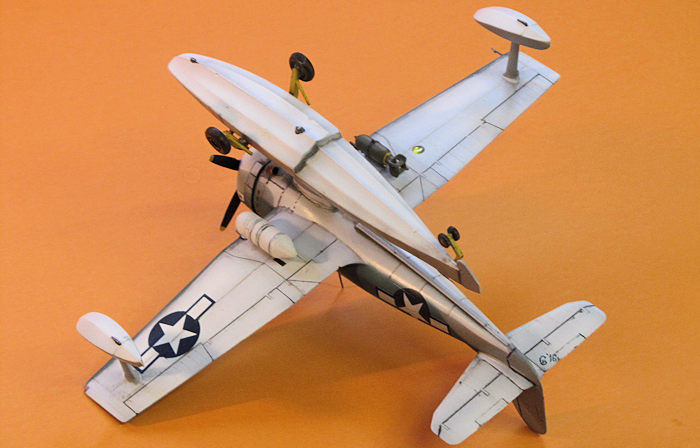
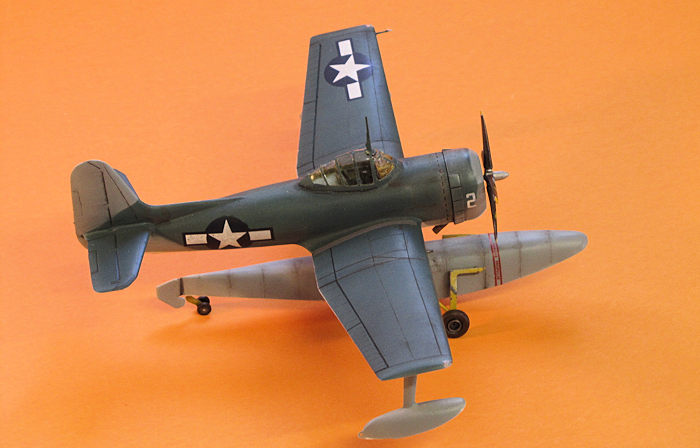 A mix of Xtracolor and Testor's enamels were sprayed in the mid-war
USN three-tone scheme, followed by a coat of Future. US national insignia
were also out of proportion with bars too long and skinny, so were replaced
from the spares box. The rest of the decals went on very well. Another clear
coat was followed by a wash and dry-brushing session
A mix of Xtracolor and Testor's enamels were sprayed in the mid-war
USN three-tone scheme, followed by a coat of Future. US national insignia
were also out of proportion with bars too long and skinny, so were replaced
from the spares box. The rest of the decals went on very well. Another clear
coat was followed by a wash and dry-brushing session| CONCLUSIONS |
A good kit let down by those lame detail parts. I didn't really give it a full-hearted effort as I was looking for an easy project and lost some enthusiasm fraggling around with that issue. But the subject matter itself did grow on me as I built it; it's an attractive seaplane and the last of a distinguished breed, even if its combat service was brief. There are no real construction issues, so it would be an ideal first floatplane for a beginning modeler.
Recommended to those who don't sweat the small stuff.
| REFERENCES |
 Larkins, William T. Battleship
and Cruiser Aircraft of the United States Navy 1910-1949. Schiffer
Publishing Ltd, 2000.
Larkins, William T. Battleship
and Cruiser Aircraft of the United States Navy 1910-1949. Schiffer
Publishing Ltd, 2000.
Matt, Paul. Paul Matt's Scale Airplane Drawings, Vol.1. Sunshine House Inc, 1991.
The Internet
There is also a very involved Ginter title, for those who want to go full-tilt-boogie on this kit.
22 September 2016
Copyright ModelingMadness.com
If you would like your product reviewed fairly and fairly quickly, please contact the editor or see other details in the Note to Contributors.